“Everyone has two deaths: when they are buried in the ground and the last time someone says their name. In some ways we can be immortal.”
Ernest Hemingway
That Baroness Mone’s been in the papers quite a bit recently. She first seized the headlines with her lingerie brand, then leveraged this onwards and upwards – big feature in our sister publication Byline Times – with huge profits in the Covid PPE game.
The Baroness is a shrewd character. She seems to have had enough of the limelight now though and is even perhaps financially on the back foot, organising an £80million ‘fire sale’ of loads of her stuff: her famous superyacht, a Cessna Citation jet plane, a six-bedroom villa on the Caribbean island of St Barts, and Ballakew, a 154-acre estate in the Isle of Man.
Ballakew and the Joughin family
And this is where our story starts: my direct line once actually owned that Isle of Man property. It was a long time ago, certainly, and the place has gone through many changes, but my Manx ancestors, in their old-style hats and coats, walked those same floors and looked out of those same windows.
Little could they have ever dreamed that it would one day be described as “one of the finest homes in the British Isles” with “a state-of-the-art indoor pool, tennis court, spa and gym complex… separate staff quarters, amphitheatre and its own helipad”. It’s hard not to be envious: Hello magazine probably needed to pulp an entire rainforest to get enough paper to cover all the riches of the place.
A farming heritage
My family were so-called yeoman farmers, going back into the mist, on a plot of land on the remote northern tip of the Isle of Man, an austere place at the best of times. Sometime around 1850, when people were being squeezed off the land in droves, my great-great-great-grandfather, Mark Joughin, seventh in line out of eight, and therefore unlikely to inherit anything, moved south to the farm at Ballakew.
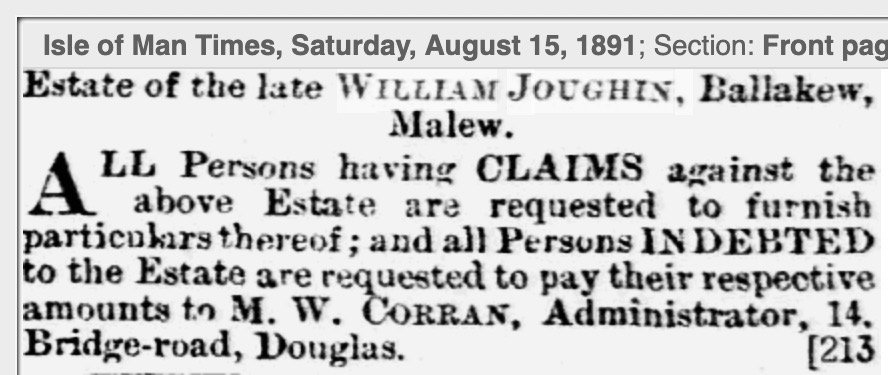
His son, William, took the place on and farmed it throughout his life, dying there in 1890. William’s oldest son, also William, my great-grandfather, had tuberculosis and was unable to farm and the property passed to the sixth born, John, three older brothers having already voted with their feet and taken off to the New World.
The next thing I know is that, in 1908, John let the farm. The family can’t have been bankrupt because the notice from that year says the place was “in the highest state of cultivation and has abundance of pasture”. It seems John and his wife Ann did not move out of the farmhouse, however, as they both died there, 30 years later, in 1935. After that, the property was sold and this line of Joughins, having no descendants beyond two generations, disappeared from history.
Sophia Joughin’s tree carving
The only other thing I know is a bit of family mythology passed down through the years. John and Ann Joughin had five children and the fourth, Sophia Joughin, born 1891, carved her name into a tree somewhere on the property. This carving, along with its reputation, was sufficiently indomitable to still survive, at least until the 1990s, when my sister visited the place. She remembers that “the house hadn’t been refurbished and the farm steading was half ruinous”. The carving was in “an avenue of old trees leading to what looks as if it was once the entrance”.
Perhaps you can see where I’m going here. Regular readers may remember that during lockdown I wrote about my project to visit all the 136 trig points in Sussex, and the improvements that followed in my countryside skills. Once the challenge of ‘the carving on the tree’ was put in front of me, I felt I had no option but to follow my nose.

Following the trail
Next thing I knew I was driving down some tortuous country road, winding about in the dark sunken lanes south of Douglas, trying to find the old place. It wasn’t difficult. There was a great big Dr No gate, a bunch of cameras, a warning about dogs at play, and a manicured tree-lined driveway that went most of the way to the horizon.
The family was with me and as we got out of the car we wondered if anything would happen. Perhaps a drone might come buzzing around, or even a helicopter? All we saw, though, was a nice old guy on an even older Massey Ferguson tractor, and when I asked him about the tree it was rapidly apparent he didn’t give a monkey’s one way or the other.
Stumbling around the perimeter, I found what seemed to be an original entrance with an ‘avenue of trees’ and just ambled in, well out of sight of the house. There wasn’t a soul about. We walked along for maybe 100 yards, checking the trees, not really expecting to find anything. But suddenly, lo and behold, there it was, just as my sister had said it would be: “S Joughin 1924”, carved deep into the wood. It seemed like a message from the past. Perhaps my sister and I were the only people who could now interpret it. It was covered a bit in moss but still very distinct.

A kind of immortality
And this is where Hemingway’s insight comes in. Sophia Joughin spent 45 years of her life on the farm at Ballakew, then died unmarried in 1955, round about the time I was born. She would have been 33 when she made this carving, but she has been dead now for well over 70 years, with no descendants of her own nor any cousins. Probably no one has thought about her at all for a very long time. By locating her there, fearsome dagger in hand, I had brought her back to life.
It struck me that Michelle Mone might have seen the carving too and wondered about it, and that, somewhere out there on the astral plane, the two of us – the three of us even: the Baroness, Sophia Joughin and me – might be strangely conjoined. I took a few snaps and then we legged it before meeting any hired muscle. Or playful dogs.