The story of Warm Norm and the Green Sock Group is quintessentially English, with a cast of wonderfully eccentric and colourful characters, including a naked litter-picker, a retired Merchant Navy officer, a generous harbourmaster, six hundred volunteers and – directing them all – Warm Norm himself.
Norman (second name unknown or perhaps forgotten in the interests of poetic licence) is a striking figure – weatherbeaten, bearded, and fizzing with enthusiasm and energy. “I’ve always been interested in clearing up rubbish”, he says. “Even as a young boy, I’d go out into the woods in rural Sussex and find bike frames and plastic litter and I’d bring it all to the edge of the road, because I didn’t know what else to do with it. But I knew that it was wrong that I was finding bits of plastic at the entrance to a fox’s earth!”
Always a bit of a rebel, he left school at fourteen and moved to a squat in Brighton, throwing himself into the early punk rock scene. He describes decades of taking part in music festivals, raves and parties, but in the midst of it all he never lost his concern for the environment and frequently stayed on after the crowds had gone home, helping to clear a site of all the detritus that festival goers tend to leave behind.
Clearing the Seven Sisters coastline of plastic waste
In his fifties, reality began to bite. “I thought, maybe I’m getting a bit too old for this sort of thing.” Which is when his lifetime enthusiasm for clearing plastic litter came to the fore. In the most original reason ever given for a choice of where to live, he decided that he would move to Eastbourne because “someone told me that there was lots of plastic waste littering the beaches there”. A magnet for Warm Norm.
Credit: Hebridean Pam, Green Sock Volunteers and www.bhassexplore.com
The move was the catalyst for all that followed, and the point in the story where Warm Norm met a key figure in the development of his mission to clear the iconic Seven Sisters coastline of plastic waste – the naked litter-picker. “I was walking along the cliffs at Holywell on the edge of Eastbourne, when I saw this guy doing some litter-picking on the beach, and I thought to myself, ‘that’s interesting’.”
Norm seemed remarkably unfazed by the fact that the litter-picker was, as he put it, “stark bollock naked”. An enquiry about which local beaches carried the highest levels of plastic pollution resulted in Adrian, the naked litter-picker, leading Norm on a two-hour scramble across rocks and under over-hanging cliffs to Cow Gap, a hidden beauty-spot between Beachy Head and Holywell.
Sure enough, there it was: tons and tons of plastic, driftwood, and discarded fishing gear. So Norm set to work, and using hundreds of bags provided by the local council, he collected up, over many months, the rubbish that had been washed up by the sea, lugging the bags up the cliffs to a spot on the nearest road where they could be picked up by council workers.
Bakelite and old phones
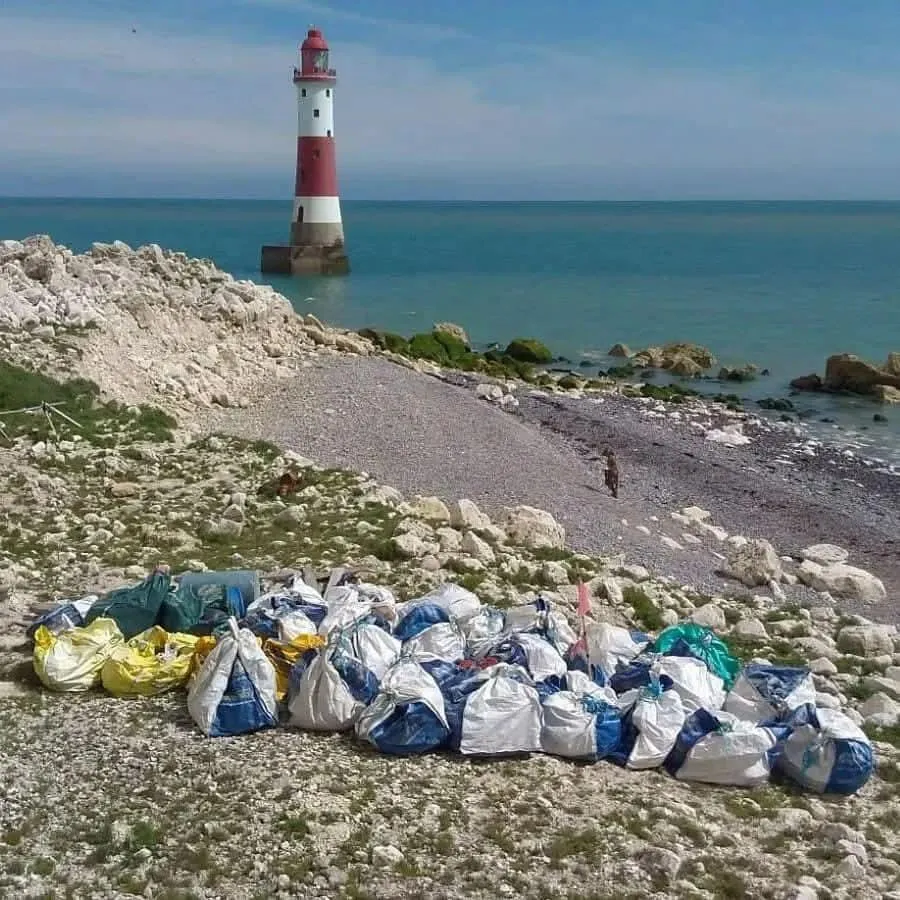
Fired by enthusiasm, Norm moved on to the stretch of beach below the lighthouse at Beachy Head, and along with his naked companion, began to tackle the overwhelming mountain of rubbish that had collected under the cliffs. It was a much tougher challenge, with no obvious way to get the filled bags to a collection point.
Norm describes digging into the strata of plastic and other discarded waste as like modern archaeology. “You can see how all these materials developed over the decades”, he says. “Right at the bottom was stuff probably dating from the 1950s – a lot of Bakelite and old phones. Then comes early polystyrene, all big blocks that fall apart easily. The later stuff is stronger and compacted into small round bubbles.”
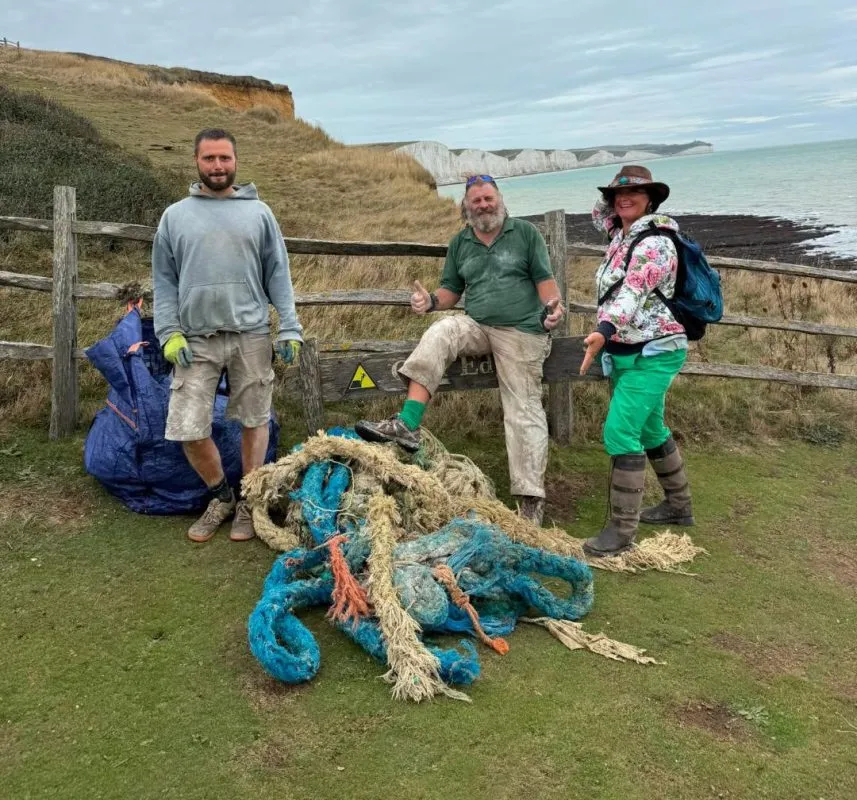
He’s fascinated by the fact that out of the hundreds of shoes that they cleared – flip-flops, trainers, wellington boots – they were only ever able to match up four pairs.
Between them, in twenty days, Norm and Adrian filled five hundred bags with the lighter plastics: a heroic effort. But at that point things stalled. They had no means of getting the bags off the beach, and as they were the bio-degradable type, there was a limit to the length of time that they would continue to hold their contents. “Bit ironic,” Norm says. “They’d just have tipped all the plastic out again.”
A further challenge he faced was recruiting the volunteers needed to help with the beach clean. Most tended to back off when they caught sight of the naked litter-picker. Eventually Norm had to ask Adrian to return to his original site at Holywell. “We had a bit of a falling out,” as he puts it.
Appeals to the public for ideas about how to shift the bags of rubbish generated numerous suggestions, most deeply impractical: “Hire a helicopter”, “Wrap them all up in a blue tarpaulin like an enormous sausage and tow them out to sea” were just two of the more left-field ideas submitted that got short shrift. “I can get very sarcastic at times,” says Norm wryly.
Warm Norm in full flow
Salvation arrived in the form of retired Merchant Navy officer and Head of the Eastbourne Maritime Volunteer Service, David Hughes. With a vessel docked in Eastbourne’s Sovereign Harbour, just up the coast, he saw a way of taking the rubbish bags off the beach by loading them in batches on to an inflatable dinghy and then towing them out to the ex-Royal Navy launch MVS East Sussex 1.

Credit: Hebridean Pam, Green Sock Volunteers and www.bhassexplore.com
Once full, the ship would then return to Sovereign Harbour for her cargo to be off-loaded and left for Lewes District Council workers to collect. Great solution – but there were major obstacles to overcome. What harbourmaster wants a pile of rubbish bags cluttering up his marina? And why should the council add an extra journey to existing rubbish collection rounds to pick up an enormous pile of plastic waste?
Neither the harbourmaster nor the responsible council official were a match for Warm Norm in full flow. He’s a force of nature. Both were persuaded to buy into the idea, the harbourmaster showing a good deal of courage in the face of opposition from his team. And so Bhassexplore and the Green Sock Group were born. “Why green socks?” I asked Norm. “Well, green for the environment and some of us were wearing green socks.” Of course.
Six years later the group has grown and flourished, involving over six hundred volunteers, while playing a vital part in the clearance of rubbish from the beaches between Eastbourne and Seaford. And if you want to know what happened to all the driftwood that didn’t end up in rubbish bags, read the story of Planksy and the wooden snail sculpture – another legend of the Sussex coast.
Bhassexplore are always looking for volunteers to join their “extreme beach cleaning” days – you can find their calendar of events on their Facebook page https://www.facebook.com/bhassexplore

CLICK HERE TO DONATE TO OUR CROWDFUNDER
HELP US BECOME STRONGER SO THAT WE CAN CONTINUE TO DELIVER POWERFUL CITIZEN JOURNALISM!