


David Cameron has won after all. His volunteering Big Society, coupled with George Osborne austerity, heralded the death knell for the welfare state. He and his successors may rejoice as public services are torn to shreds, by years of financial starvation, stealthy privatisation and outright piracy by the wealthy.
Boris Johnson lobbed public money at Covid-19, gratuitously by-passing established public sector expertise, to the enrichment of cronies and private businesses. The short-lived Liz Truss team subsequently, almost comprehensively, destroyed the economy in the cause of an unproven ideology.
Now Rishi Sunak and Jeremy Hunt get down to Conservative business-as-usual. The populace, already suffering from the ravages of inflation and cuts to services on which they must increasingly rely, are further required to pay for the sins of the powerful. Higher taxes in the short term are no guide to the inclinations of a cabinet, eight members of which just as ardently endorsed Truss’s disastrous experiment. Who can believe that a government espousing low taxation does so to increase funds for public services?
In 2020, 10% of UK households held 43% of all wealth, mostly off-shore, and it is to this minority that tax cuts, promoted by serial chancellors, have been targeted. With ‘redistribution’ as one of the dirty words in Tory consciousness, alongside ‘tax’, there appears to be no way for the average wage-earner, let alone unwaged, to benefit by more than crumbs from the groaning tables of those who already have the most. For Conservatives, then and only then, could economic growth possibly arrive.
Greater reliance on charities
Conservatism in the 21st century is no more for the general public than it was for the Ragged Trousered Philanthropists over 100 years ago. Once grudging supporters of the NHS and state education, the Conservative party post-Farage is ideologically libertarian and driven by greed as never before.
Privatisation no longer means the mere flogging off to private investors of the nation’s assets, as practised by the Thatcher government, but now includes academisation of schools, care homes mainly in private ownership and substantial specialist health services contracted out. What we witness is the permanent process of erosion: a deliberate, if slow, financial starvation of service providers including local authorities, health trusts and schools struggling to meet public need.

As these vital services falter, many in this country will be obliged to rely on charities for even the most basic needs no longer guaranteed by the state. Food security, energy supply and healthcare are all at risk. Those suffering the greatest need, acute pain or emotional breakdown as an example, or those with modest financial means, are forced into funding their own solutions, often compromising long-held principles.
Thus, do shareholders of private sector enterprises gain, as free public services shrivel. An exemplar of the reduction of the state and reliance on the Big Society is manifest when even something as fundamental as clean water is so mistreated. Amid the outrage at pollution of watercourses and beaches by sewage discharges, Environment Agency professional testing of river water is now increasingly outsourced to a volunteer force.
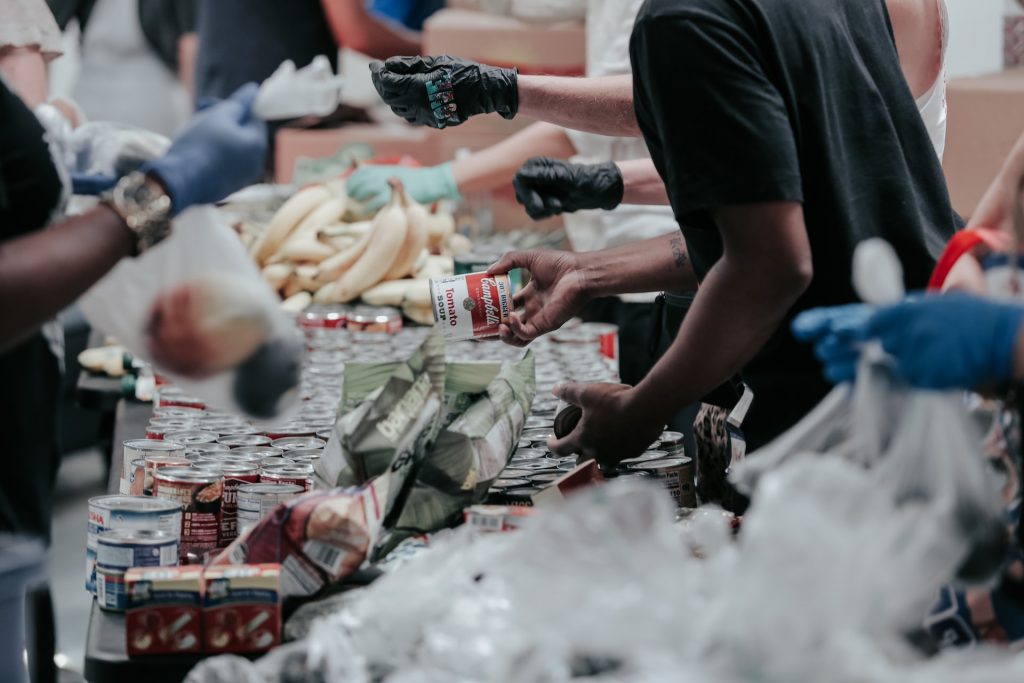
Local authorities can provide ever less for local people: schools are squeezed, care homes are run on pitiful rations, welfare payments define destitution. Every town has one or more food banks, which should not exist, but nevertheless the Trussell Trust network alone has sent out over two million parcels in the last year. Many charities and volunteers, facing huge inflation, now struggle to survive. Cash-strapped schools and their teachers provide hot meals for pupils whose parents cannot; to add to the pain, next will come the warm banks. What happens when even voluntary sector initiatives cannot provide is unthinkable. Forget the Big Society, welcome to Tressell’s Mugsborough here in Sussex.
Do not be poor, do not be ill…
The rich may cash in by investing in insurance companies, private healthcare and schools to which those who can will turn in desperation. Subject to ever lower rates of taxes into the Exchequer, this minority will stash profits off-shore, with no requirement to direct investments to the UK economy, whence their wealth originated.
The welfare state, from which the country has benefited so much and of which it is rightly proud, is disappearing before our eyes in favour of a patchy, unreliable mixture of commercial supply and volunteering. Such is the legacy of a succession of failed Conservative Prime Ministers.
Do not be poor, do not be ill: those commercial providers are destined to be allowed to charge for services we have learned to receive free. An exhausted charity sector will no longer be able to plug the gaps, and in any case should not be relied upon to do so. In the words of Nye Bevan in 1948: “Private charity can never be a substitute for organised justice.” But if we have neither – and this may not be far away – then we bury the welfare state, once and for all.





