


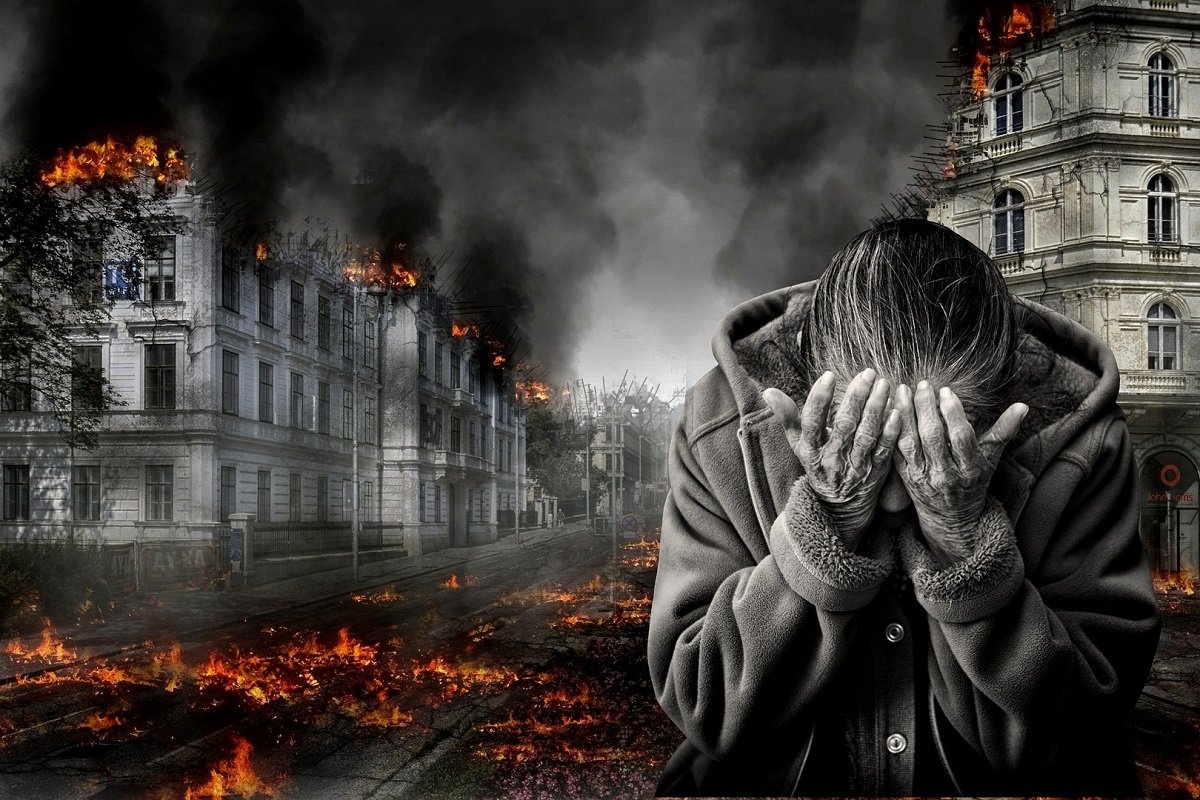
Any student of our history will be alive to the horrors of war but more so now that these are daily presented to us live. Few can think war a good idea. There was a theory that democracies did not initiate wars but recent times and apparently democratic leaders have disproven this. Men in suits rather than uniforms have taken it upon themselves to instigate asymmetric wars, with disastrous consequences. History has not been the lesson it should be.
In September 2001, in reaction to 9/11, political dynast George W Bush launched his war on terror, which led to the disastrous invasions of Afghanistan and Iraq. In 2015, Bashar al-Assad, mild-mannered London dental student-turned President so resented street protests at his rule in Syria that he declared and initiated a brutal civil war on his own subjects.
In 2022, surprised at effective resistance to his unjustified incursion into sovereign Ukraine, Vladimir Putin laid waste to communities he had planned to govern. Benyamin Netanyahu, Israel’s serial political wheeler-dealer, when shocked by the assault of Hamas on 7 October 2023, knee-jerked into a brutal devastation of the very land he wanted to control, even against the warning by his ally Biden against such excesses.
Each of these leaders perceived justification for military action but chose to act disproportionately and in haste. In each case, the use of their overwhelmingly powerful arsenals enabled them to do untold harm to the very objects of their desire. They instigated wars which subjected whole populations to retribution, despite having access to the most sophisticated and well-funded intelligence and special forces which could be used for more forensic responses. Each made their declaration of war in the heat of severe embarrassment, intelligence failure, apparent blindness to ordinary people’s lives or wider geographical impact.
Bush had been shocked at the attack on US soil under his watch. Assad was wounded by public criticism. Putin the bully had his nose bloodied. Netanyahu had to cover up his own intelligence failure. All were shamed into over-reaction as if to prove that they were strong, no matter what lives were lost. Fallujah; Aleppo; Mariupol; Gaza; and millions of lives cast to the winds were the result of their human frailties. It seems that all used war to excuse excessive force even despite the rules of the United Nations*, which condemns disproportionate and pro-active aggression but does so without the teeth to prevent them. In the field or in the aftermath, who is to police the aggressor or challenge breaches?
[*The Geneva Convention prohibits the ‘removal’ of objects indispensable to the survival of the civilian population, but what can it do when this rule is breached?]
Perhaps the very scale of the investment in arms has some bearing on this choice. Arsenals in countries like ours, Russia and the USA are surely far beyond any defensive need, as claimed by way of justification for their scale. Maybe the sheriff with a gun in his holster is more likely to shoot than to arrest. These arsenals should not be under the sole control of those quick on the draw.
War is always terrible and inevitably leads to suffering and loss, though rarely among those who take the decisions. It seems that, even after millennia of historical evidence of its impact, leaders still use war to cover up their own failures, with innocent bystanders as the expendable price and ‘defence’ as the toolkit.
Politics is perhaps the only forum where this can be stopped, by ensuring that leaders are not allowed the power to act without restraint and that defence budgets are truly for defence and not diverted for heavy-handed and unwarranted aggression. Such protections used to be assumed to be keystones of democracies, slowing down any rush to war. Perhaps the first lesson of recent history should be to defend democracy against its weakening at the hands of would-be autocrats of dubious psychological stability.






