


Arriving in 1966 as a shy 17-year-old, I found life at Sussex University something of a shock. This was the era of the Jay twins (daughters of the former Labour Minister, Douglas Jay). Everyone seemed to be a celebrity, or the son or daughter of one, and TV cameras were frequently on the scene. The other women students looked frighteningly confident: they wore ultra-short miniskirts and made seemingly brilliant remarks about Paradise Lost or The Tempest in tutorials.
And of course, there were men. Coming from an all-girls’ school, I had never studied alongside men or been taught by them, so this was a new experience, which took considerable readjustment. My personal tutor, (the sadly late Professor) Alan Sinfield, who I later realised was very approachable, seemed most daunting to me at first. During my time at Sussex, only two of the literature courses I took were taught by women, and I found it hard to adjust to the masculine perspective. This was before the days of feminist literary criticism, so to me it felt as though there was a gap in interpretations, but an undefined one. Virginia Woolf’s A Room of One’s Own provided me with something to cling on to, and an inspiration to work towards.

The guest house experience
At that time, all first-years lived in guest houses in Brighton or Hove. Judging from my own experience and that of my friends, many of the landlords and landladies were quite eccentric. My first Kemptown landlady was no exception. Every night she made a tour of the bedrooms, checking in the wardrobes and under the beds for any men we might be trying to smuggle in. She imposed a strict curfew. Anyone caught out after hours (11.00pm in the week, midnight on Saturday) would be locked out. This always struck me as inconsistent. If she was so concerned about our moral safety, why jeopardise it by locking us out? She also listened in to phone calls from her extension in the basement. It all ended in a showdown over the bacon and eggs one morning when she wrongly accused me of insulting her over the telephone the previous evening.

Madden (née Phillips), Norfolk Square Hove, 1968. Photo credit: Stephanie Lang (the other flatmate).
The final term of my first year was spent in Norwich House, one of the three halls of residence on campus normally reserved for finalists. I loved it, even though I was miles from friends and Brighton night life. For the first time I felt really independent – and for the first time I had a room of my own. The hall was supposedly women-only, but on most mornings there was a pleasant mixed-sex atmosphere in the kitchens, after students and their boyfriends had tiptoed past the warden’s flat at night, shoes in hand. In my final year, I saw the inside of that flat when I took an inspiring course on DH Lawrence with Ric Winkler, the woman warden. And when I returned as a lecturer at Sussex in 1985, those same rooms became my home from home, as they housed the crèche where my two children happily spent their early years.
Drama and the arts at Sussex
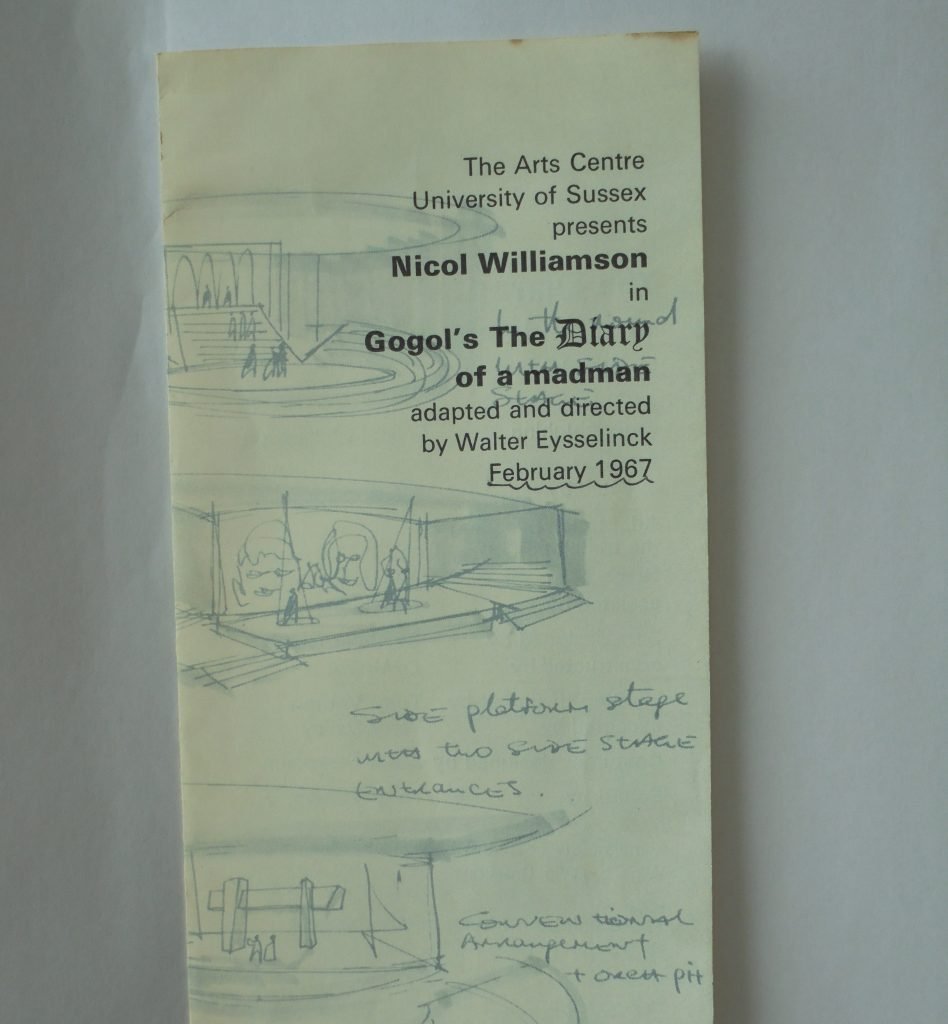
My interest in drama flourished during my time at Sussex. In 1966, the ‘Arts Centre’ consisted of a row of terrapin buildings (on the site of the current Sports Centre) where writers and artists in residence held workshops and exhibitions. Drama productions were held in the most exciting and imaginative venues. In 1968 I took part in The Seventh Seal, performed in the open between Arts A and B, and in a memorable open-air production of Euripides’ The Trojan Women on the steps of the Chemistry (now Chichester) Lecture Theatre, in which the gods materialised on top of the roof. Many performances were held in the Old Refectory (now Mandela Hall), and workshops took place in the Debating Chamber. Successful productions often found their way to the Brighton Combination, behind West Street, only recently demolished.
The 60s campus
When I started, the university consisted of Falmer House, Arts A and B, the Meeting House, the first Science buildings and not much else. Much of the campus was a building site, but Basil Spence’s vision was new and beautiful, and Henry Moore sculptures dotted the grass. The campus was set in unspoilt countryside, the bypass was just an idea and the football stadium was in faraway Hove. The JCR (junior common room) was the main gathering place for students and faculty, full of comfortable chairs and music – so full, sometimes, for a meeting or folk evening that people used to sit up the stairs.

Those were heady, innocent days, with summer balls and dancing to the music of Russell’s Clump – a bit like Oxbridge without the punting, and with Basil Spence arches instead of dreaming spires. In the ’60s everything was possible, and Sussex and the other new universities had a pioneering vision. It drew me back, years later, to spend a long and fulfilling career in education and hopefully pass on some of that vision to others.
A longer version of this article was first published in Falmer magazine in 1992. Reproduced with kind permission of the University of Sussex Development and Alumni Relations Office.




