


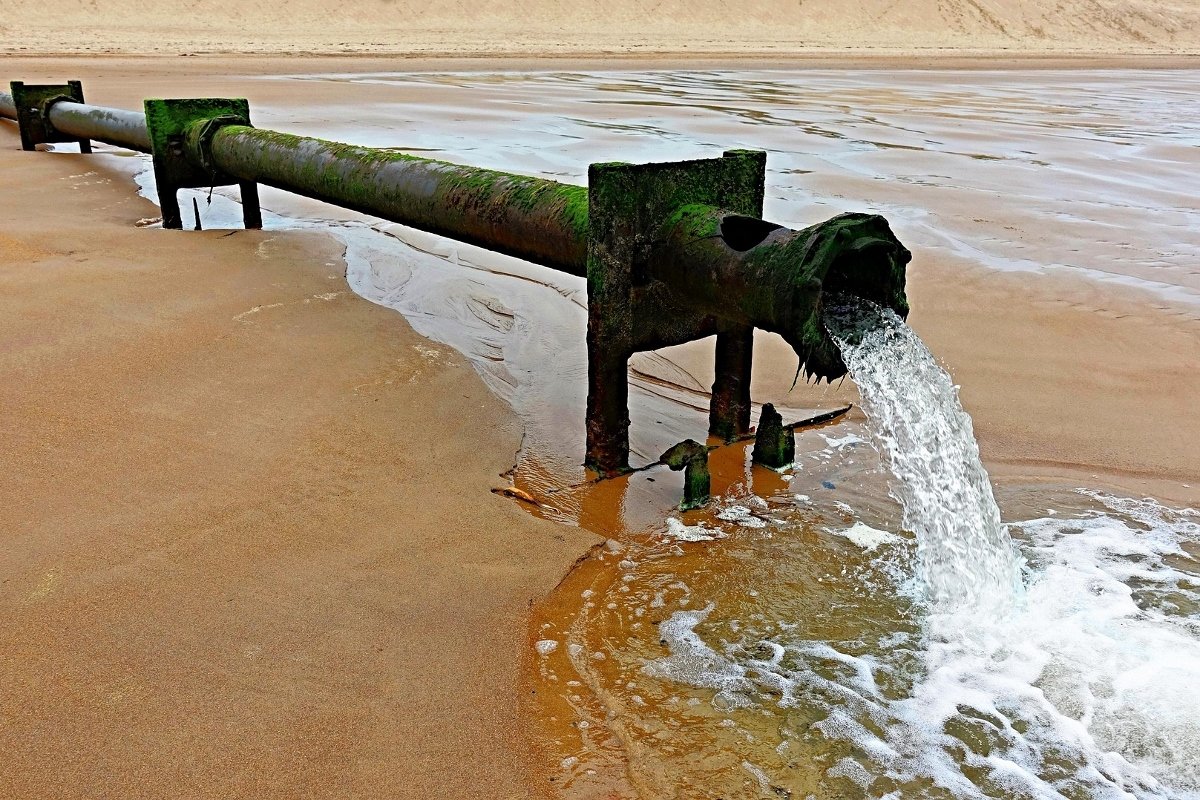
Southern Water can tell us when a storm overflow starts and when it stops. But when Sussex Bylines asked how much was actually discharged, what entered the sea and what happened afterwards, some remarkably basic questions proved much harder to answer.
At approximately 7.49am on 20 August 2026, a Southern Water storm overflow associated with the Eastbourne and Langney Point system began discharging. According to information gathered during this investigation, it continued for approximately seven hours and eleven minutes.
In these matters, seven hours is a long time. Long enough for families to arrive at the beach, for people to swim, paddleboard and fish, for dog walkers to follow the shoreline and for tides and currents to carry whatever has entered the water somewhere else.
Editor’s note
This is the first of a three-part Sussex Bylines investigation into Southern Water. Over the series, Mick Channon examines what happens when wastewater infrastructure comes under pressure, how Southern Water reached its present financial position, and whether the system is prepared for future housing growth. Southern Water was approached during the investigation and given an opportunity to respond to outstanding questions.
Southern Water’s explanation was heavy rainfall, and there certainly had been a great deal of it. In response to questions for this investigation, the company said almost 70 per cent of Eastbourne’s long-term average August rainfall had fallen within 24 hours. It also said that after prolonged dry weather the ground was in high moisture deficit, meaning much of the rain ran rapidly from the surface rather than soaking into it.
That matters because storm overflows have a purpose. When exceptional amounts of water enter parts of the sewerage system, pressure has to be managed. Without sufficient capacity, wastewater can back up into homes and businesses or overwhelm treatment infrastructure. Storm overflows are intended to provide relief under particular conditions.
But explaining why a discharge happened is not the same as explaining what happened when it did.
One of the first questions I put to Southern Water was straightforward: how much was discharged during those seven hours and eleven minutes?
The company’s response was that flow and volume are not measured because there are many variables and the Environment Agency requires companies to measure event duration. Southern Water’s monitoring can therefore tell us when this event began and ended, but it cannot provide a measured figure for how many litres were discharged during it.
That leaves an important gap. Without knowing the volume, how do we properly understand the scale of an individual event or compare one with another? Seven hours at one flow rate could represent something very different from seven hours at another. Duration tells us how long something happened. It does not, by itself, tell us how much was released.
What was actually in the water?
I also asked what proportion of the discharge was rainfall and what proportion was wastewater. Southern Water told me this was highly variable but could be more than 95 per cent rainfall. Yet in the same response the company explained that the first storm tank to fill is generally the last to empty and contains the most contaminated material.
There is an important distinction here. I asked about this particular discharge. The answer described what a discharge can contain. I was not given an event-specific percentage establishing that the Langney Point discharge actually was more than 95 per cent rainfall.
That matters because the term “storm water” can conjure an image of little more than rainwater returning to the sea. Once rainfall has entered a wastewater system and mixed with its contents, however, the relevant questions become what contaminants are present, at what concentrations and how that composition changes throughout the release.
Then there is the question of what happens after it leaves the pipe.
The sea is not an empty disposal area. It is a habitat for fish, shellfish, marine mammals, seabirds and countless smaller organisms living within a connected ecosystem. It is also used by people who swim, fish, sail and paddle along this coastline, while local businesses and tourism depend upon public confidence in Sussex’s coastal waters.
It is important to distinguish between different kinds of discharge. A storm overflow operating during heavy rainfall is not automatically an illegal sewage discharge. Storm overflows form part of the wastewater system and can operate under environmental permits. It would therefore be misleading to describe every activation as Southern Water illegally dumping sewage into the sea.
Legality, however, does not remove the need for scrutiny. The public can reasonably ask how often emergency infrastructure is being used, how much is released, what it contains, what environmental consequences follow and what investment is being made to reduce reliance upon it.
A history that matters
That scrutiny becomes particularly important because Southern Water’s environmental record extends well beyond permitted storm overflow releases.
In July 2026 the company was fined more than £7.1 million following an Environment Agency prosecution concerning illegal pollution incidents between 2019 and 2021. In one incident, approximately 10 million litres of sewage were discharged over almost 24 hours. Southern Water also admitted another 35 illegal discharges.
Then, in September, Southern Water was fined a further £2.4 million over separate pollution incidents around Faversham and Whitstable. The Environment Agency said these involved untreated sewage, sewage debris, diesel and other waste entering the sea and a brook. Around 70 dead fish, including eels, were found following one of the incidents.
These prosecutions are separate from the permitted storm overflow event being examined here and should not be conflated with it. They are relevant, however, when considering public confidence and the degree of transparency that should reasonably be expected from a company entrusted with wastewater infrastructure across much of the South East.
Southern Water has had plenty to say about the scale of the engineering challenge it faces, and some of those arguments deserve to be heard. Extreme rainfall places genuine pressure on wastewater infrastructure. Roads, roofs, driveways and other impermeable surfaces have changed the way water moves through our towns and cities, while parts of Britain’s sewerage infrastructure were built for a very different population and landscape.
Those explanations help us understand the problem. They do not remove the need to measure and understand its consequences.
Modelling is not measurement
There is another important difference that emerged from my correspondence with Southern Water: the difference between modelling what should happen and measuring what actually happened.
I asked about environmental monitoring during and after the Langney Point discharge. Southern Water explained modelling, tidal dispersal and systems used to assess risks to bathing waters. But I was not supplied with event-specific sampling results showing what was actually present in the receiving water following this discharge.
Nor was I provided with an event-specific ecological assessment establishing whether this particular release affected nearby protected marine habitat.
That does not mean such damage occurred. Without evidence, it would be irresponsible to claim that it did. But equally, modelling where contamination is expected to travel is not the same thing as taking samples and establishing what was actually present.
This distinction runs through much of the correspondence. I asked how much was discharged and was told volume is not measured. I asked what proportion was wastewater and was given a general indication of what storm releases can contain. I asked about what happened afterwards and received explanations of modelling and dispersal rather than event-specific evidence demonstrating what happened in the water.
Southern Water answered questions. The problem is that some of those answers leave the original questions unresolved.
And what happens when Sussex grows?
My investigation then moved beyond what happened on one August morning because there is a much larger issue sitting underneath it.
If parts of the wastewater system are already placed under enough pressure during extreme rainfall that storm overflows are required, what happens as Sussex continues to grow?
New homes mean additional toilets, showers, washing machines and sinks. Development can also create more roofs, roads and hard surfaces, although new surface water should be managed through appropriate drainage rather than simply directed into foul sewers.
This is not an argument against housebuilding. Sussex needs homes, particularly homes that younger people and ordinary working families can afford. Communities cannot simply be frozen because infrastructure is inadequate.
The question is whether the infrastructure required to support those communities is being built ahead of growth or whether development arrives first and the infrastructure is expected to catch up afterwards.
Southern Water occupies an unusual position within that process. Water companies are not statutory consultees on individual planning applications, while developers have statutory rights relating to connection to public sewers, subject to provisions within the Water Industry Act. Southern Water has itself said it has no statutory right simply to prevent new connections and can make recommendations to local authority planning teams.
That raises some very serious questions about who ultimately decides when wastewater infrastructure has reached its practical limit.
On 25 August I therefore sent Southern Water a further set of questions. I asked about housing growth and wastewater capacity, what influence the company has over major development, what additional treatment capacity its investment programme will physically provide, how future water and wastewater requirements are coordinated, and how the necessary infrastructure improvements will be financed.
I also asked questions about debt, investment, dividends and accountability. Those financial questions will form the next part of this investigation, because understanding how we reached this point requires following the money as well as the sewage.
I received no response to that follow-up.
The questions remain
Before publication, Southern Water was subsequently offered another opportunity to address the outstanding issues as part of a right of reply. Among other things, I asked whether it could retrospectively estimate the volume discharged at Langney Point, whether water samples had been taken, where they had been taken and what they showed, whether an assessment of marine-life impacts had been undertaken and whether the company could establish the actual composition of the discharge rather than provide a general estimate of what storm overflow releases can contain.
No response to those questions had been received before publication.
That silence does not prove that pollution occurred at any particular level, nor does it establish environmental damage for which we do not have evidence. Good journalism should not fill gaps in evidence with accusation.
But unanswered questions do not cease to matter because they remain unanswered.
The people of Sussex pay Southern Water to take wastewater from their homes, treat it and return it safely to the environment. They also live beside the rivers and sea into which storm overflow releases can flow. They are entitled to know what is happening to both.
The strange thing about the Langney Point event is the precision with which we can describe one part of it. We can identify approximately when it started and when it finished. We can say it continued for around seven hours and eleven minutes.
Yet we still cannot put an equally precise figure on how much was discharged. We have not been given an event-specific breakdown of what it contained, or event-specific sampling demonstrating what was present in the receiving waters afterwards.
And behind those unanswered questions sits an even larger one.
If this is how the system operates today, what happens when we ask it to cope with tomorrow?
That is where this investigation goes next.

CLICK HERE TO DONATE TO OUR CROWDFUNDER
HELP US BECOME STRONGER SO THAT WE CAN CONTINUE TO DELIVER POWERFUL CITIZEN JOURNALISM!







