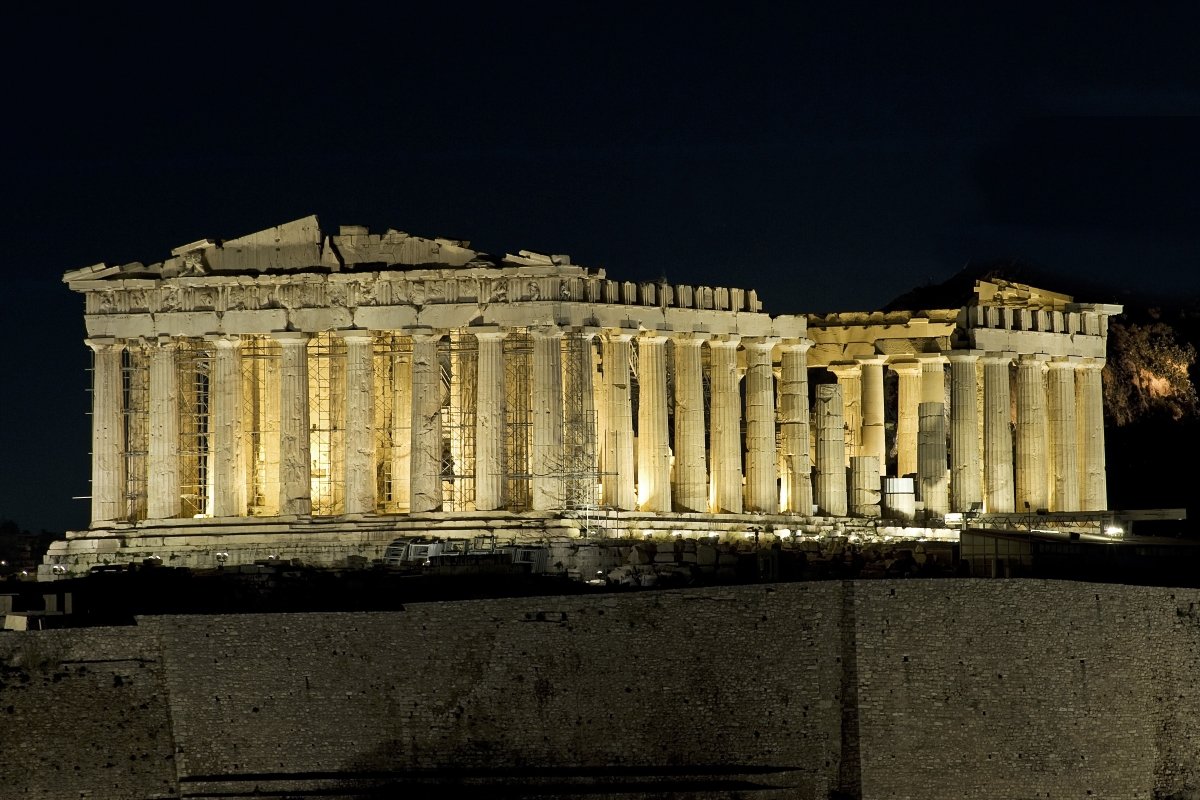
Has democracy ever been as threatened as it is now by populist strong men, serial liars, alternative truths and the eye watering wealth, power and baleful influence of big business? With its history of democracy discovered, developed, lost and reclaimed, Greece reminds us of what we owe the past, how we conduct ourselves in the present, and how long it takes for great ideas to come to fruition.
“It was the Greeks!” blurted out Shirley Valentine in the eponymous film when extolling the inventions that came forth from Ancient Greece. She claimed the Greeks had invented the wheel. While she was wrong about that, as the wheel has its origins in Mesopotamia, she’d have been correct if she’d been talking about the word and the concept of democracy.
The cradle of democracy
Both sprang forth from the city-state of Athens in about 400 BC. However, unlike the wheel, this form of government was painfully slow to catch on. From the demise of Ancient Greece to the middle ages, Greece was neither a country nor a democracy. Different regions and islands were governed by various dukes, overlords, knight crusaders, and other absentee and foreign nobles.
When Constantinople (modern-day Istanbul) fell in 1453, it was only a matter of time before the Islamic Ottoman Empire would swallow Greece too and rule it for over 400 years. The Turks ran a highly organised and bureaucratic empire that granted a degree of toleration to the Greek Orthodox Church and to their Hellenic subjects, while ensuring the Turks were in control.
Greece shakes off the Ottoman yoke
In 1683, the progress of the Ottoman Empire into Europe was decisively checked by the victory of combined Polish and Habsburg forces at the gates of Vienna. Retreat eastwards followed, yet it was not until 1821 that the Greeks fought the Turks for independence.
Over several generations, a new Greek middle class had emerged based on maritime trade around the eastern Mediterranean and was duly drawn into the European Enlightenment’s sphere of influence. In 1823 a liberal constitution was proclaimed by nationalists. It did not last long and was replaced in its entirety four years later.
A war of independence broke out, but it was clear that the declining Ottoman Empire did not have the capacity to defeat the Greeks. Crucial, however, was the resolve of the so-called ‘Great Powers’ to intervene on the Greek side.
Off to a false start
In 1832, an independent, sovereign Greece was born. It was a difficult birth. Naturally enough, it was determined that Greece, the land of Plato’s Republic, should by governed by a king. It was decided that no Greek was good enough for the new throne and that a German from Bavaria would be the obvious choice. Aged only 17, King Otto von Wittelsbach was installed as the new monarch. Surprise surprise, Otto didn’t fit in very well, and the nationalists wondered whether they’d merely exchanged one set of foreign governors for another. By 1862 Otto was deposed and back in Bavaria.
A new monarch was selected, again by outsiders, this time a Danish one. King George I (as Copenhagen-born Prince William of Schleswig-Holstein-Sonderburg-Glücksburg chose to be known) avoided many of the errors of his Bavarian predecessor. Over half a century on the throne, he established a constitutional monarchy, with day-to-day power in the hands of whichever minister could command a majority in parliament.
Prime Minister Trikoupis – a moderniser
In the second half of the 19th century Prime Minister Trikoupis led the way to modernising and industrialising Greece. Under one of his half-dozen or so tenures in office, Trikoupis oversaw the construction of the truly monumental Corinth Canal, the building of roads,and the laying of railways. However, by 1897 Greece was (in a familiar foretelling of contemporary events) heavily in debt to foreign creditors.
20th century man – Premier Eleftherios Venizelos
The turn of the century produced the towering figure of 20th-century Greek politics, eight-time elected premier Eleftherios Venizelos. In various ministries from 1910 to 1933, he doubled the territory of his country, reformed the system of government, enacted compulsory education and brought about progressive social and economic reforms.
With Venizelos’ death in 1936, a bright chapter in Greece’s history came to an end. In common with many European democracies, the dark hand of dictatorship inserted itself. After Nazi occupation during the Second World War, Greece fell into civil war. The defeat of the communists in that conflict handed power to a succession of authoritarian, conservative governments. Matters came to a head in 1967 when a junta of army colonels seized power. Their rule was one of total disaster.
Democracy comes home
With democracy being restored in 1974, Greece’s proudest political invention had returned to the motherland. In 1981 Greece joined the European Economic Community as its 10th member. While the country has endured many problems, often of its own making, a return now to a system of government, other than one elected by the people, is unthinkable.

CLICK HERE TO DONATE TO OUR CROWDFUNDER
HELP US BECOME STRONGER SO THAT WE CAN CONTINUE TO DELIVER POWERFUL CITIZEN JOURNALISM!