


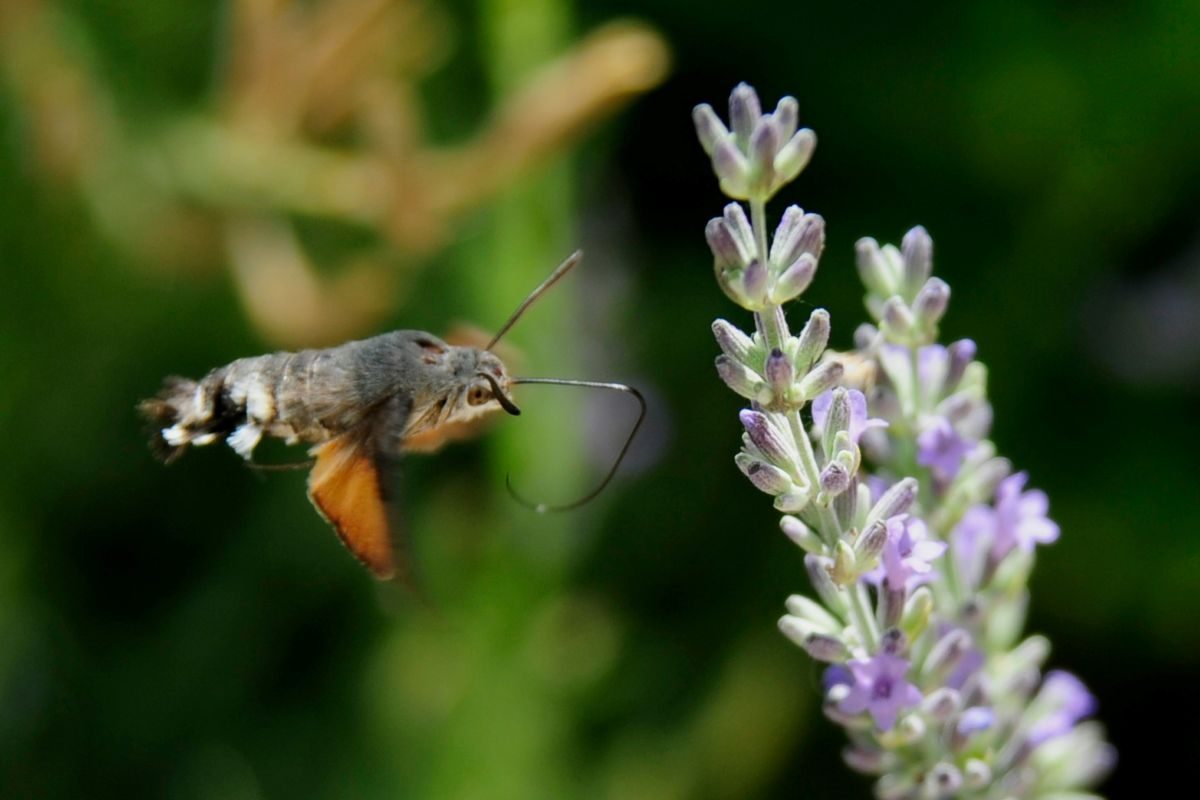
I was working amongst a patch of salvias this week when something caught my eye. There was a blur of movement amongst the flowers, hovering for a moment before darting sideways and stopping again, and although I knew almost immediately what it was, I put down what I was doing and watched.
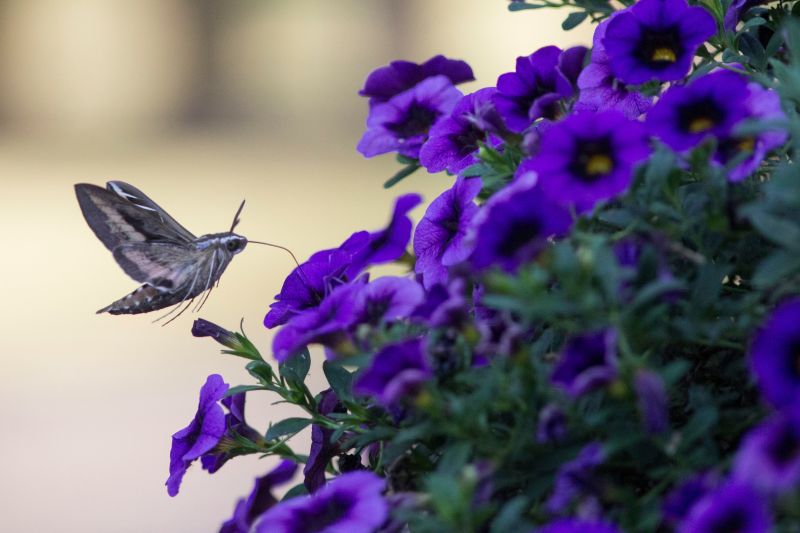
I have seen them before, but not often enough for the sight of one ever to become ordinary. There is something wonderfully improbable about them. They hover in front of a flower rather than settling upon it, their wings moving so quickly that you barely see them, while an extraordinarily long proboscis reaches into the flower for nectar. Then, almost before your eyes have caught up, they shoot across to the next flower and begin again.
Mine seemed particularly fond of the salvias. It moved steadily from one to another while I stood amongst the plants watching it, and for a little while whatever I had been doing could wait.
Later, as I often do when something catches my attention, I went looking for a little more information. The hummingbird hawk-moth, Macroglossum stellatarum, is a daytime-flying moth and a remarkable traveller. Many of those seen in Britain arrive from continental Europe, although they also breed here, and their wings can beat around 80 times a second. Their resemblance to a hummingbird is not just in the hovering flight; that long proboscis allows them to feed from deep flowers while remaining suspended in the air.
For something so small, it lives a surprisingly large life.
I don’t know where the moth I watched began its journey, and I rather like not knowing. It may have emerged somewhere in Britain or travelled here from much farther south. By the time our paths crossed it had undoubtedly visited countless flowers, escaped predators, travelled through landscapes I would never know about and somehow found itself hovering in front of a salvia in the same garden in which I happened to be working.
It was one of those small encounters that stays with you.
There has certainly been no shortage of things competing for our attention recently. This week I have seen anger about sewage discharges along our coastline, alongside the familiar mixture of politics, conflict, environmental concerns and people arguing with strangers they have never met. Some of those things matter enormously and deserve our attention, but it struck me afterwards that while all this was happening, so was the hummingbird hawk-moth.
Not in another world, but in this one.
We sometimes talk about nature as though it is somewhere we go. We take a walk in nature, spend a weekend in nature or escape into nature, and I understand what we mean, but the language has always seemed slightly odd to me. Nature isn’t something that begins at the edge of a woodland or when the houses disappear behind us. The salvia is nature, the moth is nature, the soil beneath my boots is nature and, whether we remember it or not, so am I.
We are not separate from nature. We are nature.
Standing there watching the moth wasn’t an escape from the real world. If anything, it was a return of my attention to the bit of the real world immediately in front of me.
We are nature
Once you begin looking that way, even an ordinary garden becomes an extraordinarily busy place. The bees moving through the flowers are gathering what they need. Spiders have begun stretching increasingly ambitious webs between plants. Birds move through the hedges, fruit is ripening, seeds are forming and beneath the surface of the soil roots, fungi and countless tiny organisms are exchanging nutrients, consuming, decomposing and rebuilding. We are in the middle of all of this, breathing the same air and depending upon many of those relationships whether we notice them or not.
Nature isn’t particularly peaceful either, despite our tendency to describe it that way. There is competition, hunger, danger, death and struggle. My hummingbird hawk-moth may look beautiful to me, but its life isn’t a gentle afternoon drifting between flowers. It has to find food, avoid becoming food itself and, like every other living thing, successfully negotiate whatever conditions the day presents.
Perhaps what feels different is not that the natural world is quiet, but that it doesn’t demand our opinion.
The moth didn’t require me to agree with it.
It didn’t ask whose side I was on.
It simply carried on being a moth.
There is something refreshing in that, particularly at a time when so much of what reaches us seems designed to produce a reaction. We are encouraged to be angry, frightened, delighted or offended, sometimes within the space of a few minutes. Yet around us are thousands of other lives continuing without commentary, and we are living amongst them whether our attention is there or somewhere else entirely.
This isn’t an argument for ignoring what is happening in the wider world. Caring about our communities, our seas, other people and the places in which we live is part of being human. There are things that need challenging and conversations worth having. But I do wonder what happens when the noise becomes so loud that it occupies all of our attention.
We can begin to mistake the loudest part of the world for the whole of it.
My few minutes with the hummingbird hawk-moth offered a different proportion. The problems hadn’t disappeared and nothing had been solved, but something beautiful was happening at exactly the same time.
I find that reassuring.
Not because nature promises that everything will be all right. It makes no such promise. The seasons turn, things are born and things die, summers become autumns and every living thing eventually returns what it borrowed. There is something much more grounded in simply recognising that life continues in countless forms and that we are woven into it.
The moth eventually moved away from the salvias. One moment it was hovering in front of me and the next it had disappeared across the garden. I picked up my tools and carried on with the job, although for the rest of the day I found myself looking around a little more carefully.
There is still plenty happening in the world to concern us, and there will always be something for human beings to disagree about. We are a complicated species and argument seems to be one of the things we do particularly well.
But so is noticing.
Sometimes it takes something no bigger than a hummingbird hawk-moth hovering amongst a few salvia flowers to bring our attention back to where we actually are: not outside nature looking in, but right in the middle of it.
And amongst all the noise of the world this week, I was rather glad to be reminded of that.

CLICK HERE TO DONATE TO OUR CROWDFUNDER
HELP US BECOME STRONGER SO THAT WE CAN CONTINUE TO DELIVER POWERFUL CITIZEN JOURNALISM!





