


Local campaign organiser Hazel Fell Rayner said: “We’re obviously delighted to hear that National Highways has listened to the views of residents and councillors, heard the strength of feeling locally and lifted the infill threat. From the outset, this was an ill-conceived scheme reflecting a lack of understanding as to the environmental and ecological damage it would have inflicted on a sensitive habitat and its wildlife.”
National Highways said it was keen to work with all the organisations concerned to find alternative ways of ensuring the safety of the bridge for the public. But Lewes District Council Leader Zoe Nicholson sounded a note of caution.
She said: “I was clear that infill is not an option that we at the council would support. But we are still a way off from being able to determine what the best solution is for the wildlife corridor, the community and bridge users, including local farmers.”
Are disused railway bridges liabilities or assets? It’s a question highlighted by recent plans to infill a bridge in Barcombe, plans which provoked a vigorous campaign to halt what local campaigners describe as vandalism.
The story behind Barcombe’s Save Our Bridge campaign is a universal one – it’s the story of David and Goliath, of the battle of the “little people” against government, carrying echoes of every fight ever fought by local communities against powerful and faceless bureaucrats. It’s the story of a bridge too far.
It begins at the turn of the century, when the British Railways Board, one of the remnants of the old, nationalised rail system, became BRB (Residuary) Ltd, a wholly owned subsidiary of the Department for Transport. Included in its remaining responsibilities was non-operational railway land, which also covered bridges and other structures on lines that had been closed. In 2013, BRB was abolished, and the Highways Agency Historical Railways Estate (HAHRE) assumed responsibility for what had been previously known as the Burdensome Estate. Legacy bridges, abutments, tunnels, cuttings and viaducts all came under their remit.
Old bridges? Just ‘burdensome’
“Burdensome” seemed to describe the thinking at National Highways (previously Highways England and, before that, the Highways Agency) about its newly acquired heritage estate. In 2016, HAHRE produced a strategic plan which included proposals to demolish 15 per cent – or 480 structures – of the Historical Railways Estate. HAHRE has recently issued confusing and contradictory lists of structures requiring infilling or demolition, although it subsequently denied that such plans existed.

Graeme Bickerdike of The HRE Group, the campaign group opposed to the infilling of historic bridges, has been trying, as he says, to “pick the bones out of all of that”. His best estimate is that there is a threat to over 200 structures – but the number could be significantly higher.
Bickerdike has set up the website Forgotten Relics to celebrate historic structures, keep abreast of National Highways’ plans and fight against the vandalism of infilling. “These [bridges] are a wonderful echo of our great industrial past and the extraordinarily ambitious determination of the Victorians who constructed our railway network throughout the 19th century,” he says.
But protecting historic bridges is not just about recognising their worth as reminders of our industrial heritage. Hazel Fell-Rayner, one of the leading lights of Barcombe’s “Save Our Bridge” campaign, explains that, with the advent of Covid and lockdown, far more people were spending time outdoors exploring the local environment and gaining a whole new appreciation of all the irreplaceable and unusual structures on their doorstep.
Public awareness grows
Even so, the general public was largely unaware of National Highways’ plans to infill or demolish heritage structures until the scandal of the railway bridge at Great Musgrave, Cumbria, hit the headlines in June. The bridge spanned a green corridor that the Eden Valley and Stainmore railways had hoped to use to unite their two heritage railways. Hundreds of tons of aggregate and concrete infilling put paid to their ambitions in an act of cultural vandalism that Bickerdike describes as a “scandalous wrecking ball”.
And so the story moves on to Barcombe…..
The Church Road bridge, designed by civil engineer Frederick Banister in the early 1880s, carries a minor local road and spans the old Bluebell Railway line, which was closed in 1958. National Highways claims to have had “extensive” contact with Barcombe Parish Council in 2020 detailing their concerns about the unsafe state of the bridge, contact which the council describe as amounting to just a few emails.
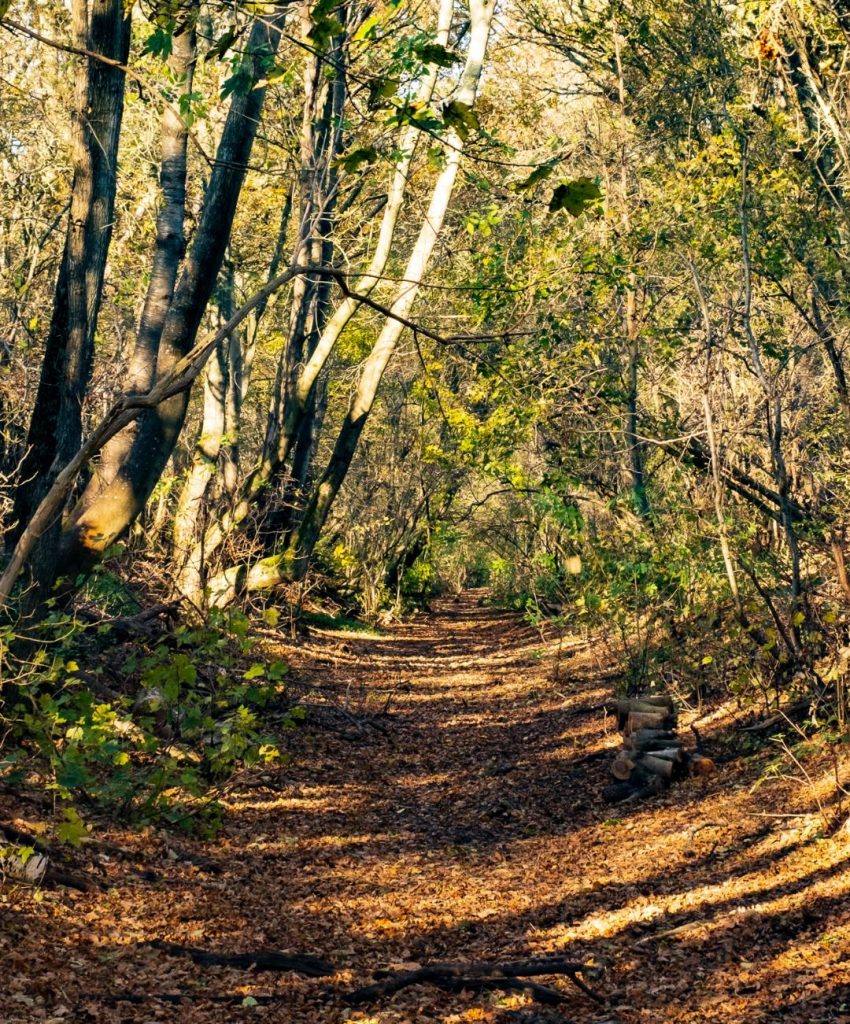
National Highways has planned to infill the bridge with an estimated 1,000 tons of aggregate and concrete, not only blocking a vital wildlife corridor but also destroying a number of mature trees. Creating access for heavy equipment threatened to damage banks and the railway cutting, as well as a nearby ghyll (a type of deeply incised wooded ravine unique to the Kent and Sussex High Weald) and ancient woodland close to the bridge.
Residents’ bridge protest
Barcombe residents marched into battle. Over two weeks in October 2021, they organised a protest held at the site of the proposed work followed by a poster campaign and community letter. Front gardens in the village sport “Save Our Bridge” placards.
“National Highways has picked the wrong village to mess with – we’re a strong and spirited community,” says Fell-Rayner, continuing the “Sussex wunt be druv” tradition. “That whole area is a unique mix. It’s a magical spot, cherished by local people,” she says.

She points out that this particular habitat is not only important in its own right but also forms a section of the wildlife corridor running from the Ouse Valley through Knowlands Wood to the north of Barcombe and continuing towards the Ashdown Forest. “We have only recently come to appreciate how essential these connecting green corridors are to the preservation of native wildlife”, she says. “Imagine proposing to destroy that in the year of COP26!”
Barcombe campaigners and The HRE Group asked two eminent engineers to evaluate National Highways’ plans for the Church Road bridge.
Contrary to National Highways’ claim that the bridge posed a danger to the public in its present state of repair, they were adamant that “there is absolutely no immediate risk that the structure may collapse”. Alan Hayward, a Fellow of the Royal Academy of Engineering, says: “Remedial works are required in the form of brickwork repairs and addition of kerbs…. but the bridge is not in a critical state, in my view. Appropriate repairs could be effected within the £70,000 cost allocated to minor works.”

So why wasNational Highways so intent on pursuing its plans to infill or demolish many of the nation’s treasured railway bridges, when neither the economics nor many of the structural surveys support their approach? Back to that old title of “Burdensome Estate”. Bickerdike believes it’s about mindset – these structures are viewed as liabilities rather than assets – and that, unlike many other strapped-for-cash public bodies, National Highways “just has too much money, and it needs to spend it”.
Want to know more?
If you want to follow the campaign and receive up to date reports on the latest developments, follow @theHREgroup on Twitter or sign their online petition:www.change.org/theHREgroup
The unfolding story of the bridge is told in a video report https://www.youtube.com/watch?v=Y7kltVY7I8Y and Dr Niall Burnside, a Landscape Ecologist, has made an excellent video https://www.youtube.com/watch?v=ElC5SjjRHy0about Barcombe Bridge and its importance as a corridor for wildlife. Follow @BarcombeBridge on twitter and on Facebook. Barcombe resident @Verushka shares the story of the old Barcombe railway line on Twitter – and why disused railway lines should actually be called “dismantled lines”.




