


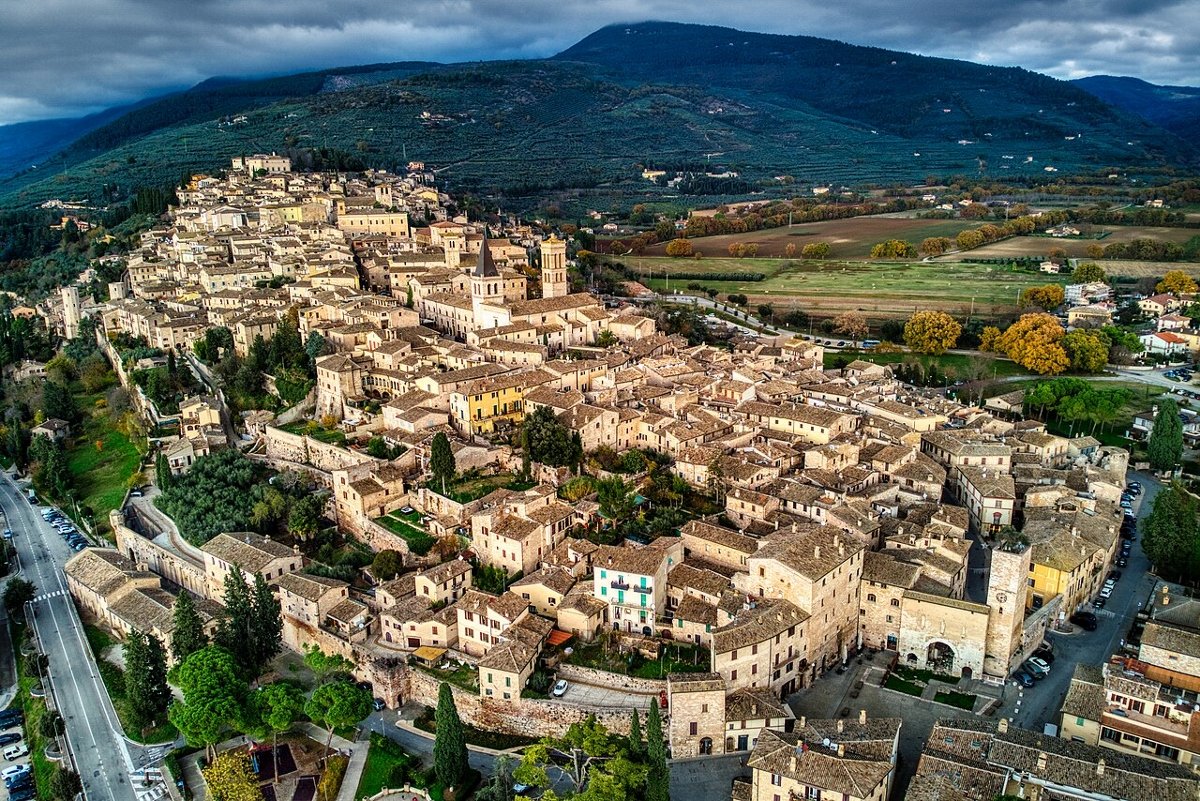
In late September, around 60 singers from the Brighton Early Music Festival (BREMF) Community Choir were lucky enough to take part in a singing course in Spello, Umbria, led by experts in medieval music.
We learnt some Franciscan laudi (songs of praise) and performed in a concert to a packed audience at the end of the week. This was one of many musical celebrations in Umbria, marking the 800th anniversary of the death of St Francis of Assisi (1181–1226).
Francis is probably best known for having chosen a life of poverty and founded the religious order of Franciscans. He loved nature and one of the many stories and legends about his life, which I remember hearing as a child, describes how he preached to the birds. That was all I knew about him before visiting Spello.
Medieval Spello
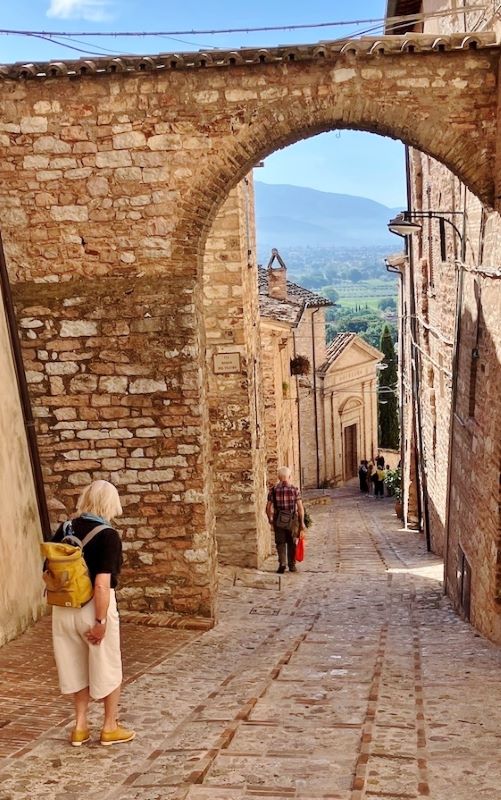
Arriving in Spello at sunset was like stepping back in time. An ancient, walled town dating from Roman times but largely built in the 13th and 14th centuries (think Lewes without later buildings), Spello stands on a hill and has wonderful views of the Umbrian plain. From certain viewpoints you can see nearby Assisi.
Entering at one of the Roman gates, Porta Consolare, it is uphill from there on. Most houses are built into the hillsides. Three of us stayed in a lovely apartment with thick stone walls, in one of the flower-filled courtyards.
We rehearsed at the Centre for the Study of Medieval Music “Adolfo Broegg“, based in one of the many old churches with beautiful frescoes. This was reached down a very steep pathway. Most of Spello is car-free, but in winter it must be treacherous navigating through the town on foot along the vertiginous streets.
Brother Sun, Sister Moon – the first lauda
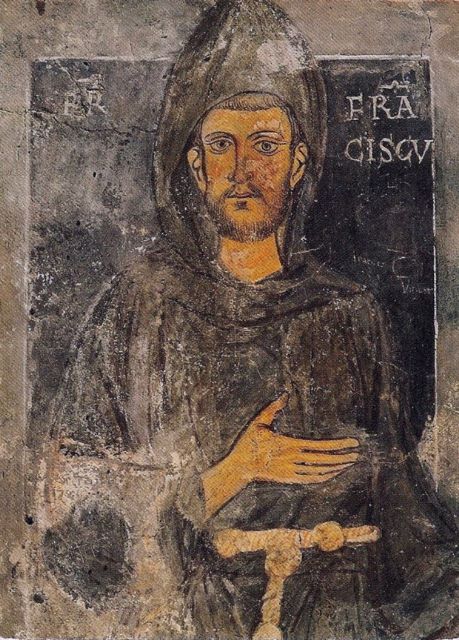
Renowned musician Patrizia Bovi gave the choir a vivid background history to the songs we were going to perform. The first example of a lauda, the Canticle of the Sun, was composed by St Francis in 1225 in vernacular Italian. In it he gave thanks to Brother Sun and Sister Moon, Mother Earth and all the elements. From here, laudi developed in the 13th century into popular devotional songs, often praising the Virgin Mary.
Patrizia emphasised the lively, dance-like nature of the songs that were accessible to everyone, not just religious fraternities, as they were written in local Italian dialect rather than Latin. She also told us about the links between laudi and rituals of self-flagellation, which developed in particular during the Black Death. Some flagellant processions still take place in Italy today, especially during Holy Week.
Composer and early music expert Leah Stuttard accompanied us in rehearsals on a bray harp, which helped set the atmosphere of the songs. Leah has spent many years researching original manuscripts of laudi in Italy, and had arranged many of those we were singing. They are quite tricky rhythmically, but with the help of Patrizia, Leah and choir director Andrew Robinson, we quickly got into the spirit of the songs, many of which have glorious polyphonous harmonies.
Concert in Assisi
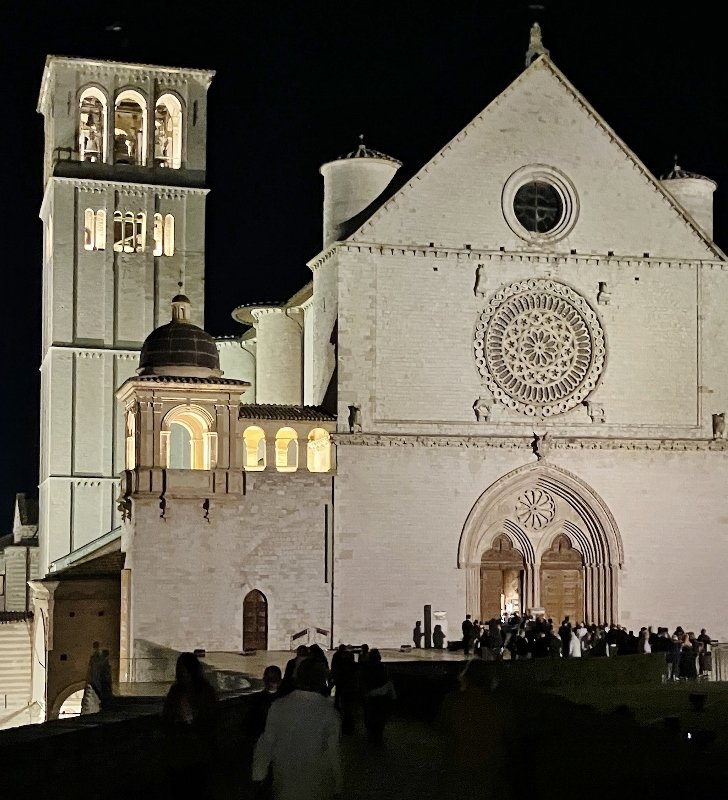
The evening before our own concert, most of the choir attended a wonderful concert of medieval music performed in the Basilica at Assisi by the Ensemble Micrologus that Patrizia Bovi helped to form. People queued outside to attend, as the group is well-known in the area, and the huge building was full.
The concert was eye-opening for the collection of instruments that included bagpipes and horns, rebec (medieval strings), lute and drums, as well as the amazing vocals by Patrizia and others. The sound was incredible and the songs were joyous. What struck me was the synergy with both Celtic and Middle Eastern music traditions.
Performance in Spello
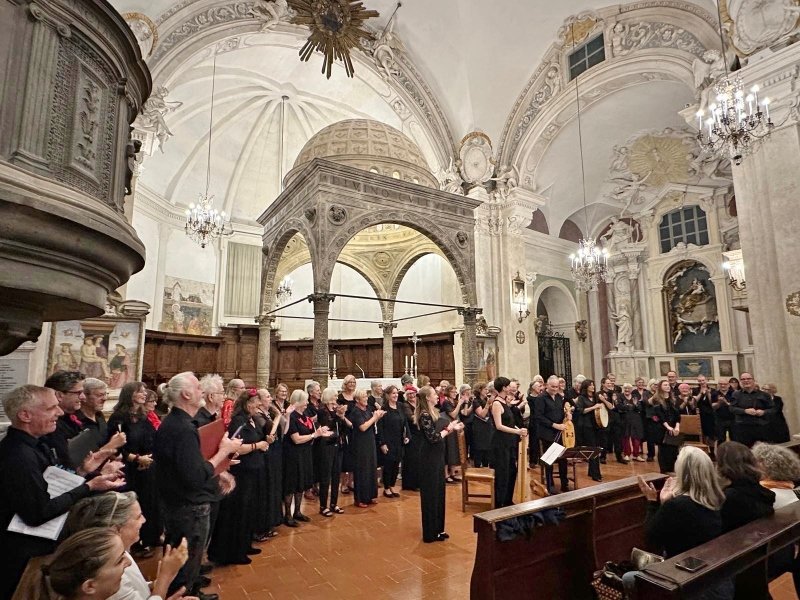
The following evening was the culmination of the week, with a concert by BREMF choir and musicians, including Patrizia and talented lute player Gabriele Russo from Micrologus. We were performing in the lovely old church of Sant’Andrea, with many frescoes by Renaissance artists.
As we had no idea if anyone would attend, choir lead Andrew Robinson decided that we would sing outside the church to entice people in. He chose the stirring ‘Venite a laudare’ (Come and praise), the first lauda in the historic Cortona manuscript, which we had learnt by heart. A dozen people gathered then followed us into the church. Much to our surprise, the rest of the church was already full.
It was very moving to sing laudi in the original setting where they would have been performed over several hundreds of years. As well as the Italian laudi, a special moment was when we sang the 15th-century ‘Lullay my child’ in northern English dialect. Leah’s solo about the Christ child foreseeing his death was heartrending. Beautiful solos by Andrew, assistant director Miriam Shovel, and BREMF co-artistic director Hannah Ely also enhanced the choir’s own performance.
Impressively, both Andrew and Leah addressed the audience in Italian, and the applause was fulsome. The appeal of the laudi is still clearly widespread in the region. Altogether, this was an uplifting experience which will stay with me for a long time.
BREMF Community Choir perform Brother Sun: Medieval and Renaissance sacred song with Patrizia Bovi and Gabriele Russo on Friday October 23, 19.30, St Paul’s Church, Brighton.

CLICK HERE TO DONATE TO OUR CROWDFUNDER
HELP US BECOME STRONGER SO THAT WE CAN CONTINUE TO DELIVER POWERFUL CITIZEN JOURNALISM!




