


Jacinda Ardern’s resignation announcement last week, without apparent prior warning, naturally came as a shock. She gave a characteristically honest and at times emotional speech explaining her reasons for stepping down from her role as prime minister of New Zealand:
“Politicians are human. We give all that we can, for as long as we can, and then it’s time. And for me, it’s time… I know what this job takes, and I know that I no longer have enough in the tank to do it justice.”
Compare this speech and overall leadership style with the macho posturing of Boris Johnson and Donald Trump, both of whom shamelessly clung on to power and, of course in Trump’s case, fired up his supporters with false allegations of voter fraud after losing the 2020 US election.
Being “exactly who I am”
To many, Ardern came to prominence from nowhere in 2017, when she unexpectedly had to take on the leadership of Labour and then the country, although she had in fact been involved in politics for over 15 years when she took office. When elected as prime minister at 37 years-old, she was the world’s youngest female head of government, and later became only the second world leader to give birth while in office.
It’s interesting to compare her speech, when taking on the Labour leadership, to her resignation speech. In a 2017 interview, she said: “I had to run the campaign as myself, be exactly who I am, run a lot based on instinct.” The ‘what you see is what you get’ attitude, a human approach without artifice, was strong from the outset.
This could have come over as naivety, but Ardern was no pushover. When challenged early on about whether she planned to have children, she told a TV host in no uncertain terms that it was “totally unacceptable in 2017 to say that women should have to answer that question in the workplace. It is unacceptable.” Double standards for women in the workplace continue to beset even those – or particularly those – in the highest office.
‘Compassionate but tough’
A combination of emotion and strength has characterised Ardern’s leadership style throughout and stands out as particularly impressive and unusual.
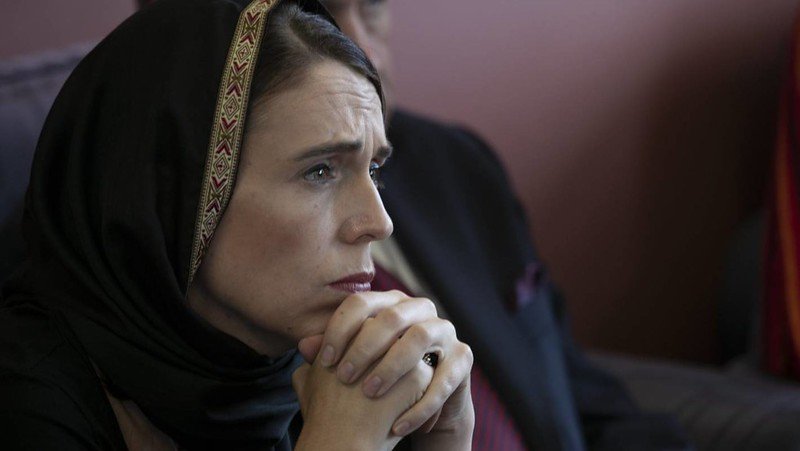
An often-cited example of Ardern’s empathy was her response, acclaimed world-wide, after the terrible shooting incidents in 2019 at two mosques in Christchurch left 50 dead. She quickly labelled the incidents as terrorism, and met members of the Muslim community the next day, respectfully wearing a hijab and hugging victims’ families. This was swiftly followed by an announcement that military-style semi-automatic weapons and assault rifles would be banned, earning her the accolade internationally of being “compassionate but tough.”
This rare combination was also very much in evidence during Ardern’s response to the Covid pandemic. Ardern was widely praised for introducing stringent Covid-elimination strategies. After the first cases were identified in March 2020, Ardern closed the country to foreigners and introduced quarantine for returning New Zealanders, plus strong internal lockdown measures soon after. There have only been 2,393 deaths in New Zealand as a result of the virus. In contrast, Boris Johnson was criticised for ignoring the problem and bringing in Covid-protection measures too late in the UK: 216,255 Covid-related deaths resulted.
Suze Wilson, from Massey University New Zealand, called Ardern’s Covid response a “masterclass in crisis leadership”, arguing that she used a skilful combination of strong communication and empathy, giving clear directions but acknowledging the challenges New Zealanders faced in following such strict prevention measures.
Comparing Ardern’s and Boris Johnson’s announcements about lockdown, Wilson argues that Boris Johnson’s approach was framed as an instruction from government, with an emphasis on enforcement: “Where Ardern blended direction, care and meaning-making, Johnson largely sought compliance.” Ardern’s nightly Facebook livestreams to ‘check-in’ on citizens helped to keep spirits up, compared to Johnson’s often bumbling messages – the contrast was unfavourable even before we knew that Johnson and colleagues were partying during lockdown.
The double bind for women leaders
Of course, Ardern was not without critics and her waning popularity at home has been cited as one of the main reasons for her resignation. The early ‘Jacindamania’ soon morphed into intensive and intrusive scrutiny of her personal life, as well as criticisms of her domestic policies.
My own research into women leaders in universities demonstrated that women in leadership roles often face additional challenges because of their gender, placing them in a double bind. In particular, the women I interviewed reported a tension between caring and authority in carrying out their roles and faced stereotyped expectations that women would be more emotional than men.
The women themselves valued caring and collegial characteristics, but sometimes tried to hide these for fear of being considered too ‘soft’ or unable to cope. Yet if they adopted more directly assertive approaches, they often found they were labelled as ‘hard’. As American researcher E.P. Gerdes wrote: “Leadership characteristics are valued when they are possessed by men but not when they are possessed by women.”
A look at female prime ministers in the UK (all Conservative), reveals that a clear tendency to appear tough has ended up rebounding. Margaret Thatcher – the so-called Iron Lady – was accused of being dictatorial and unfeeling about the effects of the poll tax. Theresa May played up the Tories’ ‘nasty party’ image, but was attacked for looking cold and unsympathetic after the Grenfell fire. Liz Truss was criticised for being robotic. Putting aside their largely disastrous policies for a moment, these women failed to display empathy, yet faced accusations for not doing so which their male counterparts avoided – think Boris Johnson again.
Ardern balanced this difficult tightrope in a highly skilfully manner. As she herself described it:
“I hope I leave New Zealanders with a belief that you can be kind, but strong, empathetic but decisive, optimistic but focused. And that you can be your own kind of leader – one who knows when it’s time to go.”





