


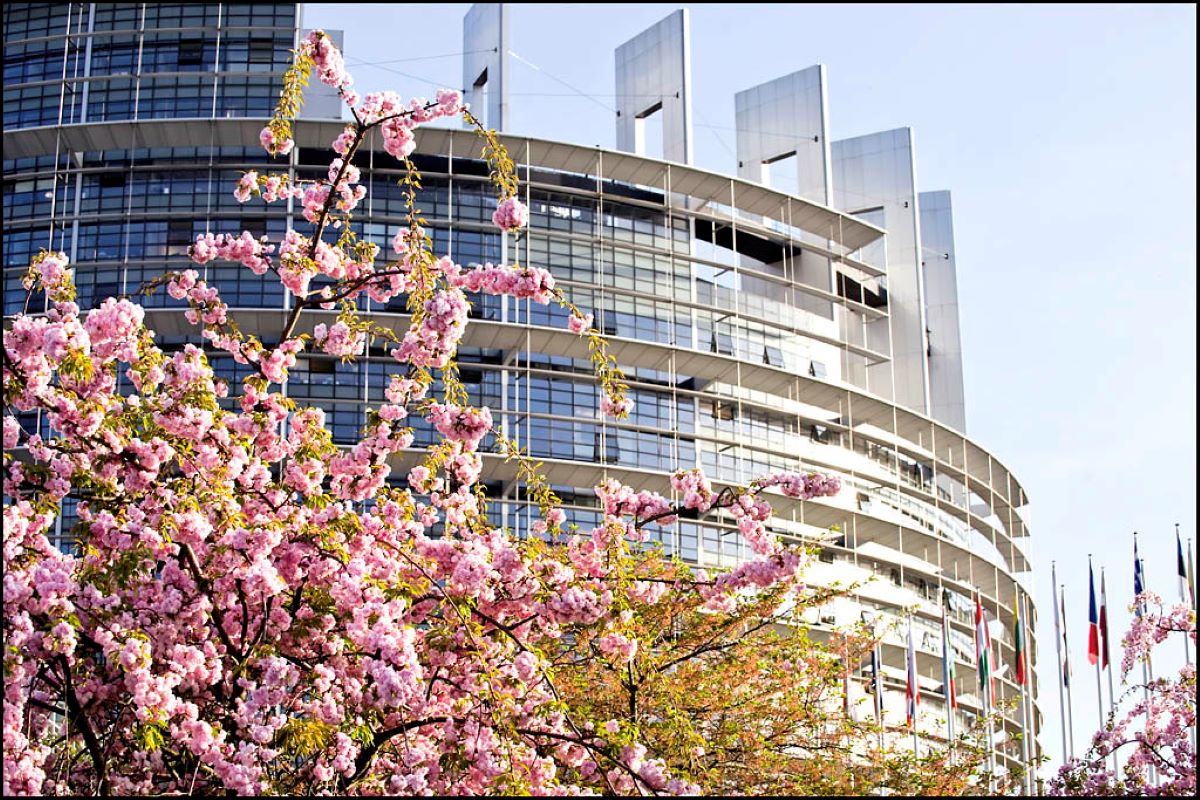
The European Parliament in Strasbourg is free to wander around six days a week. My recent visit was on a pre-Christmas City Break to the city; something a little more stimulating after the glitz and glühwein of the Christmas markets.
Being in the European Parliament on that snowy afternoon was a bitter-sweet experience – sweet because the emphasis on peace and unity is so welcome and uplifting, and the clusters of excitable children drinking in the multi-cultural atmosphere and the displays of their European heritage were heartening. Bitter because of course we are no longer a part of this, and in the current time of global conflict and division it feels the UK has turned its back on something refreshingly steeped in values of peace, integration and humanity.
As I walked around the displays of significant figures in the creation of this post-war European project, what struck me was the number of women, past and present, who have been key in the fight for European peace and integration. Indeed, although it is Robert Schuman (1886-1963) who is credited with the original concept of economic and political unity, with the Schuman Declaration of 1950, it was Louise Weiss who made the inaugural speech of the European Parliament in 1979. She was 86 years old.
Who was Louise Weiss?
The Louise Weiss Building is where you start your visit to the European Parliament. This impressive circular structure is plated with glass to symbolise open, transparent democracy. Its roof looks unfinished to suggest the ongoing nature of the European project, echoing Schuman’s acknowledgement that “Europe will not be made all at once, or according to a single plan (but) through concrete achievements.”
The French journalist Louise Weiss (1893-1983) is known as the ‘grandmother of Europe’. Her passionate belief in European unity and peaceful resolution of international conflicts following the devastation of the two world wars made her a driving force behind the creation of the European Union.
Born into a Jewish family at the end of the twentieth century, she grew up always keenly aware of discrimination and conflict in society. During World War 1 women in France were excluded from politics and Louise turned to a career in journalism as a means of ‘making war on war’. In that role she witnessed first-hand the devastation of European cities. She did more than just report; for example, she organised a humanitarian mission to rescue 100 French governesses caught up in the Soviet Union after the Bolshevik Revolution.
Reading through accounts of her life, I am struck by her bravery. In the interwar years she was one of a few journalists to write about Nazi persecution of dissidents and Jews. Although herself a Jew and at risk of her own capture, during the second world war she was very involved in the plight of Jewish refugees. In 1938 and 39 she worked tirelessly to help secure visas for Jewish refugee children from Austria and Germany to find safety in France. She eventually had to go into hiding in 1943 after hearing that her own name appeared on a Gestapo list of targeted Jews.
Women’s rights
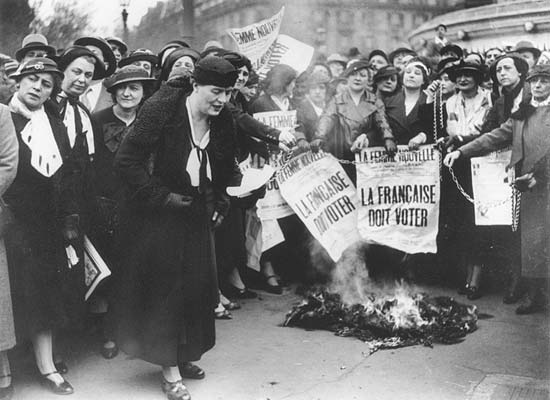
Although women did not get the vote in France until 1946, Louise Weiss had been a vociferous campaigner for female suffrage throughout the 1930s. In those inter-war years, she was predominantly interested in working for international peace, and she saw the involvement of women in politics as a means of preventing the outbreak of war.
As in the UK, campaigners for the female vote divided into those whose methods remained legal, sustained and persuasive and those for whom only sensational stunts would attract the necessary results. Weiss fell into the latter camp. In the Shalvi/Hyman Encyclopaedia of Jewish Women, it is noted that she arranged for the interruption of the Grand Prix Horse race by an aeroplane dropping leaflets attached to socks on which was written: “Even if you give us the vote, your socks will still get darned.”
Filmmaking
Weiss believed in the power of international journalism to inform and challenge. In the 1960s and 1970s she also took up filmmaking and through the documentaries she made it is possible to see a change of position, a pessimism about the possibility that peace can always be achieved without military intervention. Her view of the integration of Europe shifted from solely cultural and economic unity to the development of its own military force, as the threat of Russian and American superpowers loomed large during the Cold War. We struggle with the same tensions today in the face of muscle-flexing by dangerous leaders like Putin.
Commemoration
Every street name and building in France seems to be dedicated to historical figures and events, so it is unsurprising there are a fair-few Louise Weiss streets throughout France. There’s also a tiny park in Strasbourg named Le Square Louise Weiss, and a museum dedicated to her in Saverne, to the northwest of Strasbourg.
She is just one of very many women who have made their mark in the progression of European suffrage and integration, and, when we return to the EU, I am determined to be a bit more clued up on its extraordinary story. Learning about the key women in the European project seems a good place to start.


