


Had I been asked for my opinion of Michael Portillo in 1997, the response would have been withering scorn. He seemed typical of the younger Thatcherite Tories of the era: anti-Europe, anti-union, and slavishly devoted to the free market. Yet his second public career as a dandyish travel presenter has slightly altered my perception of the man. Some ambiguities remain. It is still hard, for example, to square his love of European state railway networks with his role as Minister for Transport, in which he helped lay the groundwork for British Rail’s break-up.
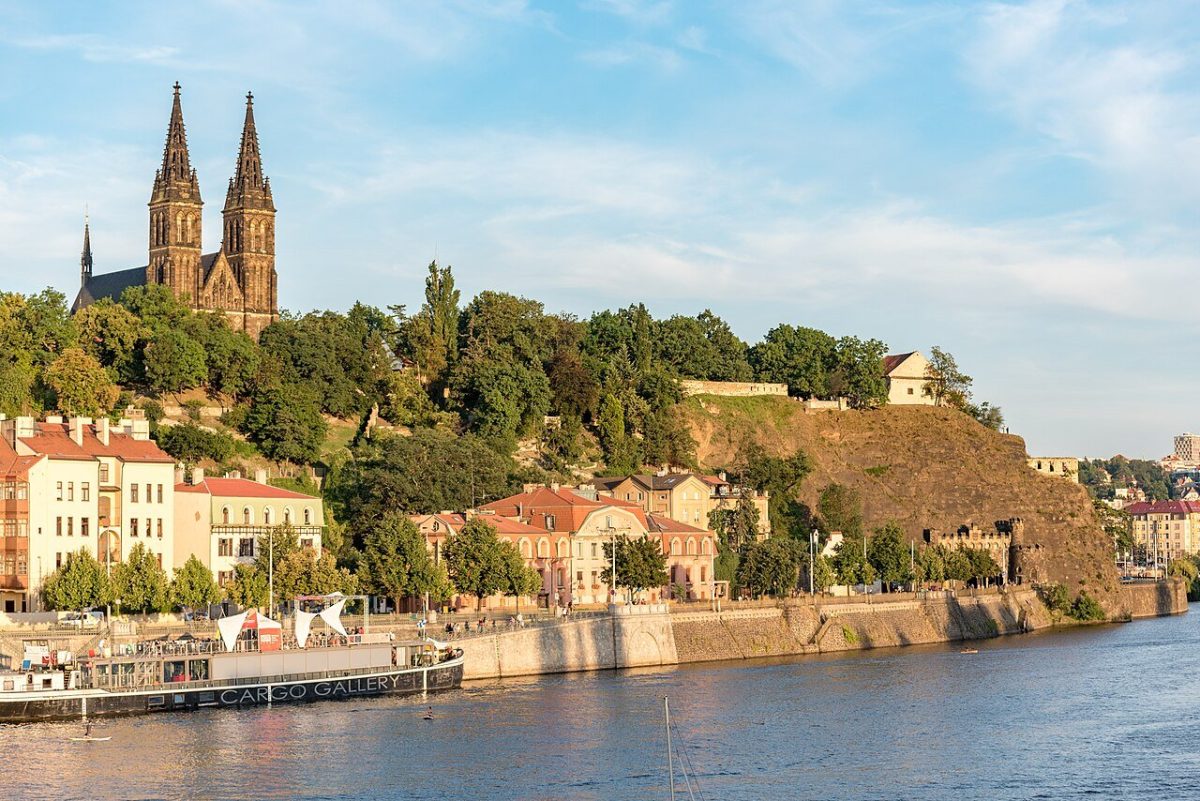
His mini-series on Europe are well worth watching and, while football never comes into the equation, his visit to Vysegrad Castle in Prague for Channel 5 gave me an idea. I’d already seen the main tourist attractions in the city centre and explored Zizkov (more of which to come), but I hadn’t really ventured further afield. Could there be a football game nearby that would allow me to combine history with the beautiful game?
As luck would have it, this couldn’t have been easier.
After jumping off the number 24 tram, a lengthy climb — a familiar theme in Prague — leads up to the walls of this mighty Hapsburg fortress, which dominates the surrounding area and gives commanding views of the River Vltava. Steep steps lead to the citadel’s Basilica, which contains the remains of numerous Czech luminaries, including the composer Dvorak, whose tomb was suitably imposing. Vysegrad is bound up with Czech history, being the supposed site of the first settlement that later became Prague.
A stroll through the vast castle, passing the 11th century Rotunda, brought me to the monumental Tabor gatehouse, where the tell-tale strains of appalling Eurodance (Dvorak wouldn’t approve) suggested that a football ground was close by.
A couple of hundred metres from the walls stands a much humbler structure. Slavoj Vysegrad’s stadium is ringed by houses, communist-era flats, and the fortress park. On the day I visited, they were entertaining SK Steti, from a town north of Prague, in the heavily regionalised fourth division. This being eastern Europe, the 10.15 morning kick-off didn’t deter most of the patrons from drinking beer, and there was a decent bar, with a restaurant attached, as well as a stall selling scarves and other memorabilia. In short, European hangover football – a phrase coined by a friend and absolutely appropriate today.
The ground itself was exactly the sort of place I love; three flat sides with the odd bench scattered around, and one makeshift stand with wooden bench seats on a raised step down one side. Older men in shabby suits and moustaches, younger friends of the players, a few groundhoppers, and hard-drinking locals made up the 250-strong crowd. The club is fighting its way back, having previously played as high as the second division before being implicated in a 2021 corruption scandal involving bribed referees. That led to its demotion to the 5th level, although I’m not sure how the ground could ever have coped with any sort of away-fan presence, given the basic facilities.
The game itself was a really good one. Played on a sanded artificial surface of very dubious quality, both sides attacked from the off and seemed committed to missing chances with amusing regularity. A spectacular overhead kick from a burly home striker clattered the post, hefty challenges were waved on, and long balls careered over the touchline. The quality was probably akin to Step 4 in England’s non-league Pyramid, but on an extremely hot day, the players’ effort was appreciated by the fans in the ground, as well as by a vocal old lady on a balcony overlooking one end.
Finally, the home side broke the deadlock and went into half-time 1–0 up after a clever finish from midfielder Skop.
Another curiosity was the high-tech filming operation taking place, complete with proper sound equipment and a TV truck. After I had taken some pictures in the interval and chatted to a couple of German Darmstadt fans, who were watching a few Czech games before heading to Dresden to see their team on Sunday, the camera crew began interviewing supporters.
The novelty of an English voice meant they spoke to me at length during the interval. Given the resulting Roy Hodgson/Cary Grant accent I always seem to adopt when speaking to Europeans, I can only hope this documentary never sees the light of day.
The second half began with the heat unrelenting, but the action actually improved. A ferocious screamer brought the away side level, much to the approval of their manager, who was in full kit but, oddly, wearing football socks without shoes. Both sides then missed several presentable chances before Vysegrad went ahead on 63 minutes and finally wrapped things up a couple of minutes from time. A great highlight was seeing the sock-wearing manager bring himself on in the final few minutes. Bearded and at least 45 years old, he barely touched the ball but hats off to him for giving us all hope!
Although the standard wasn’t top-class, the players’ effort and the charm of this unexpected little ground meant I enjoyed this game more than some of the top-flight ones I’ve been to over the years. It would make an excellent groundhopping stop, especially if Bohemians or Slavia are playing on the same day, as both stadiums are only about 10–15 minutes away by tram.
In the end, Vysegrad offered exactly what the best football detours so often do: a bit of history, a bit of absurdity, a good match, and a reminder that the most memorable days are rarely the ones you plan too carefully.

CLICK HERE TO DONATE TO OUR CROWDFUNDER
HELP US BECOME STRONGER SO THAT WE CAN CONTINUE TO DELIVER POWERFUL CITIZEN JOURNALISM!






