


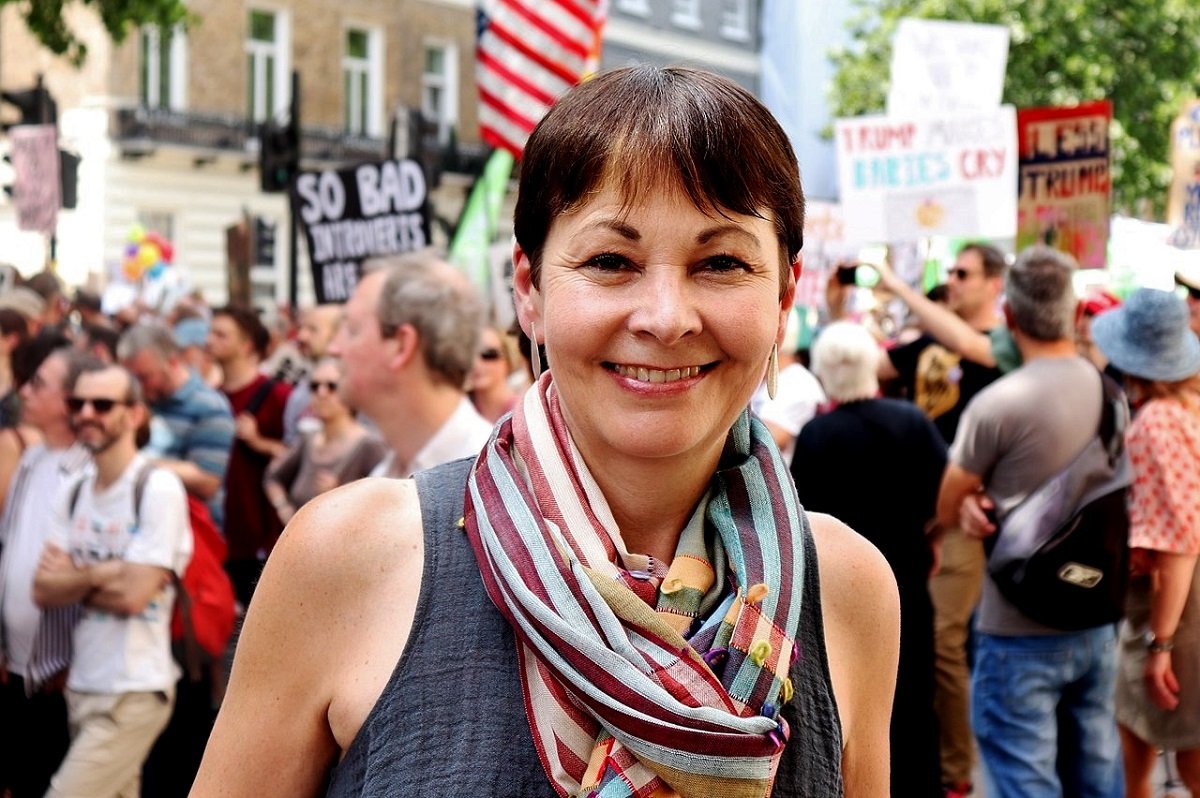
At 4.39am on 24 June 2016, the day after the EU referendum, Green MP Caroline Lucas stood on Westminster Bridge, “profoundly shocked” at the result.
This is the powerful opening of Lucas’s new book, Another England, which she read from to a packed Brighton Dome on 5 May. Lucas was passionate, eloquent and surprisingly hopeful as she outlined her vision for a fairer democracy and how to reclaim our national story, in conversation with Brighton Festival’s guest director Frank Cottrell-Boyce.
Lucas talked about the deep divisions and sense of alienation within our society which the referendum revealed. The sharp differences between the four nations of the UK in how they voted, and developments since then, have left her with the view that “the future of the UK itself is now in doubt.”
“The Right have hijacked Englishness”: can it be reclaimed?
One impetus behind the book is Lucas’s desire to reclaim the idea of ‘Englishness’ from the narrative of the Right. She wants to challenge the story of exceptionalism, imperial nostalgia and ‘world-beating’ Britain, exemplified in Tommy Robinson’s followers waving Union flags on St George’s Day: “The stories on the Right are so simplistic. We need complexity.”
Running through the relaxed and at times light-hearted conversation was a serious thread. Lucas stressed the “deeply dangerous” impact of the present government, from Boris Johnson’s attempt to prorogue Parliament, to the undermining of the rights to strike and demonstrate, and even the right to vote. These collectively amount to a “rolling back of democracy”.
She was scathing about Keir Starmer’s opportunistic adoption of the Union flag, which she regarded as “lazy” and “muddled”. An alternative narrative, to Lucas, must be greener and more inclusive, with social justice at its core, following national and international law, unlike the “horrible” Illegal Migration Bill.
Reclaiming links to nature and the countryside
Cottrell-Boyce pointed out the “surprising” centrality of literature in Lucas’s book as a way of reframing what it means to be English. She reminded him that her doctorate was in 16th century romance, so seeing things through a literary lens was second nature. This was obvious in the way she made reference to poets and writers – John Clare, William Cowper, Edward Thomas and others – who wrote about their relationship to nature and the natural world.
One kind of reclaiming which was obviously important to Lucas was the ‘right to roam’, which in England is very limited compared to Scotland: “We feel shut out from the countryside.”
She pointed out the huge inequality that half of England is owned by only 1% of the population and how many landowners block or divert public footpaths across their land, despite this being a “criminal offence”. A prime example was Dartmoor, one of the few places in England where wild camping is allowed, where the wealthy landowner tried to block this right and the Dartmoor national park had to go to court to get the right restored.
An alternative history
Lucas also argued that we need to reclaim a different, radical version of history. Instead of lauding Britain’s imperial past, she talked about the Peterloo Massacre, Tolpuddle Martyrs, and (one I hadn’t heard of) the 1217 Charter of the Forest, which established rights of access to the royal forest and was only repealed in 1971.
As a recent example of reclaiming history, she praised Cottrell-Boyce’s opening ceremony for the London 2012 Olympics, for which he was the writer, which celebrated the industrial revolution and the NHS.
Caroline Lucas as role-model
Lucas concluded by setting out some key aspects of her alternative to the current government’s approach: “It’s not rocket science!” These include: a fairer voting system, which would give the chance of votes translating into power; giving more power to regions: “There’s a need for devolution of power to places starved of power.”
She also wants an elected House of Lords, though she acknowledged that the Lords had done a brilliant job recently in contesting the Rwanda Bill. And unsurprisingly, she argued that leaving fossil fuels in the ground is a “no brainer” – and the opposite of what the government is doing.
A longing for alternative approaches was evident in the many questions put to Lucas after her conversation with Cottrell-Boyce. It was particularly heartening to see several young women environmental activists asking questions – Lucas is clearly an important role model.
Another England or another Britain?
Although I agree with the majority of Lucas’s ideas, I found myself struggling with her whole emphasis on ‘Englishness’, which extended to a proposal for an English Parliament to match the Scottish, Welsh and Northern Ireland Assemblies. This may partly be because of a sense of shame about English exceptionalism, but mainly because I’m proud of my Welsh heritage, and regard myself as British not English – so I wanted Lucas to focus on ‘another Britain’, not just England.
Nevertheless, I share Lucas’s worry that this is “a moment of real jeopardy” and her concern that “Labour’s not up to it”, giving the example of Starmer ignoring the members’ recent vote for a change in voting system: “We need the Greens to make Labour bolder.”
She was also clearly shocked at how quickly Starmer (as well as Sunak) rejected the EU’s recent proposal for a youth mobility scheme – “most depressing” – though she was optimistic that the UK would return to the EU “faster than we think”, albeit in incremental steps. I hope she’s right.
Whether one agrees with everything Lucas stands for, there’s no doubting her stature as an outstanding politician (one of the few) and constituency MP. She was fulsome in her praise of Brighton as an exciting and forward-looking city and said it had been “the privilege of my life to serve Brighton and Hove”.
Those of us who live in Brighton Pavilion have been the privileged ones.
Thanks to the brilliant BSL interpreters Jill Blackadder and Ali Gordon.





