


Last week the Towner Gallery in Eastbourne opened a major new exhibition for the summer, Emma Stibbon’s Melting Ice | Rising Tides. This aims to explore “the warming environment in the polar regions” while acting “as a stark reminder that the seemingly remote events of polar ice sheet melt is directly connected with the changes that we are witnessing in our local, more familiar UK landscape”.
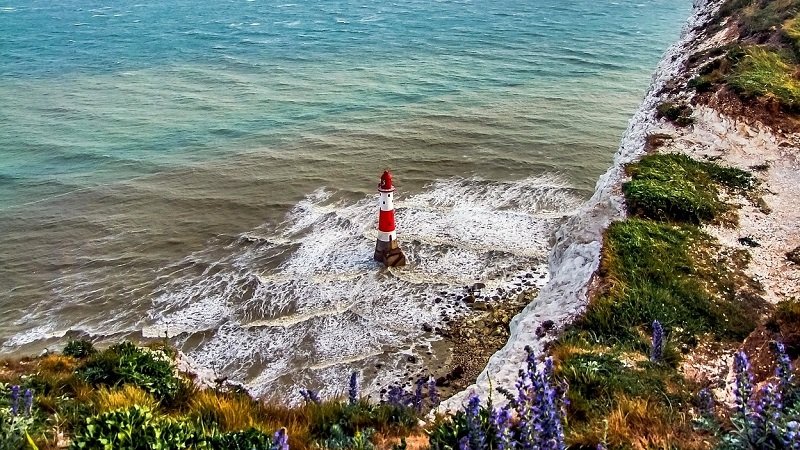
The exhibition brings this home with graphic new drawings of the Sussex coastline, including Birling Gap and Beachy Head, noting that, of the eight coastguard cottages built in 1878, only four remain: all the rest have been overtaken by the sea as the coast has been eroded by as much as one metre a year.
To accompany the exhibition there are talks about how current art practices can bear witness to the climate crisis, a panel discussion with the Green Party MP Caroline Lucas and a series of Climate Cafés – a chance for residents to discuss their climate anxieties in a safe environment.
The climate crisis and hurtling towards the impenetrable
The exhibition has affected many visitors deeply with comments left such as “Don’t forget to listen carefully to the natural world, it’s shouting silently in your muffled ears”; “Stepping off into the icy waters of bureaucratic indifference, I flounder, slipping, hurtling towards the impenetrable” and; “Question your sense of your own importance, the iceberg coming towards you is icily indifferent to your narcissistic ways”.
It is uncomfortable then that the Towner has just announced it has obtained a grant of £750,000 to fit out Black Robin Farm, now renamed Towner Seven Sisters, as a hub for ‘art, culture, heritage and ecology’. The project plans to use some of Eastbourne’s £11m levelling up monies to transform what was once a quiet downland farm in the South Downs National Park.
Serious ecological concerns
The project is controversial. In a town where the average wage is around £27,000 a year and 27 per cent of households have no access to a car, many residents find it difficult to understand how an arts centre, high on the Downs, has anything to do with levelling up. Some question why the funds could not be spent refurbishing the down-at-heel town centre or even improving public transport.
Others wonder if the project doesn’t conflict with the National Park’s conservation aims. As ecologists have noted, chalk downland is rare and ecologically sensitive. In reports to the National Park’s planning authority, officers noted that 100,000 visitors required for the site to break even will overwhelmingly come by car and that this is likely to totally change the character of the area, adding significantly to pollution, damaging the delicate ecosystem, and having an impact on the nearby Sites of Special Scientific Interest (SSSIs).
Furthermore, there appears to be a proposal to demolish some heritage farm buildings, currently the home of a rare species of bat, and also to dig some 27 boreholes which may damage the chalk aquifer that is the source of Eastbourne’s drinking water supply.
With the same passion for the environment as the visitors to the Rising Tide exhibition, objections were raised at the South Downs NPA meeting: “This is a project at odds with itself – destroying the very thing children come to learn about,” said one contributor, and they “came for paradise and got a parking lot.” Overall there were 16 objections to the proposals including concerns from the MP for Lewes but the application was approved 5 to 4.
While new walking, cycling and sustainable and accessible transport routes will be developed to create a link between Black Robin Farm and iconic landmarks such as Beachy Head, Birling Gap, Seven Sisters and Cuckmere Haven, there are currently no plans for frequent convenient public transport to get visitors or residents from Eastbourne town centre to 500 ft up on the Downs.
For the moment it is unavoidable that the increased car traffic will add significantly to Eastbourne’s carbon footprint. As yet, there are no published plans for dealing with this or the other serious ecological concerns raised. Whether the Towner can square the circle of attracting thousands of visitors while doing no harm to the Downs, and not adding significantly to Eastbourne’s carbon footprint, remains to be seen.
A voice against global heating
The Towner is in an awkward situation. Its new exhibition presents the gallery as an organisation engaged with, and supportive of, attempts to limit global heating. But at the same time, the gallery is the lead for a development project which seems likely to have a substantial carbon footprint and thereby add to the threat of the sea rising and more floods in the town. Some are wondering whether the Towner’s aspirations to be a voice against global heating are not in conflict with these plans.
The pressing question they have is: Can the designs for the Towner Seven Sisters not be adapted to provide a project more sensitive to this ecologically sensitive environment?
The Melting Ice | Rising Tides exhibition is on display until 15 September 2024. For more information, please go to: www.townereastbourne.org.uk.

CLICK HERE TO DONATE TO OUR CROWDFUNDER
HELP US BECOME STRONGER SO THAT WE CAN CONTINUE TO DELIVER POWERFUL CITIZEN JOURNALISM!






