


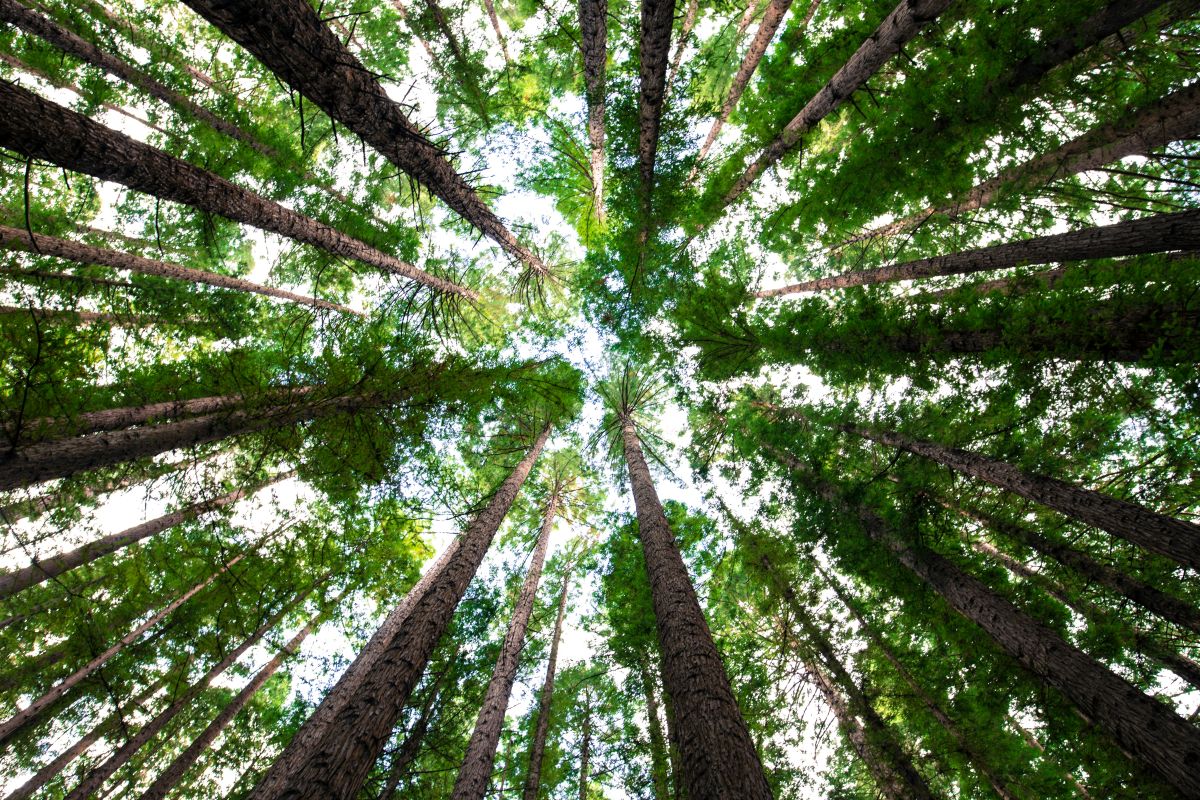
Stand beside a tree for a moment and consider a strange possibility: much of what you are made of was once drifting through the air above your head. Not metaphorically. Literally.
We tend to imagine trees as creatures of the soil. Their roots disappear into the ground, their trunks rise from it, and their fallen leaves return to it. It feels natural to assume that the substance of a tree must come from the earth beneath it. Soil in, wood out. But the deeper truth is far more surprising.
Most of a tree does not come from the soil at all. It comes from the sky.
A tree grows by pulling carbon dioxide from the air. Invisible gas enters through tiny pores in the leaves and, with the help of sunlight and water, is rearranged into sugars. From these sugars the tree builds everything we see: wood, bark, leaf, root. The towering column of an oak, the wide reach of its limbs, the slow thickening of its trunk – all of it assembled atom by atom from carbon that once floated freely in the atmosphere.
If you were able to weigh a mature tree and then weigh the soil it grew in, you would find something unexpected. The soil has hardly changed. The mass of the tree has arrived from somewhere else entirely.
Air has quietly turned into timber.
Over decades a tree performs this quiet act of transformation again and again. Carbon drifts invisibly across the sky. A leaf catches it. Sunlight rearranges it. Slowly, almost imperceptibly, the tree thickens. Rings form. Branches extend. What began as gas becomes the solid weight of wood you can lean your back against.
Trees are translators of the atmosphere
An oak, after a century or two, may hold hundreds of kilograms of this captured carbon. A small forest holds tonnes of it, all drawn down from the air by leaves no larger than your hand.
We rarely think of trees this way. To us they look like pillars of earth, anchored and immovable. But in truth they are great translators of the atmosphere. They are one of the few living things on Earth that visibly turn air into substance.
And once you see this, another thought follows quietly behind it – because the same carbon does not remain in the tree forever.
Leaves fall. Branches decay. Insects eat them. Fungi dissolve them. Animals feed on the plants that grow in forest soils. The carbon moves again, slipping from one body to another, passing through roots, beetles, birds, deer and grasses.
Eventually some of it reaches us.
Every apple, loaf of bread, potato or carrot began with carbon that plants drew from the air. Even meat and dairy begin there, carried into animals through the plants they graze upon. The carbon in our muscles, our skin, our bones and brains is simply the latest stop in a journey that began as a drifting molecule in the sky.
In a very real sense, our bodies are built from air that trees and plants have gathered and transformed. This idea becomes even stranger when you stretch your view a little further back in time.
The Earth does not gain or lose many atoms. The same carbon atoms move endlessly through the great cycles of life – through the atmosphere, oceans, soils and living things. They combine, separate, drift and return. The carbon you carry today may once have been part of a forest centuries ago. Before that it may have been part of a grazing animal, or a patch of grass, or a leaf trembling on the branch of a tree that grew long before you were born.
Atoms are patient travellers.
They pass through bodies the way water passes through rivers. A human life holds them only briefly before they move on again.
Trees, in this endless circulation, are among the great gathering points. They slow the movement of carbon, holding it for decades or centuries at a time. Where grasses store carbon for a season, a tree may hold it for generations. The oak in a village churchyard may be carrying atoms that once drifted through medieval air.
Its trunk is not just wood. It is time made visible.
Stand beneath such a tree and the thought becomes quietly disorientating. The substance of the trunk above you was once part of the open sky. The substance of your own body was once there too. At some point in the distant past, the atoms that form your hands may have passed through leaves very like the ones now rustling overhead.
The boundary between us and the tree becomes less certain than it first appears.
Our connection with nature is physical
We often speak about our “connection” with nature as though it were something philosophical, something sentimental. But the relationship is far more physical than that. The traffic between trees and people is constant and literal. We breathe out carbon dioxide. Leaves draw it in. Leaves release oxygen. We breathe it back again. Meanwhile the carbon moves quietly through food, soil and living tissue.
Back and forth, endlessly.
A forest is not separate from us. It is part of the same circulating system of matter.
Seen this way, a tree is not simply a plant rooted in the ground. It is a slow, patient machine for gathering pieces of the atmosphere and lending them temporary form. Branch by branch, year by year, it assembles fragments of the sky into something you can walk beneath.
And we, without noticing, are made of the same borrowed material.
Perhaps that is why time spent among trees often feels oddly calming. Some deeper part of the mind recognises the familiarity. The same atoms move through both of us. The same ancient circulation binds trunk, leaf and human breath into a single long exchange.
The tree standing beside you today may one day return its carbon to the air. From there it will begin the journey again – through leaf, fruit, soil, animal and perhaps another human body centuries from now.
Nothing is wasted. Nothing truly disappears.
Air becomes tree.
Tree becomes life.
And for a short while, life becomes us.

CLICK HERE TO DONATE TO OUR CROWDFUNDER
HELP US BECOME STRONGER SO THAT WE CAN CONTINUE TO DELIVER POWERFUL CITIZEN JOURNALISM!





