


Sarah A. Son, University of Sheffield
Ten years ago, a divorced father and his young daughter boarded a high-speed train from Seoul to Busan. But before they reached their destination, most of South Korea had been overrun by zombies.
This simple premise turned director Yeon Sang-ho’s Train to Busan into one of the most successful Korean films of its generation. Following its premiere at the 2016 Cannes Film Festival, it went on to draw more than 11.5 million viewers in South Korea and broke box-office records for Korean films in several Asian markets.
The film is now returning to cinemas in a new 4K restoration for its tenth anniversary. However, this new version arrives in a world where Korean films and television shows occupy a very different cultural position from that of 2016. The genre-bending film Parasite won best picture (and a slew of other awards) at the 2020 Oscars, the hit TV drama Squid Game has become an international phenomenon, and Korean actors are increasingly familiar to audiences far beyond Asia.
Looking back from 2026, Train to Busan was an important stage in that transformation. It showed that Korean commercial film could attract global attention, while also depicting important social concerns and storytelling traditions coming from the film’s Korean context.
A society in crisis
The film follows Seok-woo (Gong Yoo), a successful fund manager, taking his daughter Su-an (Kim Su-an) to visit her mother in Busan. Their train has barely pulled out from Seoul Station when a woman on the train infected with a zombie contagion begins to attack other passengers.
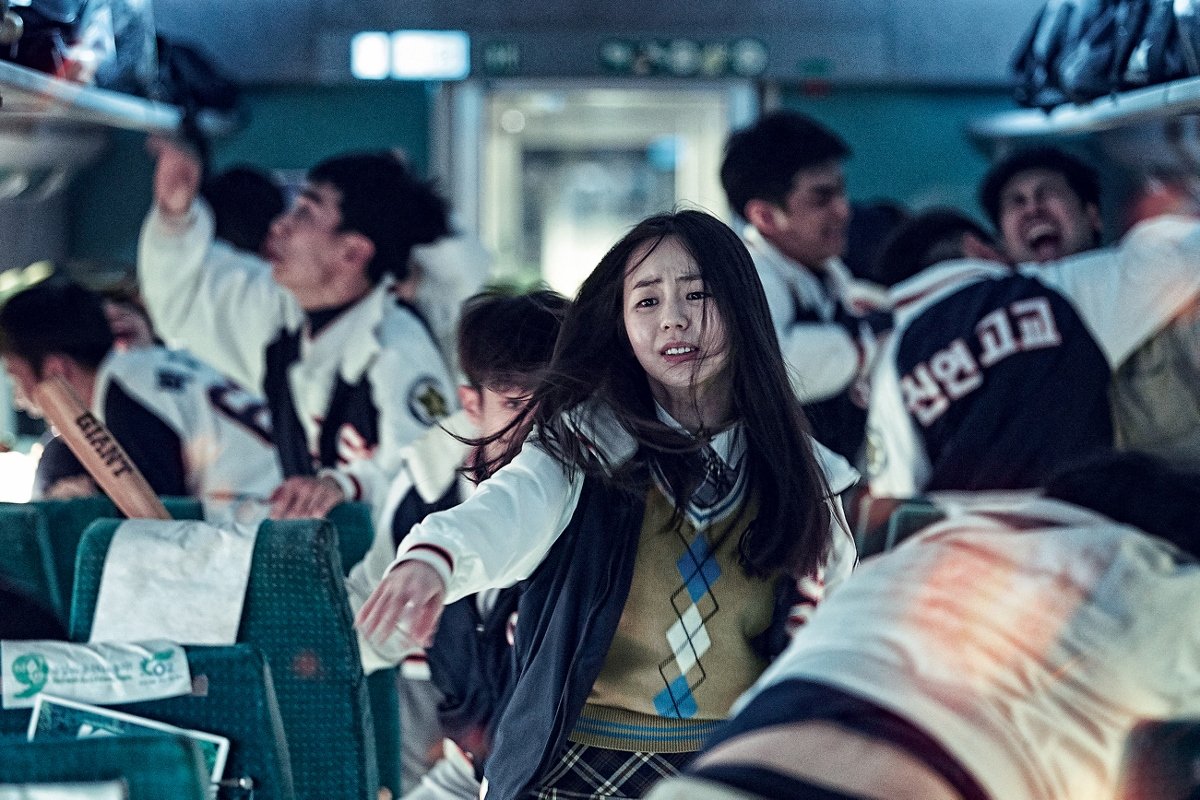
The train gathers a cross-section of South Korean society into one confined space. Its passengers include a pregnant woman and her husband, school pupils, elderly sisters, railway employees, a homeless man and a wealthy transport executive. The train is also a key character in the film, with its narrow corridors and automatic doors turning every movement between carriages into a tactical challenge.
As the infection spreads, social position offers little protection. Instead, each person’s character is measured by how they respond to the vulnerability of others. The executive, Yong-suk, tries to persuade other passengers to exclude people who have fought their way to apparent safety and his selfishness quickly spreads to others. https://www.youtube.com/embed/fVEURju797Y?wmode=transparent&start=0
</figure>The main character, Seok-woo, initially shares this instinct. He tells his daughter, Su-an, to look after herself and uses his personal contacts to seek protection only for him and his daughter. But Su-an’s actions challenge this choice. Her concern for strangers draws her father towards a different understanding of responsibility. She shows that those who cooperate with each other create possibilities for survival, while those who treat others as expendable jeopardise their own safety.
Institutional failure
Train to Busan also explores themes beyond individual behaviour. As panic rises among the passengers, government announcements and television reports describe the disaster vaguely as violent unrest, offering little useful information. A supposedly secure military presence at Daejeon Station is shown as being overrun with marauding zombies.
These images were especially poignant in South Korea in 2016, as two years earlier, over 300 people, including 250 pupils from a single secondary school, had died in the Sewol ferry disaster. Investigations into the incident exposed regulatory failures, poor emergency management and misleading official communication.
The national trauma surrounding the disaster persisted. In the years that followed, popular culture repeatedly returned to the fate of people failed by institutions that were supposed to protect them.
The government’s response to the Sewol disaster contributed to a wider loss of public trust in the then president, Park Geun-hye. In late 2016, millions joined candlelight protests against Park, leading to her impeachment over a corruption scandal. Although Train to Busan came before the largest demonstrations, its scepticism towards corporate and political authority reflected the public discontent of the time.
Before Parasite and Squid Game
Before making Train to Busan, Yeon Sang-ho was already known for dark animated films. Films such as The King of Pigs and The Fake examined bullying, poverty and religious exploitation. Train to Busan, his first live-action feature, continued to combine social criticism with Korean melodrama. It marked his move into blockbuster filmmaking and brought his concerns into a much larger commercial production.
Korean cinema already had a strong international reputation by 2016. Directors such as Bong Joon-ho and Park Chan-wook had spent more than a decade attracting film festival audiences and critics through films including Oldboy, Memories of Murder, and The Host.
Train to Busan moved beyond those established audiences to a wider market via the familiar zombie genre. Its action crossed language boundaries and its emotional stakes were widely understandable, but the institutions, social conflicts and family relationships were firmly rooted in the South Korean experience.
This ability to work through recognisable genres would become central to the global success of Korean screen culture. The film Parasite used thriller and black comedy to examine class inequality, and the TV series Squid Game turned children’s games into a story about debt, desperation and brutal competition. Like Train to Busan, both explored pressures experienced within contemporary South Korea in ways that international audiences could understand.
Yeon has argued that this international success developed over many years, as Korean creators gradually built credibility with global audiences, with Train to Busan helping to extend that credibility from film festival cinema to mass entertainment. Ten years on, the film retains its compelling message of human behaviour in the midst of societal challenge, at the same time as Korean screen culture continues to ascend in its commercial influence.
Sarah A. Son, Senior Lecturer in Korean Studies, University of Sheffield
This article is republished from The Conversation under a Creative Commons license. Read the original article.

CLICK HERE TO DONATE TO OUR CROWDFUNDER
HELP US BECOME STRONGER SO THAT WE CAN CONTINUE TO DELIVER POWERFUL CITIZEN JOURNALISM!






