


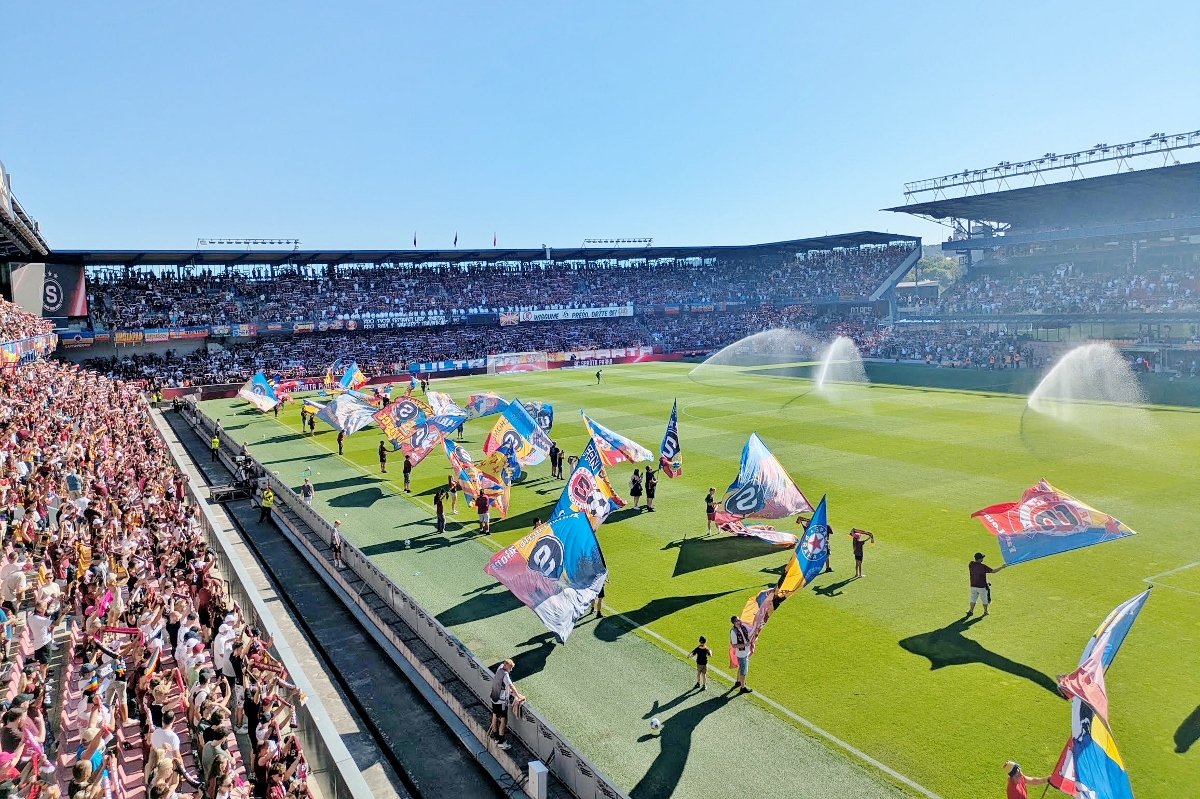
After the low-key charm of Vyšehrad earlier in the day, the late Saturday afternoon atmosphere around Sparta Prague’s stadium felt like another world. Sparta and Slavia are the twin giants of Czech football, and the scale of Sparta’s support was obvious long before reaching the ground: trams packed tight, pubs spilling over with maroon-clad fans, and coaches arriving from far beyond the capital. With 54 major domestic honours, Sparta remain by some distance the most successful club in Czech football history.
By 4 pm, the temperature was still hovering around 35 degrees at the Letná Stadium, Sparta’s long-time home above the city. It is an unusual setting. On three sides, a broad park slopes gradually down towards the River Vltava and the castle; on the fourth, old-fashioned apartment blocks press close to the stadium’s edge.
Inside, the ground shows its age. The concourses are exposed to the elements, which was no hardship on such a hot day but must be far less appealing in rain or cold. Queues moved slowly through cramped service areas, and several food and drink outlets accepted only card payments, still relatively unusual in the Czech Republic. The machines repeatedly failed, adding to the delays. As I tried to place what it reminded me of, the answer eventually came: QPR’s Loftus Road, with its compact, four-sided, slightly worn concrete character.
The open, terrace-like concourses did at least offer an excellent view of supporters streaming in. They also revealed the more intimidating side of the occasion: heavily equipped riot police lined up below, a sharp reminder of how far this was from the non-league atmosphere at Dukla earlier in the trip.
Sparta Prague v Teplice
Once through to the seats, the ground was close to capacity. The visiting Teplice supporters, squeezed into the corner opposite my block, made themselves heard throughout. At the other end, Sparta’s Ultras — whose reputation has long carried an ugly right-wing edge — displayed a strong selection of banners and answered the away fans noisily.
The pre-match rituals were theatrical without quite feeling coherent. The club anthem was preceded by banner-waving on the pitch and vigorous scarf-twirling in the stands, yet the players themselves seemed to emerge almost as an afterthought.
As the game kicked off, around 200 Ultras entered the upper tier behind the goal, dressed menacingly in white boiler suits. It looked like some form of protest, and they did little to soften their image. Fireworks were set off, filling the pitch and stands with smoke — impressive visually, though less welcome in the oppressive heat.
The match itself was lively from the start, with both sides prepared to attack. Teplice initially looked in danger of being swept aside and fell behind after nine minutes, but they steadied themselves and began creating chances of their own. Their equaliser, a superb long-range strike after a cleared corner, was fully deserved. On the right flank, pacy Ecuadorian winger John Mercado caused Teplice repeated problems, though the visitors could also make a reasonable case for having had a penalty.
Sparta take control
Sparta gradually regained control. Scottish midfielder Alan Irvine drove in a powerful shot from outside the box, and, slightly against the run of play, Costa Rican Josimir Alcocer converted from a deep cross to give the home side a flattering cushion at the break.
The second half belonged largely to Sparta. Alcocer’s brilliant solo second goal gave the scoreline a flourish, while the loudest reaction of the half came when on-loan former Slavia winger Matěj Jurásek was introduced. Every touch was booed, and the coordinated chants left little doubt that he was an unpopular signing.
Teplice offered little after the interval, aside from one close-range effort brilliantly pushed away by Sparta goalkeeper Surovčík. By the final whistle, I was as grateful for the chance to escape the direct sun as I was for the contest to be over. The protests against Jurásek continued after the whistle and, reportedly, required intervention from Sparta players and officials.
As an afternoon’s football, it had plenty to recommend it: goals, noise, colour and a stadium full enough to give the occasion weight. Yet Sparta themselves were harder to embrace. The Ultras’ choreography was impossible to ignore, but beneath the spectacle was an edge that felt less like passion than something more troubling. Having visited Prague’s old Jewish quarter the previous day, I found those far-right undertones especially jarring in a city still visibly marked by the history of Nazi occupation.
Letná, too, falls strangely short of the club it houses. The disconnected main stand, exposed concourses and dated facilities give parts of the ground a temporary, almost unfinished quality. For a club with Sparta’s history, support and regular appearances on the European stage, the overall impression is oddly underwhelming memorable, certainly, but not especially likeable.

CLICK HERE TO DONATE TO OUR CROWDFUNDER
HELP US BECOME STRONGER SO THAT WE CAN CONTINUE TO DELIVER POWERFUL CITIZEN JOURNALISM!




