Before around 2010, the idea that Dulwich Hamlet were in any way remarkable would have seemed laughable. Granted, their pink and blue kit stood out, with colours borrowed from Dulwich College and Westminster School, the alma maters of the Lloyd brothers, among the club’s most significant early players. Beyond that, however, what made them special?
Founded in 1893, Hamlet enjoyed a reasonably successful first few decades. They won Isthmian League titles during the 1920s and 1930s and made occasional appearances in the Amateur Cup final. Their Champion Hill ground, located on Dog Kennel Hill, was a classic old-fashioned non-league stadium, complete with a large, covered terrace and a distinctive pitched-roof stand.
Their place in the non-league pantheon, however, was no higher than that of numerous other historic south London clubs such as Bromley, Sutton United and Cray Wanderers. Local rivals Wimbledon entirely eclipsed them, winning election to the Football League in 1977 before famously reaching the top flight and lifting the FA Cup in 1988.
Although Hamlet maintained a loyal following, average crowds hovered between 300 and 400, dropping even lower for midweek fixtures. They remained a sleepy suburban non-league club, experiencing the occasional promotion and only briefly attracting national attention when the original Champion Hill was demolished in 1991. Temporarily exiled to Tooting, they eventually returned to a much smaller and less impressive ground built beside a Sainsbury’s on the edge of the original site.
To understand why this otherwise unremarkable story has become one of English football’s most intriguing cult-club tales, it is necessary to visit Champion Hill today.
On an overcast Saturday in September, the second qualifying round of the FA Cup brought a south London derby against Welling United. Dulwich itself remains an unusual corner of a city once dismissively regarded as unfashionable and the scourge of taxi drivers. Dominating the area is the vast Victorian Gothic edifice of Dulwich College, which was hosting dozens of sporting fixtures as I walked past.
Dulwich College
Rugby matches and the occasional football game unfolded across immaculate pitches. Shrill whistles cut through the air while parents in pink school scarves and quilted gilets watched from the touchlines. The sprawling 28-hectare campus, once attended by figures as varied as P. G. Wodehouse, Ernest Shackleton and celebrity racist Nigel Farage, remains a monument to Britain’s educational class system. With fees starting at more than £32,000 per year and carefully controlled access, the hoi polloi remain at a safe distance from its sacred halls of learning.
Whether the self-styled man of the people Farage ever visited Dulwich Hamlet is unrecorded. Around the corner, however, outside the Dulwich Picture Gallery, the sort of middle-class families traditionally associated with rugby union are waiting at bus stops with children dressed in garish pink and blue. It is an early indication of just how far the club has drifted from the conventional non-league mould.
As buses unload passengers at the evocatively named Goose Green, most are wearing Hamlet colours. So too are many of the drinkers spilling from the East Dulwich Tavern onto the pavement. The demographic offers another clue as to the club’s rise. Moustachioed men in their twenties, dressed in cropped trousers and ill-fitting woollen hats, chat to craft-beer-drinking girlfriends in a variety of accents.
A football team and cultural symbol
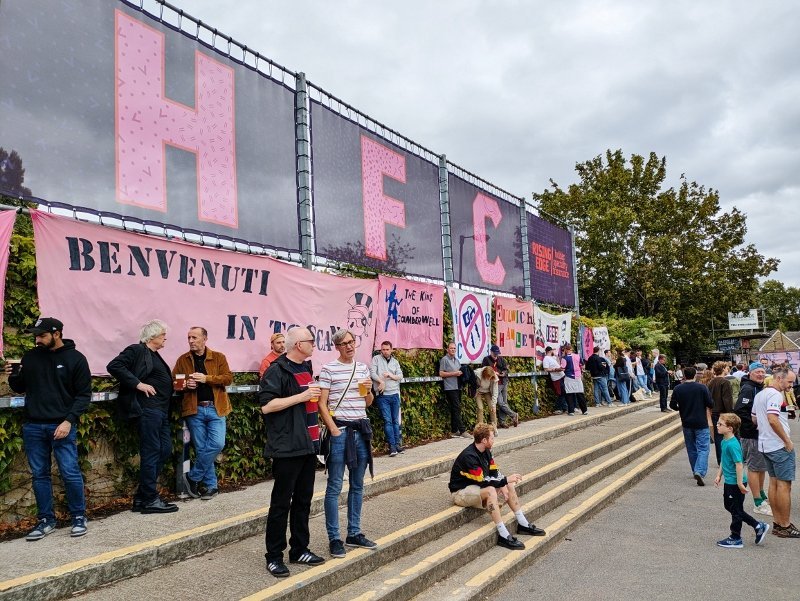
Since the mid-2010s, Hamlet have attracted a largely young professional following as Peckham and the less salubrious districts surrounding Dulwich have undergone rapid gentrification. The area has become a magnet for newcomers to London, many of whom have embraced the club as both a football team and a cultural symbol.
This influx has helped create supporters’ groups such as The Rabble, which champions causes ranging from refugee rights and anti-racism to LGBT inclusion, while also expressing solidarity with Palestine. The club has forged links with the German side Altona 93 and become shorthand for a semi-serious form of ultra culture that remains rare in England. If Farage were ever to revisit the area, he would likely find little sympathy among the four-figure crowds that now make Dulwich one of the best-supported clubs outside the Football League.
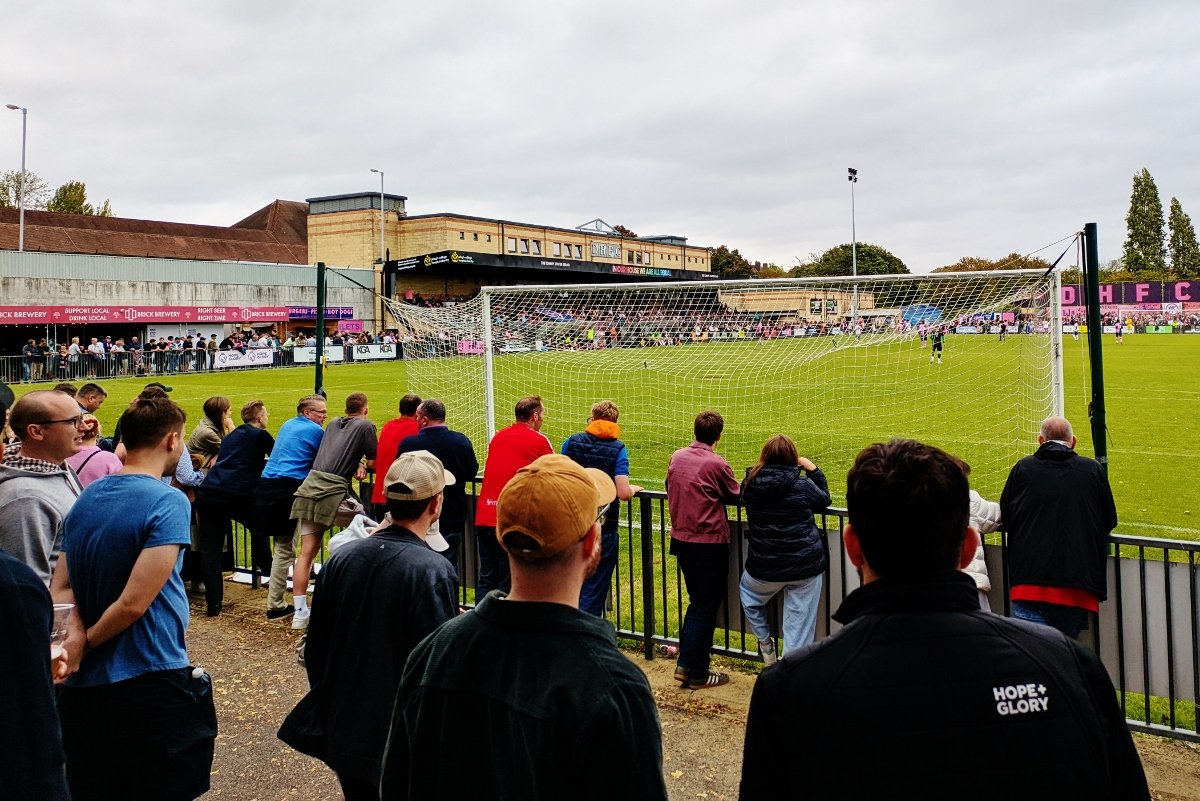
The phenomenon has inspired both admiration and resentment among more traditional non-league supporters and Welling United’s travelling fans provide a glimpse of the latter. They fill one end of a ground that has become visibly too small for the crowds it now attracts, a victim of a popularity few could have imagined twenty years ago. Around the pitch, banners promote everything from anti-racism campaigns to refugee solidarity. Yet as kick-off approaches, the political messaging feels almost secondary to the wider social atmosphere enveloping the stadium.
For all the colour and activity around Champion Hill, the match begins in surprisingly subdued fashion. The usual crackle of anticipation that precedes an FA Cup tie never quite materialises. Even the normally vocal Welling support sounds restrained. Pints flow steadily from the bars while clusters of supporters continue conversations seemingly unrelated to events on the pitch.
Dulwich scarves and hijabs
What immediately stands out is how different the crowd looks from that of a typical non-league ground. Buggies and dogs are everywhere. Women and ethnic minorities are represented in far greater numbers than is usually the case in English football’s lower reaches. One group sporting Dulwich scarves and hijabs chat animatedly near the touchline. The club has undeniably succeeded in attracting people who might otherwise never have attended a football match.
The trade-off is that the football often appears to be competing with the social occasion rather than driving it. Groups of twenty-somethings watch intermittently, turning back towards friends between passages of play as though gathered in a particularly lively pub garden. In classic non-league fashion, supporters switch ends at half-time and a sizeable section of Hamlet fans congregate behind the goal. They generate some noise, but there remains a curious absence of the tribal edge that normally gives knockout football its intensity. Clever passages of play draw polite applause rather than roars of approval, while mistakes are met with shrugs rather than groans.
On the pitch, however, Dulwich are far more convincing than the atmosphere surrounding them. Physical, committed and direct, they gradually overpower a strangely passive Welling side. By full-time, a 4-1 victory scarcely flatters the hosts. The travelling Wings supporters can at least console themselves with a share of a crowd exceeding 2,000 before turning their attention to next weekend’s FA Trophy commitments.
For Dulwich, progress in the competition means another welcome injection of revenue, money that will help support plans for a new stadium on the site of the original Champion Hill ground. Few clubs at this level generate such interest, and fewer still provoke such debate about what a football club should be.
There is much to admire about this club. They have created a safe, inclusive environment where people of all ages and backgrounds can watch affordable football and participate in a genuine community hub. Their crowds are remarkable, and their social activism has helped forge a distinct identity. Yet there is a trade-off. The atmosphere can feel muted, and there are moments when parts of the new support appear more attached to the idea of Dulwich Hamlet than to the football itself.
Their cult status, however, is beyond dispute.

CLICK HERE TO DONATE TO OUR CROWDFUNDER
HELP US BECOME STRONGER SO THAT WE CAN CONTINUE TO DELIVER POWERFUL CITIZEN JOURNALISM!