While riding across the Herefordshire countryside in the 1920s, amateur archaeologist and author of “The Old Straight Track”, Alfred Watkins, had a sudden vision that every landmark he saw was linked by straight lines that he called ‘leys’. He believed they were a pre-historic network, criss-crossing the British landscape.
In the 1960s, new age ‘esotericist’ and counter-culture icon, John Michell, took up Watkins’ ideas, writing that these ‘ley lines’ were a manifestation of hidden energies intersecting the globe, a ‘map of ancient and sacred power’. He argued that one could see, in this veiled landscape of Britain, traces of an ancient civilisation which was governed by sacred geometry and that, unbeknownst to us, these invisible energy lines held the world together.
Sometimes, when I’m out ‘trig-hunting’ and doubting now that the world will hold together, I can imagine I have stepped into a new variant of the leylines ecosphere, something akin to a secret society, this one facilitated by adepts just as committed as those who still follow Watkins and Michell.
Holding the world together
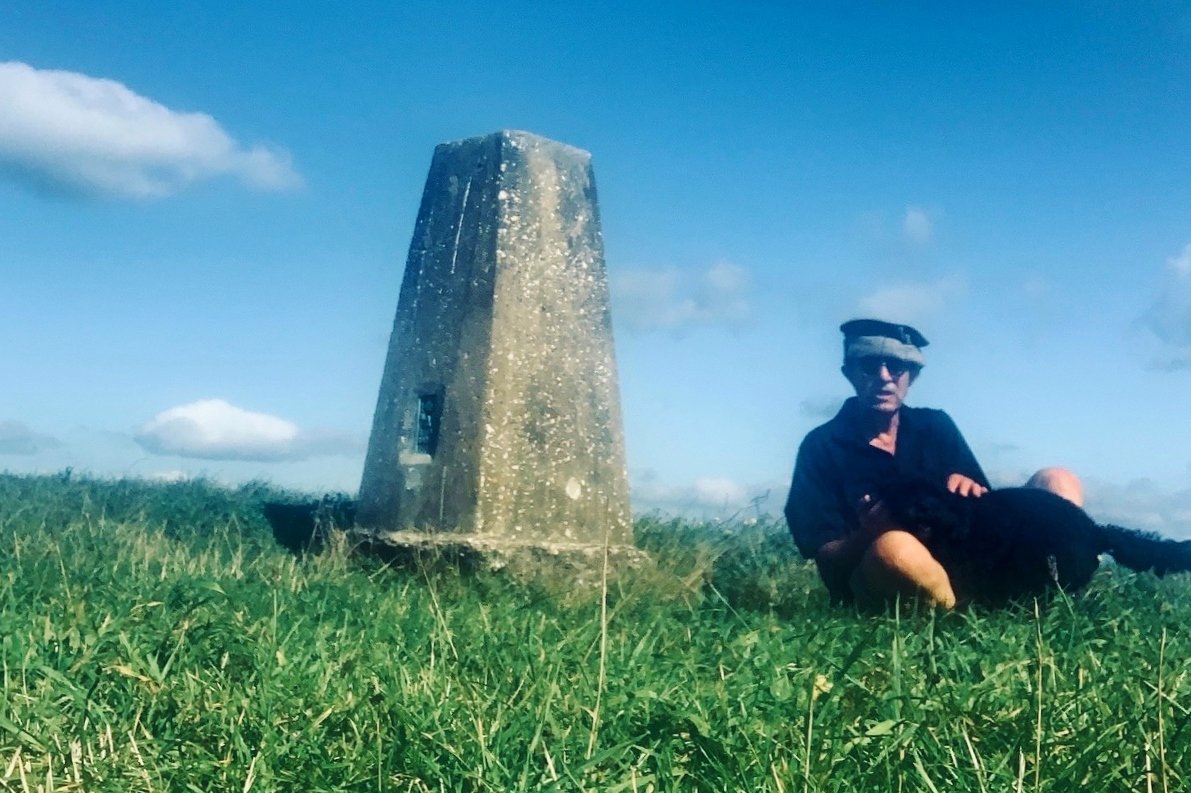
I’ve written already about how I started chasing trig pillars. It was during Covid and I was walking in the Downs, randomly collecting photographs of myself at the local trig pillars, or ‘triangulation points’ as they are properly known, concrete blocks erected by the Ordnance Survey to undertake the accurate mapping of the nation.
It came to me, as a ‘Covid project’, to visit all the trigs in Sussex,136 in all. I completed the quest in mid 2022 with photos of myself at every pillar, sometimes with friends and family. Some of the trigs were a little testing but nothing genuinely difficult. I think of those walks as my diary of the plague years.
Once I’d completed the 136, I told myself that, like an art project, this had a beginning and an end and it was time to stop. I could see people thought I was becoming a little obsessive. My reading had progressed from Rebecca Solnit, and Dave Bangs to Robert McFarlane’s account of his meeting with witches at Chanctonbury Ring. I was babbling about ‘psycho-geography’ way too often. Things were getting weird.
Long story short, I was unable to stop. It was something about the way these paths were formed and where they came from and the stories that are embedded in them. People have been walking these paths, don’t forget, for ten thousand years, since the ice retreated.
The numbers keep growing
Notching up additional pillars is not that easy for me because they’re all outside Sussex, by definition at least 50 miles away. But I slowly gestated the idea that I would not leave the county in the car without doing at least one trig. I would also try to get friends to accompany me so that I could make some kind of record of my friendships at this time in my life.
As the numbers grew, the scale of this enterprise began to bear in on me. The total number of surviving British pillars is reckoned to be 6194. Only one person – Rob Woodall – has ever seen them all.
Imagine what that involves. If you managed an average of three a day (and that requires not just walking to the pillar but figuring out where it is and sometimes plotting with maps and GPS a circuitous route in, then actually finding it, sometimes in thick bush) it would take 2000 days, or close to six years. Again, by definition, the more pillars you do, the further and further away the unvisited ones get from your home base. To do them all, you surely have to permanently leave home. Presumably Rob had a few breaks because it took him 14 years. Still, he must’ve had a lot of time in his camper van.
Good days on the hill
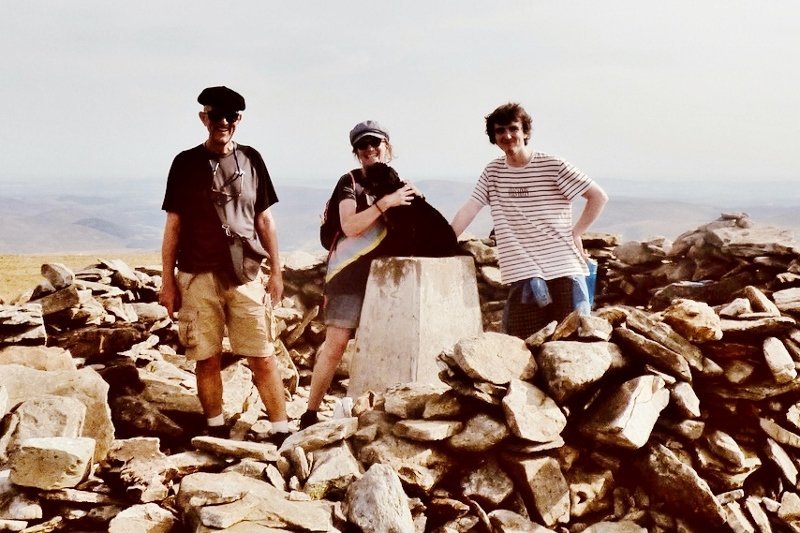
My efforts were much more modest than Rob’s but early highlights of my ‘second project’ included Driesh in Scotland in summer 2021. This is one of the easier ‘Munros’ (and that’s another geek world). It’s inland from Fortrose. You drive west to the end of the valley then keep walking. I had wondered whether I had any more Munros left in me but my efforts in the South Downs had improved my fitness a bit and I didn’t have much problem.
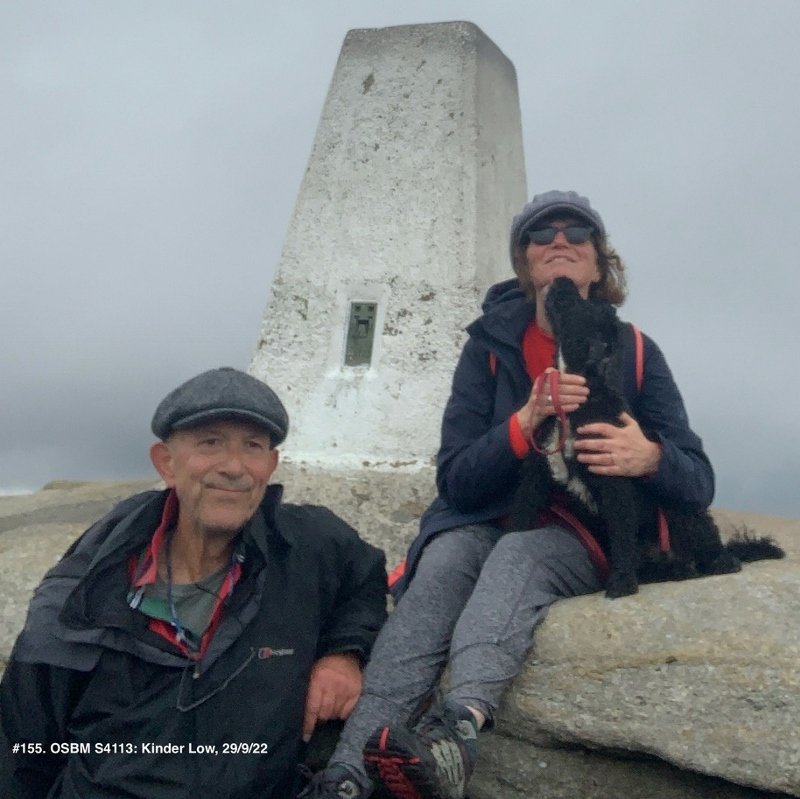
And then there was Kinder Low in the Peak district, an historic spot. There was hardly anyone around; certainly no trespassers. That was ‘a good day on the hill’.
I was in St Ives in the summer of 2023 and got a few good ones there, including Zennor, way out to the west. Then, a few months later I was doing family history research on the Isle of Man and grabbed a few more: one day, in perfect weather we just parked on the road in the centre of the island and ran up Snaefell. No bother.
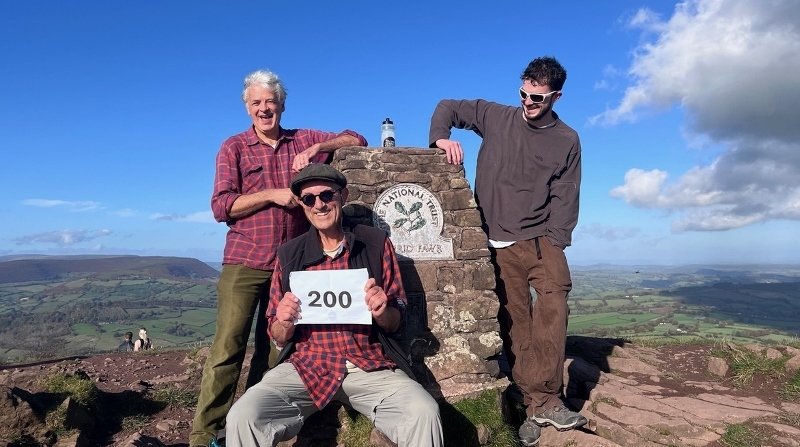
Since then, I have managed to keep nudging the numbers up. I got to my 200th – Skirrid Fawr – in October 2024 on a delightful long weekend in the Brecon Beacons. I made my little sign in advance, pulled over in the car park to the south and spent the whole day walking the high-level contour, a lovely afternoon in the autumnal warmth.
An invisible web of my own
As I write, the map of my endeavours now stretches from Skye to Somerset, to Cornwall, to the top of Ben Macdui, to East London, to the Isle of Man to North Berwick, Manchester, Fife, the Moray coast, and much more. In the next few weeks I’m hoping to grab a few in Argyll.
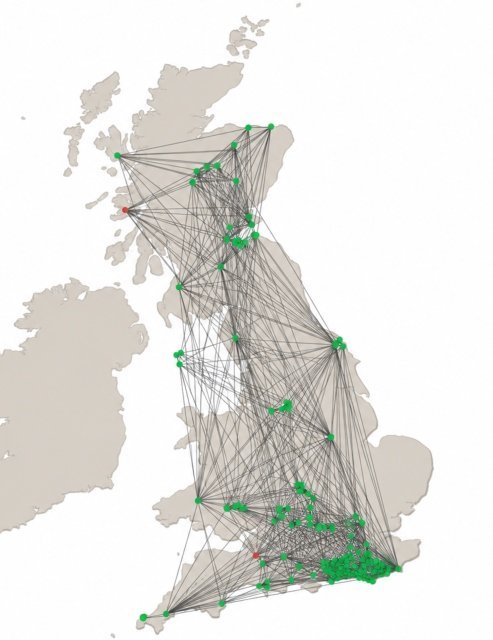
Strangely, my chart – I think of it as a map in search of a territory – is starting to take on an uncanny resemblance to the arcane scribblings of Watkins and Michel. I’ve simply recorded the pillars and joined the dots. But I find myself wondering sometimes exactly what this is. Is it just a simple record of a lost technology, capturing in its web a maze of ancient hill forts, wartime gun emplacements, derelict radio mast sites, civil defence bunkers and the like, or is it something more?
As he tried to reach deeper into his view of the sacred landscapes of Britain, John Michell plotted what he called ‘geomancy schemata’, early psycho-geography. Never mind ley lines, I realise I have stumbled into my own invisible web. All I can say is that, as the connections continue to grow, they give me some comfort in these dark times: something genuine to hold on to as the various official institutions that are meant to be holding us together seem to be falling apart.
In the final episode to follow: Can I get to 300?

CLICK HERE TO DONATE TO OUR CROWDFUNDER
HELP US BECOME STRONGER SO THAT WE CAN CONTINUE TO DELIVER POWERFUL CITIZEN JOURNALISM!