


You can take the girl out of Padstow, but not Padstow out of the girl, as I discovered recently when listening to a recording of the ‘Obby ‘Oss May Day celebrations and was unexpectedly ambushed by a tidal wave of nostalgia.
I grew up near Padstow – “Padsta” as it’s known to locals – historically Petrocstow, the town of St Petroc or Patrick – and more recently, mortifyingly, “Padstein”, reflecting the Rick Stein take-over of the town. The May Day celebrations were the highlight of the year. Even many decades ago the town was awash with visitors on 1 May and I suspect that the crowds are almost unendurable now that Padstow has evolved from a small fishing town on the north coast of Cornwall to the gourmet centre of the West Country.
In the 1960s and 70s it was a magical place to be young. Although most people still earned their living from farming and fishing, tourism was growing rapidly, and summer seasonal jobs were easy to find. Our pack of local teenagers referred scornfully to summer visitors as “grockles” or “emmets” but were only too pleased to flirt with the wealthy public-school kids who sailed across the Camel Estuary from Rock or caught the regular ferry to spend the day in Padstow.
Sometimes scuffles would break out between locals and visitors who had been drinking in the harbourside pubs all evening. I was once thrown into the harbour by a drunken youth outraged by the slogan on my tee-shirt – “UDI for Cornwall” – a Universal Declaration of Independence that I thought highly sophisticated, unaware of the darker connections with Ian Smith, and his breakaway regime in Rhodesia – now Zimbabwe.
Padstow is a different place when the tourists leave
In the winter, when the crowds of tourists left, the town closed in upon itself. Storms battering the beaches and high cliffs of the north Cornish coast were a reminder of the high cost that local fishermen often paid for their way of life. The local RNLI office on the harbourside had a map of the coast displayed in its window, covered with multiple coloured pins, every one representing a wreck. Navigating the shifting sands and powerful currents of the Camel Estuary remained challenging even for the most experienced sailors and fishermen, and many ships had foundered on the Doom Bar at the entrance to Padstow harbour in the past.
Local legend had it that the Doom Bar was inflicted on the town by a beautiful mermaid whose advances were spurned by a local fisherman. Furious, she cursed the town and vowed that it should never prosper. Overnight, the sandy hump of the Doom Bar appeared, blocking the large fishing fleets that had previously visited Padstow with their catch, and the prosperity of the town declined. The mermaid lives on in a carving on the end of an ancient wooden pew in St Petroc’s church.
With the first signs of spring came excited anticipation of May Day, the ritual so unique to the town, and so dear to Padstownians that even in the trenches of the First World War, whenever one Padstow man met another on 1 May, they celebrated by singing the May Day song together.

Past and present history
The origins of the Padstow ‘Obby ‘Oss are obscure. The first recorded mention of the celebrations dates back to the early 19th century, but many claim that the figure of the ‘Oss and his “Teazer” have links to ancient pagan fertility rites. Legend had it that if a young Padstow maiden found herself captured under the pitch-black canopy of the dancing ‘Oss she would be with child within the year.
More recent history is certainly reflected in some of the verses of the Padstow May Day song, with a poignant reminder of the losses that war has inflicted on the youth of the town over the centuries:
“Where are the young men that here now should dance,
For summer is acome unto day,
Some they are in England some they are in France,
In the merry morning of May.”
But many of the references are wonderfully obscure. Who, I always wondered, was Aunt Ursula Birdhood, and what had happened to her old ewe that they both should be embedded in the slow dying verse of the May Day song?
“O! where is St. George,
O!, where is he O,
He is out in his long boat on the salt sea O.
Up flies the kite and down falls the lark O.
Aunt Ursula Birdhood she had an old ewe
And she died in her own Park O”.
The beat of the drums echo down the years
Padstow May Day actually begins on the last hour of the previous day, when groups of singers collect underneath the windows of local worthies to sing the Night Song, soliciting beer and money:
“And give to us a cup of ale the merrier we shall sing,
In the merry morning of May.”
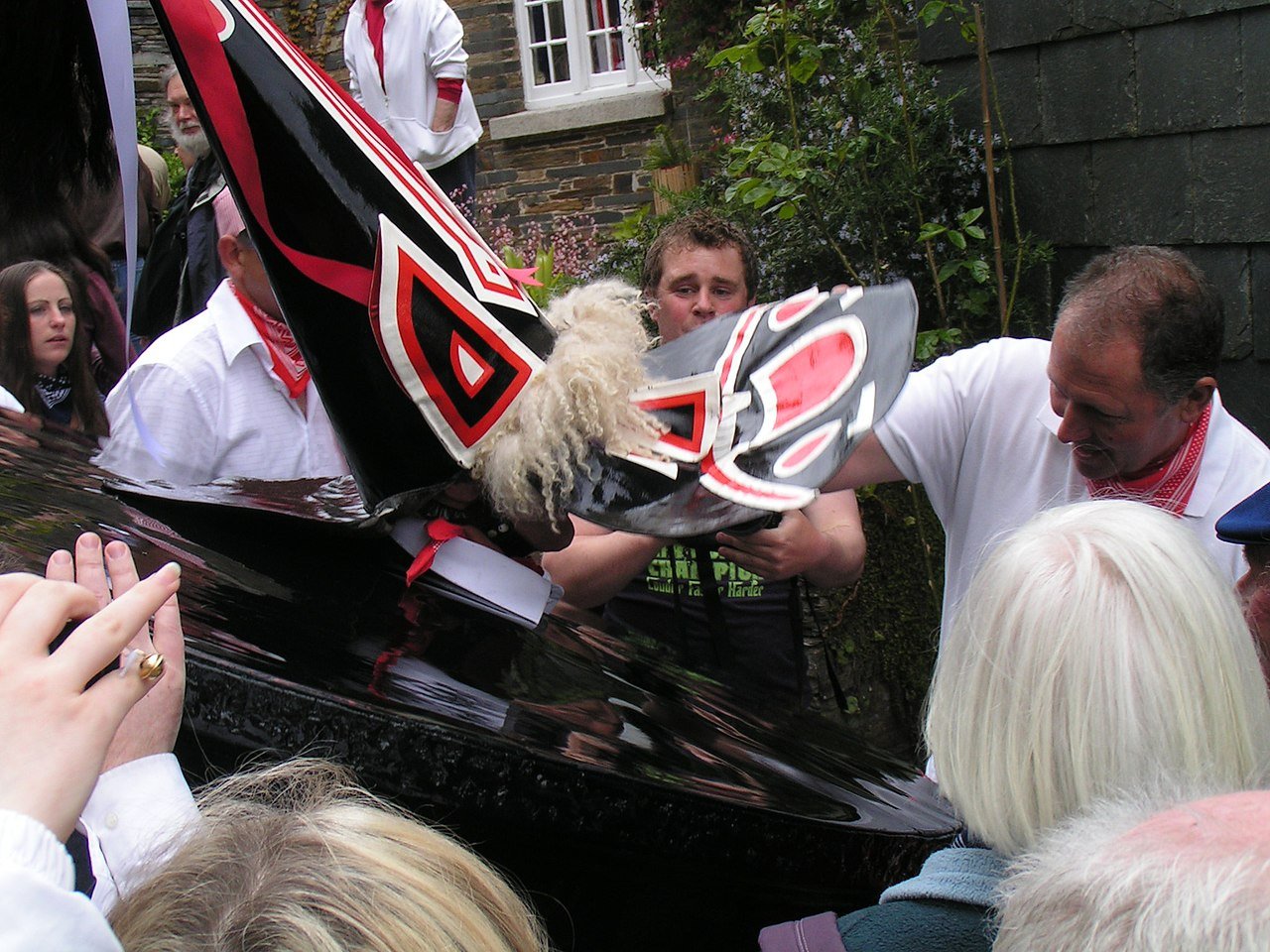
Nomis Elaws on Wikimedia Commons.
On the morning of 1 May, the full processions issue forth from their respective homes, led by bands of accordions and drums, with the ‘Obby ‘Oss and his Teazer dancing, wheeling and circling amongst them. The Victorians, outraged by the wildness and drunkenness of the celebrations, established a rival to the original red ‘Oss in the form of a Temperance Movement blue ‘Oss, and to this day the two rivals still dance the streets of Padstow and only meet at the maypole at the end of the day.
And so, with the beat of the drums and the shouts of the crowd, “’Oss, ‘Oss, wee ‘Oss!” echoing from past Padstow celebrations, I wish you a very happy May Day in 2024.
“Now fare you well and bid you all good cheer,
For summer is acome unto day,
We call no more unto your house before another year,
In the merry morning of May.”
The Blue ‘Oss Emerges on May Day morning: https://www.youtube.com/watch?v=aUVi4a-K-0I
“‘Oss, ‘Oss, Wee ‘Oss”: https://youtu.be/7Yol4Y7rdew
The Blue ‘Oss Farewell: https://youtu.be/LIGpMjecopY

CLICK HERE TO DONATE TO OUR CROWDFUNDER
HELP US BECOME STRONGER SO THAT WE CAN CONTINUE TO DELIVER POWERFUL CITIZEN JOURNALISM!






