


We are into the New Year and right away we are on a rollercoaster. I’m already in need of a break. What better time to go and check out a few more local restaurants as they take further steps on ‘the sustainability journey’.
I’ve written in these pages before about the Sustainability Toolkit and how some Brighton restaurants are adjusting to a more environmentally sustainable model. 50 plus establishments have joined the scheme with more engaging all the time. Regular trainings are underway with a mixture of venues and suppliers.
At the last one, there was lively and creative discussion around what makes a ‘Nature Friendly Plate’. Lots of simple ideas were in play and I especially liked: (i) Adding clear notes to menus saying where ingredients come from; (ii) Using QR codes to link to supplier stories; (iii) Talking to diners about the food; (iv) Using local, seasonal and fresh ingredients; (v) Using less and better animal protein.
All these restaurants are operating in a difficult environment right now with the cost-of-living crisis bearing down on them and it was interesting to pick up a degree of anxiety about getting accused of being ‘woke’ and/or part of the so-called ‘anti-meat brigade’. Some participants were wary of sticking their heads above the parapet.
This got me thinking about the restaurants that do stick their head above the parapet and, in the spirit of the Veganuary campaign, now with 26 million people taking part, I thought I would check one out.
Where better to look than at the vegan pub on my doorstep?
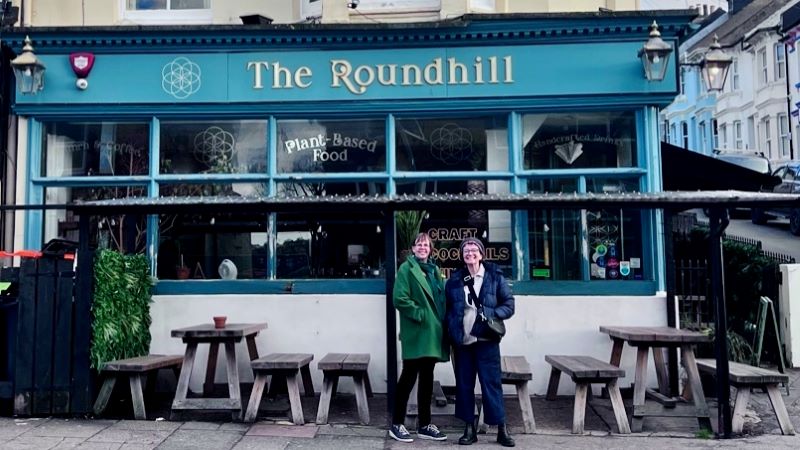
The Roundhill pub, on Ditchling Road
Short version: The Roundhill Pub is a Sustainability Champion. Presumably they get a lot of points on the scoreboard just by not importing steaks from Argentina but they also source their ingredients and alcohol locally, have a pro-active waste management system and recycle everything they physically can.
When I visited, the food was good and the staff were friendly and not at all threatened by this old geezer with his notebook and roll ups and pen behind his ear. Full marks to their model and good luck to them in the brutal environment they are trying to compete in.
Long version: After a couple of visits I’ve fallen down a rabbit hole and I’m struggling to get out. It all started with their new menu, only rolled out this month. I had to confess to the waitress that I was confused by the menu with its many references to meat products, so much comparison with the stuff vegans wanted to leave behind. I felt a bit awkward bringing this up but with items like Chik’n Wings and Beef Patty and Sticky Korean BBQ, there seems an awful lot of this language.
In my last article I stumbled on the phenomenon of Greenhushing – the practice where companies deliberately under-report information about their environmental efforts, choosing to stay silent rather than be accused of being too ‘woke’. Now we have some vegan restaurants deliberately using meat-derived language rather than inventing their own terms. I knew that this was not a new thing but I hadn’t realised how much thought – cultural, commercial, and psychological – has gone into this. It’s very well studied by journalists, food-writers, and academics.

Using familiar language is welcoming
The debate is animated. Some in the vegan culture are fine with the practice if it does business, others uncomfortable. The latter say using meat-derived language reinforces meat as the “norm”, keeps vegan food defined by what it isn’t and perpetuates dependence on animal-centric menu framing.
Many vegan restaurants are not aimed only at committed vegans of course: they are trying to engage with flexitarians, curious omnivores, and people eating with mixed-diet groups. Using familiar language reassures these diners that the food will be recognisable and satisfying, not alien or austere.
I’m not sure what I think. I probably feel more sympathetic to so-called ‘ingredient-led framing’ where the dish is not trying to stand in for meat at all and where dishes are named for the key ingredients or preparations. There, plants are treated as the primary source, not secondary. The problem with this of course is that some diners are deterred and probably the meal is more expensive.
I said this was a rabbit hole and it doesn’t end here. I tried to do a close reading of the whole Roundhill menu and this threw up a number of issues not just the explicit meat mimicry. Note also how the tone (‘loaded fries’, ‘melted cheez’, ‘smothered in our house buffalo sauce’) all align with indulgence and abundance, not virtue! There is no mention of what the patty is made from.
What is a proper meal anyway?
The philosophers are fascinating on this and there is a vast literature. Roland Barthes, the post-structuralist, wrote Towards a Psychosociology of Contemporary Food Consumption way back in 1961. Even then he is describing terms like ‘burgers’ and ‘wings’ not as neutral descriptors but as ‘semiotic anchors’.
Mary Douglas in Deciphering a Meal (1972) writes about how desserts are culturally ‘less serious’, and look how the Roundhill menu changes when it gets to the sweet stuff. There is no confusion here because, unlike with savoury dishes which have to struggle against a meat-centred idea of what “a proper meal” is, everyone understands that there is no meat in a pudding and so there is no risk of confusing the unwary. And sweetness always prevails.
While plant-based main dishes often carry unspoken suggestions of moral choice, desserts are culturally coded as indulgent and infantile. They are allowed to just be nice, without any ideological scaffolding.
I said it was a rabbit hole. I’ve got to climb out now and get back to my supper. I had the Big Cluckowski. I couldn’t even guess what kind of moral choice that suggested but it was quite yummy. When I asked, I was told it was made from wheat extract. I had a low alcohol IPA to wash it down.
There was no mention of semiotics (just in case the anti-woke police are watching).

CLICK HERE TO DONATE TO OUR CROWDFUNDER
HELP US BECOME STRONGER SO THAT WE CAN CONTINUE TO DELIVER POWERFUL CITIZEN JOURNALISM!






