After shaky periods in the past, the immediate future of the Newhaven-Dieppe link was secured in 2022, with the DFDS ferry service being extended until 2027.
The previous deal had been set to expire at the end of 2022. Only one bid was received. As reported by the BBC, the link across the channel was secured with an annual subsidy of €20 million (£15.3 million) from the French government. The Danish company, DFDS (Det Forenede Dampskibs-Selskab) which won the new contract in 2022, has been running the service since 2012. DFDS Seaways is the only ferry company operating the Newhaven to Dieppe ferry crossing. They use two ships for the route, the Côte d’Albâtre and the Seven Sisters, built in 2005 and 2006 and branded as Transmanche Ferries.
The Dieppe-Newhaven line has a key role in territorial attractiveness
In 2027, the French regional government (Département de la Seine-Maritime) will again decide on whether they should continue funding the ferry connection. The Syndicat Mixte de Promotion de l’Activité Transmanche (SMPAT) will no doubt be involved. SMPAT was created in October 2000 to relaunch the maritime link between Dieppe and Newhaven following the withdrawal of private operators. Clearly the French local public stakeholders are keen to support the crossing, stating on their website:
“The benefits of the connection characterised by local consumption made in particular by British people staying or in transit, the use of local suppliers as part of the operation of the line, the direct and indirect jobs generated, the support for the two ports served, support for the local transport and logistics sector, the contribution to international trade, or even the contribution to the bicycle sector through the feasibility of the Avenue Verte London-Paris, give the Dieppe-Newhaven line a key role in territorial attractiveness.”
But sadly the route isn’t so popular as it would seem with British tourists. The graph below shows the lack of growth in passenger numbers over the last 10 years. Of course, in the peak summer holiday months of July and August the ferries are running at near capacity, but that leaves most of the year when it’s probably running at much lower capacity than it could. There is little or no advertising of the service on the UK mainland and sustainable travel connections are poor on both sides of the channel.
In 2012, passenger numbers were 267,000. After this they peaked at 399,000 in 2015, falling after the Brexit vote in 2016 and reaching a low point in 2021 at 95,000 due to Covid. In 2022, numbers recovered to 372,000.
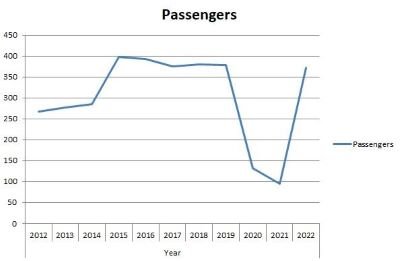
Figures taken from the data produced by the Department for Transport.
Lack of sustainable travel connection in Normandy, France
Currently foot passengers arriving at the port of Dieppe have a 35-40 minute walk of some 2.3 km to the Gare de Dieppe (the railway station). This must surely put people off travelling to France via Newhaven-Dieppe. A simple solution would be to use the existing transfer bus (which is operated within the port to bring passages from the ferry to the customs barrier) to take people onward to the Gare de Dieppe and the centre ville. For those with baggage it’s an arduous walk especially in the rain. There is the possibility of a taxi, but availability seems to be limited, especially early morning and late at night. However, there may be some good news in 2024. It is rumoured that a 10-seater bus could be available from May 2024 for transfers between the port and the railway station. We will have to wait and see if this actually materialises.

Foot passengers travelling onwards by train are also confronted with making a change at Rouen as there is no longer a direct service from Dieppe to Paris. The 200 km journey normally takes over three hours.

Lack of sustainable travel connection in Sussex, UK
Thankfully in Newhaven there is only a short walk from the town railway station to the ferry terminal. However, you could still get very wet in bad weather. It’s a pity as in past times a direct rail connection from London Victoria stopped at Newhaven Harbour station, allowing direct access across a covered bridge to the ship. It’s also a pity that nothing is made of the frequent bus connections along the south coast from Brighton and Eastbourne, passing by the ferry port entrance!
The loss of the direct train from London Victoria is surely a discouragement for those wishing to travel sustainably on the UK side of the channel. Now one has to change at Lewes and possibly at Haywards Heath. Nevertheless, it’s puzzling to understand why the railway authorities in England don’t promote this route for foot passengers: it would bring extra revenue for the railway services and relieve the pressure on travel via the overcrowded Eurostar trains.
Why is Newhaven important?
Along the southeast coast in Kent, Sussex and Hampshire there are now only four methods for crossing the Channel especially for tourists. These include Dover, Newhaven and Portsmouth ferries, and the rail link through the Channel Tunnel. If the Newhaven service is lost, there will be extra pressure on the Dover-Calais and Portsmouth routes and on the Channel Tunnel and Eurostar rail connection.