


The headline news as this article was being written is that, for the first time, global warming in 2023 has exceeded 1.5C across a whole year. If we are to stay within the longer-term 1.5C COP ceiling for world temperature increase, the planet needs, between now and 2050, to limit global carbon emissions to 286 Gt of CO2. This is equivalent to each individual alive in the world over this period being limited to a lifetime allowance of some 100 tons of CO2, or, in ball-park terms (setting aside distributional and equity issues), 1.1 tons of CO2 per annum per person.
The problem: global per capita emissions are currently running much higher than this. Local data from The Place-Based Carbon Calculator gives a total emissions figure for Brighton and Hove of some 7.8 tons per person per annum – seven times our putative allowance.
To effectively reduce emissions, we need to know where they come from and which sectors contribute the most. Electricity and heat production are the largest sources, followed by transport, manufacturing, construction and agriculture. The Food System (what we eat; how we grow, ship, sell and cook it; and how we dispose of it) cuts across all these sectors, however, and the UK’s Committee on Climate Change, identifies it as accounting for over one third of all UK CO2 emissions. International research supports this: in 2015, food-system emissions world-wide were estimated at 34 per cent of total global GHG (greenhouse gas) emissions.
The biggest contributor of emissions
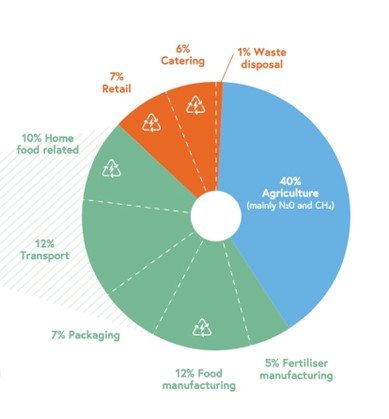
The UK National Food Strategy 2021 helps us look inside the box of the entire food system. As Fig 1 shows, the biggest emitter is on-farm production (which includes methane from ruminants), but transport, packaging and processing together account for more than another 30 per cent.
As citizens, what can we do?
If the UK is to reach its net zero target, the heavy lifting must come from policy changes, probably involving carbon pricing. But even as politicians argue about how they might do that, citizens can make a substantial contribution themselves. A new Brighton-based think tank, Climate:Change, is creating a space to explore the challenges and the solutions as to what realistically can be done locally.
Of course, a lot of effort has been going on for a long time now, but Climate:Change is trying to push things up another gear. As the clock ticks and the temperature gauge rises, there is a renewed sense of urgency.
Transformation will have to come through behaviour change. Perhaps pressure can be productively applied to local policymakers, but Brighton and Hove City Council has very little authority or discretionary funds. As we go to press, it is trying to avoid bankruptcy, after years of being throttled by central government. Unfortunately, climate change is not a statutory function for councils and so when budgets have to be cut, climate change measures will be high on the list for the chopping block.
The Brighton and Hove Food Strategy is scheduled to be updated soon, just as the council works on a ‘refresh’ of the economic strategy for the city. This is an opportunity to combine these long running planning frameworks as part of a new and wider drive to adopt serious carbon reduction strategies. Right at the heart of it, if the whole community is to buy-in to the new policy, will have to be the serious justice and equity challenges that exist in Brighton and Hove.
Most residents won’t know that per capita emissions in Preston Park are over 9.1 tons, twice those of East Brighton and three times those for North Moulsecoomb and Bevendean. This difference is largely a function of income disparities and, of course, people at the lower end of the scale will be more anxious about meeting today’s basic living costs than worrying about tomorrow’s GHG emissions.
Three areas of impact
There are three obvious areas which can be addressed immediately. The first is waste in the food system. The Intergovernmental Panel on Climate Change estimates food waste contributes 8-10 per cent of all GHG emissions. In the UK, food waste from all sectors has a value of over £22 billion a year. Sussex Bylines has already published an excellent piece on the local challenges and we need to get behind the Committee on Climate Change’s call for government to introduce measures to reduce food waste by 50 per cent by 2030, and 60 per cent by 2050.
The second area is the way downstream supermarkets, restaurants and other retailers do business. All kinds of positive changes could be envisaged here. One source said that if every restaurant in town put the vegetarian option at the top of the menu, it would make a significant difference to meat consumption in the city.
Meat consumption is the third area – the elephant in the room. Just try talking about this with your environmentally mindful friends and see how quickly they/we edge away. If you can show them the graph in Fig 2, however, they will be shocked. One headline will suffice and that is the extraordinary contribution of ruminants to greenhouse gas emissions.

The worst culprit is the beef industry. Producing 100 grams of protein from beef emits around 50 kg of CO2 equivalent, that’s nearly 3 per cent of your annual carbon allowance. Lamb is next worst, at around 20 kilograms. Then dairy, then pork, followed, a long way back, by chicken. Most plant-based foods lie at the bottom of the list.
There is no avoiding that if we want to reduce our carbon footprint, we must reduce our meat intake. This doesn’t mean everyone suddenly has to go vegan, but even just substituting chicken for beef would make a real contribution. The NFS suggests: “We must reduce the amount of meat we eat by at least 30 per cent in order for the UK to reach net zero by 2050.”
So much to take in, so little time. Every journey starts with the first step, and all that, but we need to pursue high ambitions. We need to make an impact. We need to see something happening. This year.
************
On 29 February 2024, Climate:Change is holding an event on the contribution the Brighton and Hove food system can make to cutting emissions, with speakers from the Food Foundation and the Brighton and Hove Food Partnership and participants from the food industry, the voluntary sector, local government, academia. Use this link for details: http://tinyurl.com/4dwck7u9




