


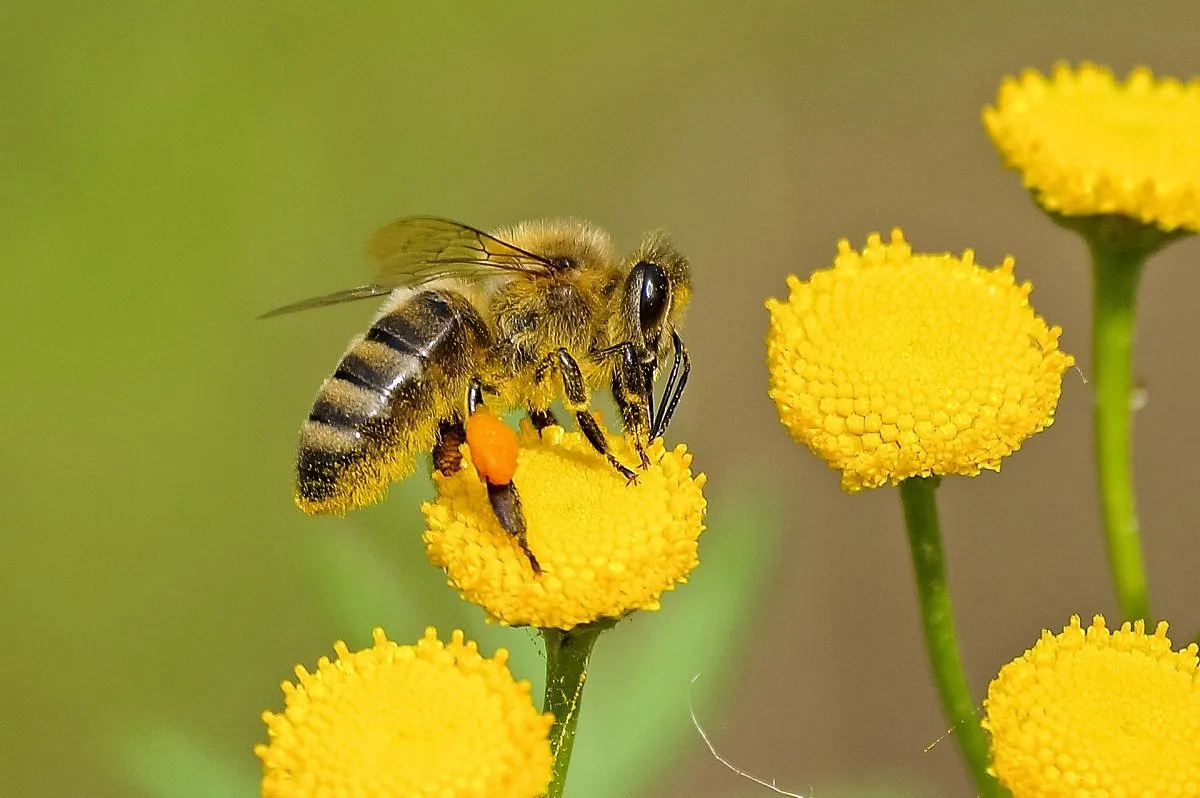
There are roughly 100 million managed western honey bee (Apis mellifera) colonies in hives worldwide, with about half in Europe, Africa and western Asia, where the species is native, and the rest in the Americas, Oceania and eastern Asia, where it is introduced.
Collectively, these hives produce 1.8 billion kg of honey each year. More importantly, the honey bee does as much crop pollination as all other bees (around 20,000 species) combined.
Bee hives are familiar. But who has seen a wild-living colony? Honey bee swarms select large nest cavities, usually in hollow trees or buildings, but are often hard to spot. The average entrance height of 36 wild colonies we found surveying trees in southeast England was nearly seven metres above the ground.
Based on a review of surveys of wild colonies published in scientific journals, we found that wild honey bee colonies are surprisingly abundant. We estimated that that there are between 200 and 300 million wild honey bee colonies worldwide – two to three times as many as managed hives.
Wild colony density is lowest in Europe, the only continent with more managed colonies than wild ones. Africa, meanwhile, has nearly seven times as many wild colonies as managed hives.
From time to time there is a news story about a person or organisation “helping the endangered honey bee” by placing hives on city roofs, for example. Our review provides further evidence that the honey bee is in fact exceedingly abundant.
Living on all continents except Antarctica are approximately 350 million honey bee colonies, the majority wild. This equates to one colony for every 23 people. At approximately 10,000 bees per colony, there are approximately 3.5 trillion individual honey bees on the planet – or 440 per person.
How to find wild colonies
Across the studies we analysed, researchers found wild honey bee colonies by searching for them, asking locals and bee-lining, in which foraging worker bees are given syrup. The direction they fly off is noted and the syrup bait is moved in that direction over multiple visits until the colony is located.
In the Bwindi Impenetrable National Park in Uganda, researchers were aided by local honey hunters, the Batwa pygmies. Unfortunately, such expert assistance is unavailable in England, where we are based.
The number of wild colonies can also be estimated indirectly from DNA samples of drone bees caught using a lure containing queen pheromone, as the drones reared in each colony are genetically distinguishable. https://www.youtube.com/embed/EAt0pkag9YY?wmode=transparent&start=0
Our study showed a clear relationship between the density of wild colonies and average annual temperature. The density of colonies increased up to 18°C, after which it levelled off and appeared to decline above 23°C.
Many colonies starve in winter, and longer winters increase the challenges to survival. Before spring flowers arrive, the bees in overwintering colonies (up to about 10,000 a colony) must live off stored honey alone.
We managed to gather information from wild colony surveys in 41 locations globally. More information would be valuable. One information gap is Asia, where we could find no surveys.
Some scientists suggest that wild western honey bee colonies cannot survive in eastern and southern Asia because they are more vulnerable to the pests and diseases that afflict the eastern honey bee (A. cerana), a species native to these areas and which is also managed in hives.
Wild or domesticated?
In French, the honey bee is called “l’abeille domestique”, the domestic bee. Given that wild honey bee colonies outnumber managed ones, and that mating and foraging are largely unmanaged, this name is misleading. The honey bee, even when managed in hives, is still very much a wild animal – unlike dogs or cattle whose movements, food supply and mating tend to be controlled by people.
Studies on wild honey bee colonies have revealed the varroa mites, a parasite of the eastern honey bee, have spread from Asia and now blight western honey bee colonies worldwide. Surveys carried out in the Arnot Forest in western New York State in the USA located wild colonies by bee-lining before and after the arrival of varroa parasites in about 1990, but fieldwork in 2002 and 2005 showed that the density of wild colonies in the forest hadn’t changed, despite all being infested with varroa.
Nesting sites in hollow trees would not be in short supply and so some other factor must be placing an upper limit on the number of colonies, probably the food supply (nectar and pollen).
Wild honey bee colonies do not benefit from the pest and disease control efforts of beekeepers – they are subject to the full force of nature’s challenges. As a result, their evolution will also be subject to stronger natural selection pressures for disease and parasite resistance than managed colonies.
Given that wild colonies outnumber managed ones, natural selection for improved disease resistance will be significant in most areas even if beekeepers use various techniques and chemicals to control pests and diseases in managed colonies.

Don’t have time to read about climate change as much as you’d like?
Get a weekly roundup in your inbox instead. Every Wednesday, The Conversation’s environment editor writes Imagine, a short email that goes a little deeper into just one climate issue. Join the 30,000+ readers who’ve subscribed so far.
Francis Ratnieks, Professor of Apiculture, University of Sussex and Oliver Visick, PhD Student in Ecology and Evolution, University of Sussex
This article is republished from The Conversation under a Creative Commons license. Read the original article.




