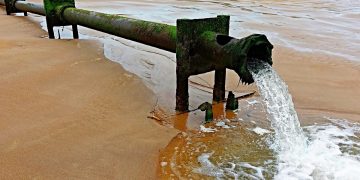
It came as a relief to gardeners and farmers when, after the recent intense hot spell, the Met Office predicted thunderstorms and heavy rain in all parts of Sussex. But others heard the predictions with dread. The fishing community, environmental campaigners, sea swimming groups and wildlife trusts all knew what to expect.
Yet again, storm outflow pipes on the coast and in rural Sussex would be pouring untreated sewage into already depleted and polluted streams and rivers, and rendering popular swimming beaches all along the coast off-limits. Or to put it another way: “After decades of under-investment… water quality was poor, rivers were polluted, and our beaches were badly affected by sewage” … a description by industry body Water UK of the UK’s water infrastructure. Not recently but 30 years ago, when Britain was dubbed ‘the dirty man of Europe’.
It is a shocking indictment of governments, regulators and the water industry that so little changed. But why? We have to go back to the 1970s to understand how a toxic mix of ideology, short-termism and the power of vested interests made it almost certain that the future of the country’s water infrastructure would be threatened.
Thatcher’s privatisation: ‘an organised rip off’
Margaret Thatcher, a great exponent of privatisation, certainly had the water industry in her sights after her election in 1979. Her first attempt in 1984 was thwarted by environmental groups, members of her own party and the public at large. Undeterred, she returned to the fray three years later, offering a more attractive deal to investors with the cancellation of debt and the offer of subsidies for investment.
Jonathan Portes, now professor of economics and public policy at Kings College, London, then a junior civil servant in the Treasury, describes the deeply unpopular water privatisation as ‘an organised rip off’. The argument put forward by the government, that privatisation would secure value for money for taxpayers and for water consumers, was rapidly disproved. In reality, taxpayers lost out as the shares were sold well below their market value, and consumers, he said, “have been paying through the nose ever since.”
Undertones singer and environmental activist Feargal Sharkey expressed it rather more strongly in a recent BBC interview. He said: “We are looking at 30 years of under-investment by the water industry, of profiteering, of regulatory failure and lax oversight.”
Back to 2022, to that Met Office forecast on August 24… and to the images shared across national media of sewage outfall pipes spewing toxic brown sludge on to Sussex beaches. Southern Water, the company responsible for managing water and waste water services across East Kent, parts of Sussex, Hampshire and the Isle of Wight was yet again in the frame.
History of misreporting illegal discharges
The company has a long history of misreporting and of illegal sewage discharges. In 2007, it faced a £20m fine from Ofwat, the water regulator, for “deliberate misreporting” to enable it to raise prices to customers, and for failing to meet guaranteed standards of service. The then Southern Water chief executive, Les Dawson, was quoted as saying: “Today’s announcement draws a line under a shameful period in the company’s history.” Would that it had.
Far from drawing a line, frequent incidents of illegal spillages have continued to the present day, often resulting in the decimation of fish stocks and wildlife in rural streams and rivers. The company has been hauled over the coals and fined by the regulator Ofwat with astonishing frequency.

Most other businesses, faced with fines totalling millions of pounds over the decades – last year it was fined a record £90m – and with a reputation at rock bottom, would have folded a long time ago. But as a monopoly, Southern Water, along with the other English water companies, is remarkably well protected from normal business shocks. The regulatory framework set up at the time of privatisation was, as Jonathan Portes makes clear, deliberately designed to be light touch, influenced only by interventions from Downing Street and the investment banking sector.
Liz Truss – budget cutter
Even that insufficient oversight has been weakened over the years, particularly under recent Conservative governments. Since 2010, the Environment Agency (EA) has suffered cuts to its budget of almost two-thirds, leaving it, in the words of its Chief Executive, only able to respond to the most serious reports of pollution. Liz Truss, predicted to be our next Prime Minister, was directly responsible when in charge of Defra for cutting £80m for sewage monitors from the agency’s budget in 2016.
Raw sewage discharge has subsequently more than doubled in England and in a recent Dispatches report on Channel 4, an ex-employee of the EA revealed that run-offs of slurry and chemicals from farms go almost unreported, as there are simply not enough staff on the ground to run regular inspections.
Southern has had a succession of owners, and at the time of the company’s latest acquisition by the Australian bank Macquarie in 2021, they were one of the most heavily indebted of England’s 11 water companies. Which, given that Southern’s shareholders took home £622 million in profit between 2013 and 2017, seems to point to their financial priorities.
What all those dividends add up to …
More recently the company defied an instruction from Ofwat to prioritise the reduction of customer bills and infrastructure investment over rewarding shareholders – they have continued to pay out dividends to their holding company, largely to service debt obligations. Their chief executive, Ian McAulay, also received a generous package in 2020/21, earning a bonus of £550,900, bringing his total remuneration to over £1 million.
The conclusion is inescapable. Southern Water, along with most of the industry, has chosen to prioritise short-term profit and shareholder dividends over its duty to protect the health of the public and the environment. It has rewarded its chief executives with large salaries and bonuses – not for modernising and improving the crumbling water and sewerage infrastructure in Sussex but for building up debt to finance dividends.
Water privatisation has proved to be one of the very worst examples of a generally failed and toxic policy, and the overwhelming public support for re-nationalisation should show the way forward.