


Grounded in her New York studio during the pandemic, Penny McCarthy was inspired by a newspaper picture featuring Sussex clouds. These drift through her drawings on show in one of three exhibitions at Hastings Contemporary, among an eclectic bunch of subjects, from Star Trek’s Captain Kirk to Greek myth, to the depths of space and even a flying cat.
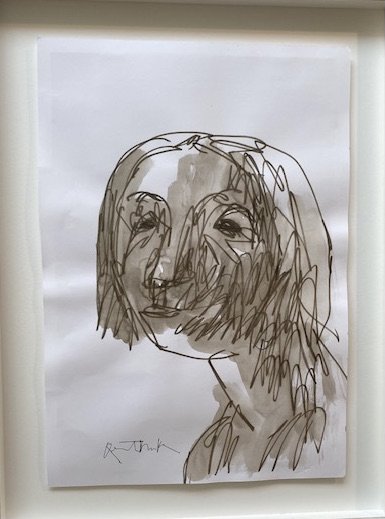
McCarthy’s work, in the gallery’s top floor, is alongside a retrospective of past exhibitors. There are some famous names, such as Quentin Blake, the artist who brought Roald Dahl’s characters to life. Blake, now 89, and one of the gallery’s staunchest supporters, offers a double take with one of eight pastel portraits of ‘people’ conjured from his imagination. But wait! Who is that among them? It looks to me a lot like our former, short-lived prime minister!
Well, they say life sometimes imitates art. This is the main point of McCarthy’s playful drawings. The clouds that inspired the US-born artist (who spends most of her time in the UK) were a fata morgana, which she describes as “a type of image that … distorts the object on which it is based …This renders the object completely unrecognisable.” And the cat? Well, ‘Bandit’ decided one day to sprawl out on some drawing paper. McCarthy did a few quick measurements and now he’s a flying Bandit.
A video of the artist at work reveals some of these insights and more, as we watch how she patiently uses a pencil to create her almost photographic images.
Ten years of art at the gallery
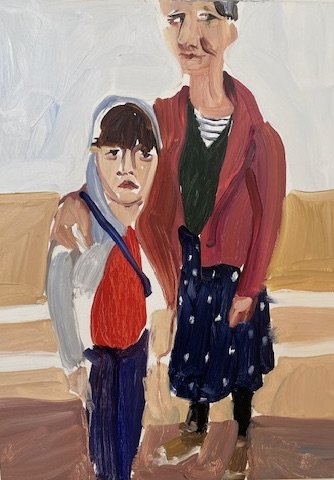
McCarthy’s monochrome art contrasts madly with the nearby Making Waves show of artists who have featured in the gallery since its launch as the Jerwood ten years ago. There are striking splashes of colour over five rooms. John Bratby makes a return with his nude study Jennifer Mallam Twice. The artist lived in Hastings from 1979 until his death in 1992. His work was celebrated at the gallery in a major retrospective in 2016. There is a painting on the prom from another Hastings visitor, Chantal Joffe: a simple and appealing self-portrait alongside her daughter Esme.
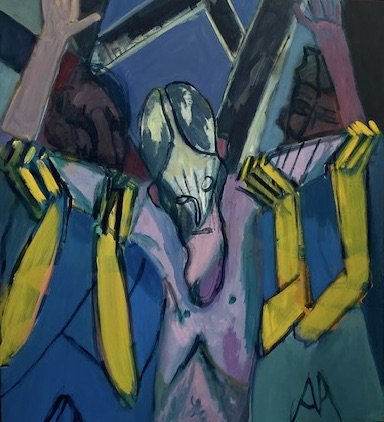
Ansel Krut’s Last Man Standing, with arms lifting a man up to what looks like a cross, invokes an original take on the image of the crucified Christ. In contrast, there’s Gillian Ayres’ Bagatelle, who describes her striking abstracts as “about shape and colour, not about telling stories.” For Lakwena Maciver, an internationally recognised muralist, words are central to her art, and here the invitation to DREAM is displayed against an acid-bright abstract design.
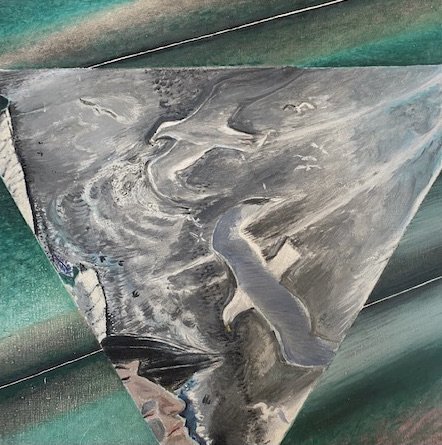
The work of Jeffery Camp – the master of colourful coastal art – was celebrated in a solo show in 2013 to mark his 90th year. He died in 2020, but leaves the legacy of a distinctive, naturalistic style. Featured here, his seagulls over a cliff edge create depth and a sense of vertigo, probably painted en plein air on one of his frequent forays to Beachy Head.
Caragh Thuring: volcanoes and submarines
On the ground floor, the Caragh Thuring exhibition features vivid bubbling volcanoes and startlingly sparse pen and ink drawings. Her art often explores where the natural and manufactured worlds collide – and so a brick wall almost obscures one volcano, creating a sense of mystery and menace. Her work is said to be influenced by growing up near Scotland’s Holy Loch, the construction site of the first concrete North Sea oil rigs and once a Cold War US submarine base.
Engaging with the community
Director Liz Gilmore said the gallery was focusing on ways to use the shows to engage with the local community over the life of exhibitions.
“Penny’s Cloud falls in love with Mortal has sparked a creative writing session. It’s the first time in a while that we’ve done this and we’re very much developing our learning engagement programme, with a staff dedicated to this.
“We turn over our exhibitions roughly twice a year, rather than more quickly. So what we’re looking for is really building the ways in which people can enjoy them.”
These include adult creative day courses, as well as free family days during half-term. “They were enormously successful over the summer,” she says. “We want as many children to come and take part and to grow in these difficult times.
“We want people to feel that there are many reasons to come back and enjoy the show rather than just visiting it once. There’s good environmental reasons for doing that. Also, I think the habit of visiting cultural venues needs to be practised again.”
Gilmore says the current shows were affected by the aftershock of the pandemic: “This meant Penny’s show was long delayed. Caragh’s was always set for this time. But at the beginning of the process of asking artists, we didn’t know what they were going to give us. So the exhibitions have come together in ways we might not have envisaged.”
The result is some stimulating contrasts. And, as Gilmore notes: “Something for everyone.”
All three shows run concurrently at Hastings Contemporary until March 23 2023



