


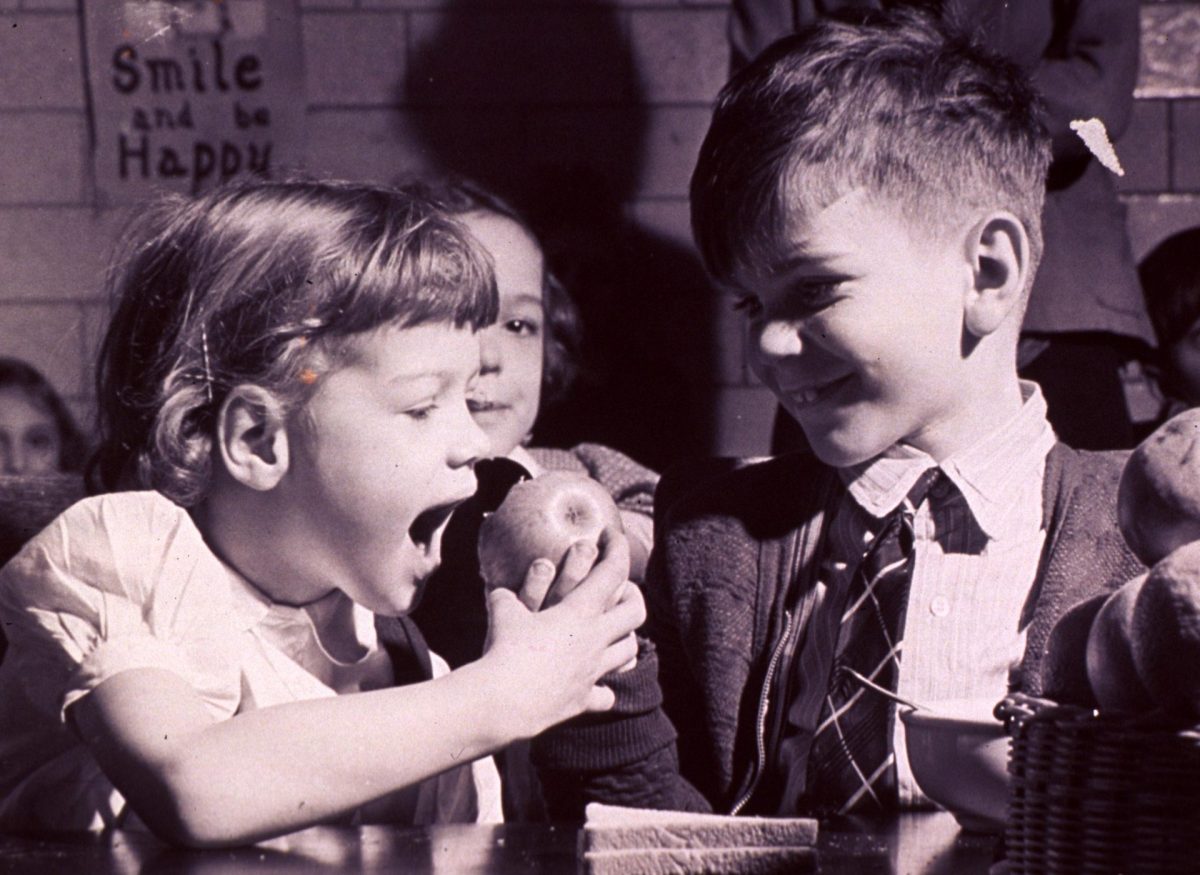
The UK has one of the world’s oldest school food programmes. The mere phrase ‘school dinners’ evokes powerful memories, good and bad, for all of us. But less of us might be familiar with its origin story and the role school meals could play in transforming our food system.
It all started in the 1870s when compulsory education was first introduced via the Elementary Education Act. However, since thousands of poor children went to school hungry, they were unable to benefit from their learning. This led Manchester to give free school meals to ‘destitute and badly nourished’ children in 1879.
Around 1900, there was a lot of concern about the poor physical state of the people of Britain and in 1906 the new Liberal government’s Education Act allowed local authorities to provide school meals. However, very few did. It was not until 1944 that the National School Meals Policy was passed, requiring all local authorities to provide nutritious school meals for all. Two years later, universal free milk was introduced and these provisions ensured essential nutrition for thousands of children.

‘Thatcher, Thatcher, milk snatcher’
In 1968, Harold Wilson’s Labour government ended free milk in secondary schools and three years later, Margaret Thatcher, then Conservative Education Secretary, stopped free milk for primary school children, earning her the taunt “Thatcher Thatcher, milk snatcher!”
In 1980, she also abolished the minimum nutritional standards for school meals and the statutory duty of local education authorities to provide a meals service. The standard of school meals fell so dramatically that a 1999 survey found that, despite food rationing, children in the 1940s and 1950s had a better diet than children growing up in the 1990s.
Horrified by the amount of junk food, lack of veg and the notorious turkey twizzlers on the school menu, TV chef, Jamie Oliver, put the school lunch on to the political agenda in 2005 with his series Jamie’s School Dinners. The resulting Feed Me Better public campaign led to some improvements in nutrition in schools.
Universal infant free school meals came into force in 2014 and in 2015, new school food standards became mandatory in all state-funded schools to ensure children have healthy, balanced diets. Despite this, a Food for Life investigation in 2019 discovered widespread non-compliance with the standards and found Ofsted’s reluctance to champion school food and healthy eating symptomatic of wider failings in government policy.

Holiday hunger
School meals have hardly been out of the news since. The Covid-19 pandemic and the resulting ‘lock downs’ highlighted just how many families relied on a term-time meal for their children.
Over a million people signed footballer Marcus Rashford’s petition calling for free school meals to be extended to school holidays and to all families on universal credit. When the government refused, the public reaction was strong. Empty plates were left outside one MP’s office, another resigned in protest, and individuals, schools and businesses across the country had to step in to alleviate holiday hunger themselves.
The issue of school holiday hunger is not new. Back in 1907, when school meals were first introduced, a feeding experiment took place in a school in the poorest quarter of Bradford. As this graph from the National Archives shows, when given breakfast and lunch at school, the weight that children rapidly gained during term time reversed during the holiday period.
Universal free school meals
The current #FeedTheFuture campaign is calling on the government to expand free school meals to 900,000 children in England living in poverty who are not currently eligible. But Sustain, the alliance for better food and farming, go further, calling for universal free school meals across England, arguing that just like desks, books and bathrooms, we should give free school food to every child.
The British government could do well to look at countries already providing universal free school meals, including Brazil, India, Sweden, Finland, Estonia and a number of states across the USA, with Kenya and Benin making firm commitments. Indeed, London Mayor, Sadiq Khan, made the news by introducing free school meals to all children in London’s state-funded primary schools. Today, 418 million children receive free school meals worldwide.

The power to transform food systems
We know what school meals can do for children and their education, but could school food also help to transform our food system?
Speaking at the 2023 Food Systems summit in Rome, UN Secretary-General António Guterres warned that “global food systems are broken and billions of people are paying the price.”
Worldwide, Guterres explained, almost one-third of all food produced is lost or wasted, while more than 780 million people experience hunger and over three billion cannot afford healthy diets. “Many communities are one shock away from plummeting into food insecurity or even famine”, said Guterres.
With its huge spending power, school meals programmes are one of the easiest ways for governments to transform our food system for the better. But the first step is to see the school food programme as an investment rather than an expense.




