


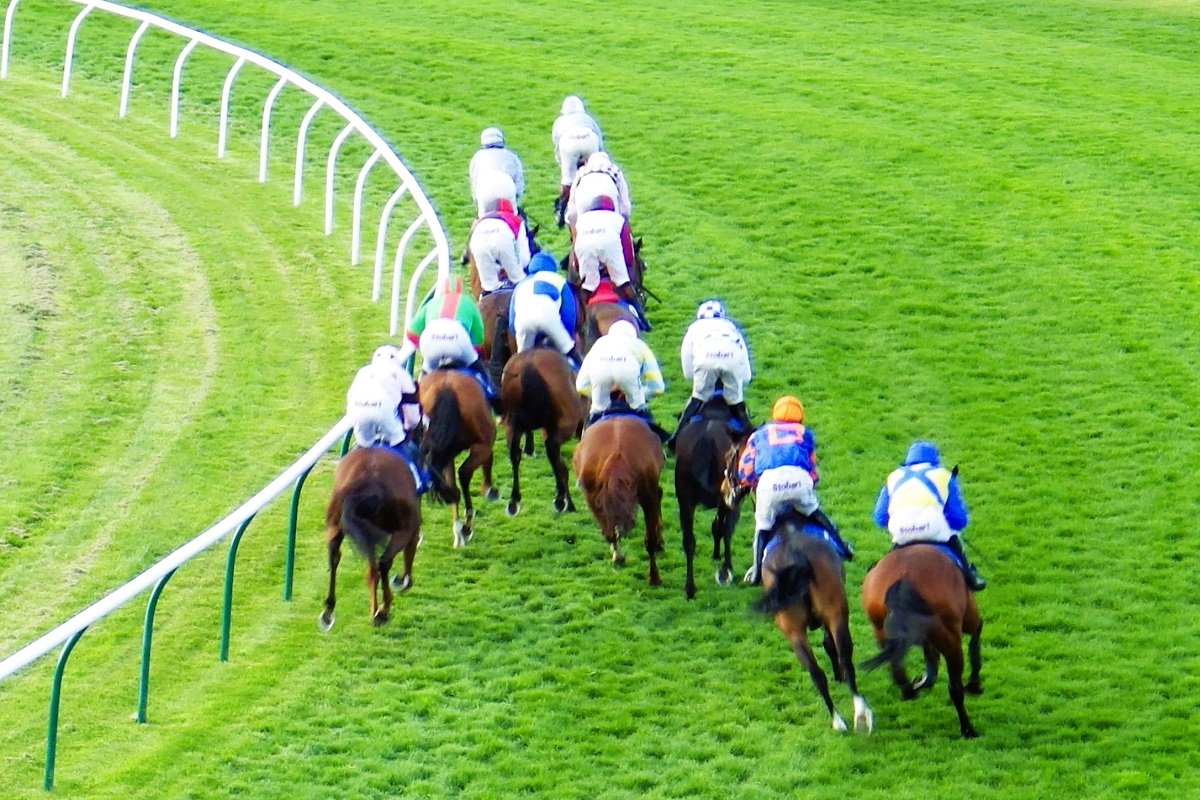
This June saw the annual gathering of global elites, alongside crowds of dolled up social climbers, at the Royal Ascot races. This year’s meet happened to coincide with a heatwave, with temperatures on Wednesday 18th exceeding 29°C. The significant number of spectators taken ill as a result raises several questions.
Firstly, is it strictly sensible to dress up in suits and ties and stand around outside in a busy crowd during a heatwave, simply as a pretext for socially acceptable day drinking and gambling?
Secondly, and more importantly, how is it acceptable or legal to force horses to race a mile or so around a track, when the spectators are collapsing from the heat?
Even aside from the extreme weather conditions of this year’s Ascot, horse racing is an ethically dubious affair at best.
Direct action protests
In 2023 the campaign group Animal Rising, an offshoot of Extinction Rebellion focused on animal welfare, drew attention to this with direct action protests disrupting the Grand National and Epsom Derby.
As climate change makes conditions like last week more likely at spring and summer racing events, and greater public consciousness of animal welfare makes this type of ‘sport’ increasingly contested, we might reflect upon Britain’s proud history of opposing animal cruelty in the name of entertainment, and consider building on that tradition.
Following the civil wars of the 1640s, culminating in the public execution of King Charles I in 1649, there was a decade of tumult as various forms of unprecedented republican government were tried and tested.
At the end of 1653, Oliver Cromwell instituted himself as Lord Protector of the Commonwealth, and began his First Protectorate Parliament in 1654.
Bans on cockfighting and bear baiting
While the First Protectorate ultimately failed to bring about lasting political stability, it did achieve some legislative success, among which were bans on cockfighting and bear baiting, to which Cromwell had always been opposed.
These bans were reversed after the Restoration of Charles II, though such barbarous practices continued to wane throughout the 17th and 18th centuries.
Subsequently, following years of effort during the early 19th century, including the establishment in 1824 of the Society for the Prevention of Cruelty to Animals, parliament passed the first Cruelty to Animals Act in 1835.
This act outlawed a wide range of bloodsports and entertainments, including cockfighting, dogfighting and the baiting of bulls, bears and badgers. Despite the limited efficacy of the bill, it was a milestone in legally recognising the sentience and capacity for suffering in other species, and our moral responsibility to prevent it.
This trend has continued over the last 200 years.
Just as important as what this landmark bill included, however, is what it left out. Those 19th century pioneers of preventing animal cruelty were wealthy educated gentlemen.
Their moral judgements were shaped by class, and as a result, entertainments which had come to be associated with the nascent urban working class, such as cockfighting and dogfighting, were included in the bill.
However, those that were the preserve of the aristocracy and gentry, such as foxhunting, deer hunting, hare coursing and grouse shooting, as well as racing sports, were omitted, despite their cruelty and immorality differing only in degree.
Trail hunting
Mounted hunting of mammals with dogs, most commonly of foxes, was finally banned by the 2004 Hunting Act, though it continues to take place illegally under the cover of trail hunting.
In theory, trail hunting involves the hounds chasing after an inanimate object covered with a scent, removing the need for a live quarry.
In practice, it’s often merely a smokescreen.
In these cases, the animal is typically chased for an unnaturally long time, likely under extreme physical and psychological stress, before being torn to pieces by dogs. Additionally, a hunt charging through the countryside, across roads and private land, with barking dogs and toffs blowing horns, causes disproportionate disturbance and safety risks to surrounding wildlife and people.
Trail hunting should be banned – as Labour pledged in its 2024 manifesto – and the Hunting Act strengthened.
Environmental destruction on a huge scale
Driven grouse shooting, in which artificially high numbers of red grouse are driven by ‘beaters’ towards a waiting line of guns, is not only cruel and unfair – barely distinguishable from ‘canned hunting’ – but also involves environmental destruction on a huge scale as moorlands, including areas of carbon rich peat, are regularly burned to stimulate new heather growth to feed the young grouse.
In order to maximise grouse numbers, shooting estates routinely and illegally persecute predators like foxes and birds of prey.
Driven grouse shooting should be banned.
Returning to horse racing, a crowd of horses running at full pace continuously over long distances, confined within a narrow trackway and forced to run directly towards and jump over large barriers, is clearly a completely unnatural form of coercive abuse, reinforced with whips.
Despite recent attempts by the industry to regulate whipping, it remains cruel and unnecessary. The risk of injury and death to the horses is substantial, especially given that many thoroughbreds begin racing at around 18 months to two years old, when they’re only just approaching physical maturity.
The go-to defence – that the horses are well looked after when they’re not being made to risk their lives – seems rather a poor excuse. Horse racing should be banned.
The UK loves to portray itself as a nation of animal lovers, and some of its history supports this image. But the ongoing practice of such barbaric entertainments as trail hunting, driven grouse shooting and horse racing jar rather heavily with the claim.
To one degree or another, animal welfare abuse is inherent to them all, for no purpose beyond entertainment and, in the case of racing, the sleazy profiteering of the gambling industry and PR for corporate sponsors.
It’s time we reckoned with this and consigned these bloodsports to history.

CLICK HERE TO DONATE TO OUR CROWDFUNDER
HELP US BECOME STRONGER SO THAT WE CAN CONTINUE TO DELIVER POWERFUL CITIZEN JOURNALISM!




