


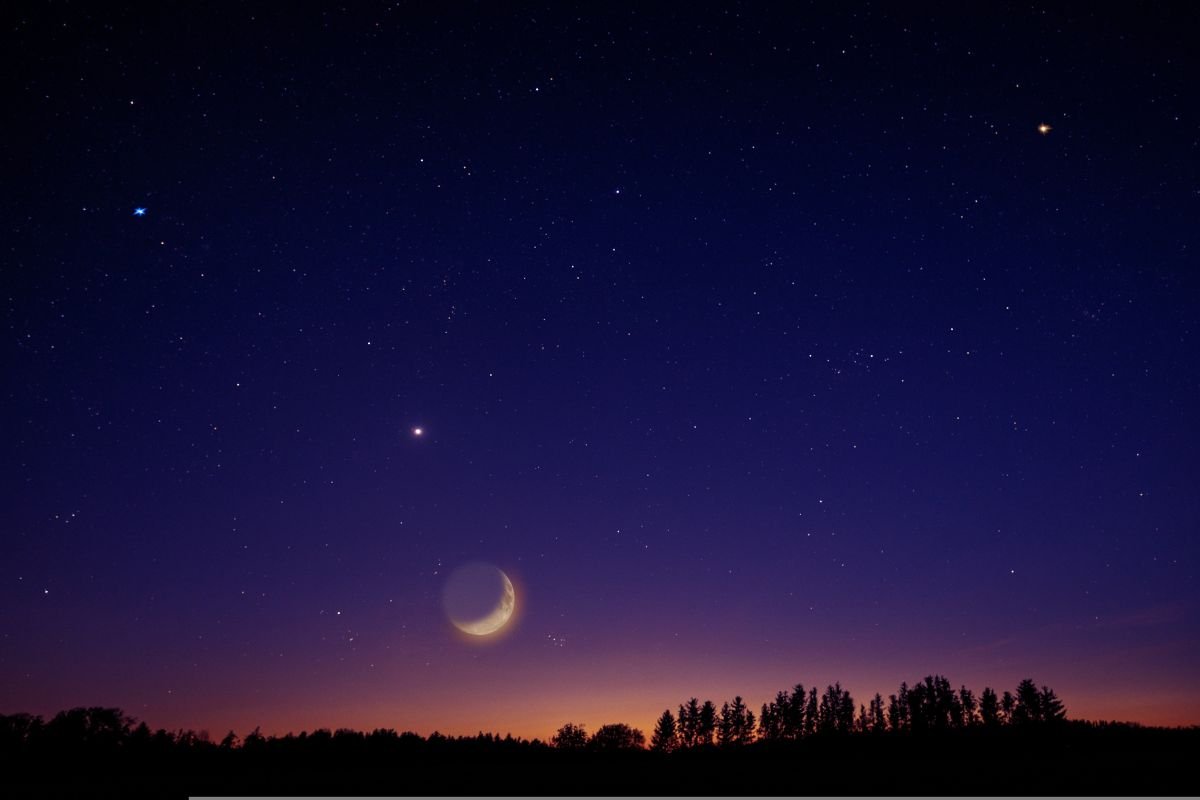
There is a particular kind of night most of us think we know.
It arrives without ceremony. The streetlights blink on. The sky settles into a soft, indistinct grey – never fully dark, never fully gone. A few stars appear if you look up, scattered and tentative. Orion, perhaps, if you know where to find him. The brighter planets. The Moon, when it chooses to show itself.
And this, we assume, is the night sky.
It is not.
What we live under now is a version of night that has been thinned, diluted, quietly stripped of its depth. Not dramatically, but steadily, and almost completely. On paper, the figures are stark: more than 99 per cent of people in the UK live under light-polluted skies, with truly dark conditions – where the Milky Way is clearly visible – now confined to a small fraction of the land.
Astronomers describe this loss on a simple scale, running from one to nine. At one, the sky is as dark as it can be: remote, unlit, the Milky Way casting a faint shadow, thousands upon thousands of stars visible in layered depth. At nine, the inner city, the sky is no longer really a sky at all – just a luminous backdrop in which only the brightest points survive. Most of us in Sussex live somewhere between five and seven. Not bright enough to feel urban, perhaps, but far too bright to be natural. A sky where the constellations thin out, and the Milky Way has already disappeared.
Drive out from the towns – past the last retail parks, past the lit edges of housing estates, into the long folds of the Sussex countryside – and something begins to change. At first it is subtle. The sky darkens by degrees. The orange haze at the horizon loosens its grip. The air feels, for no obvious reason, slightly larger.
And then, if you go far enough, and wait long enough for your eyes to adjust, you begin to see what has been missing.
Not just more stars, though there are more – hundreds becoming thousands – but a different quality of sky altogether. The darkness is no longer empty; it is alive with detail.
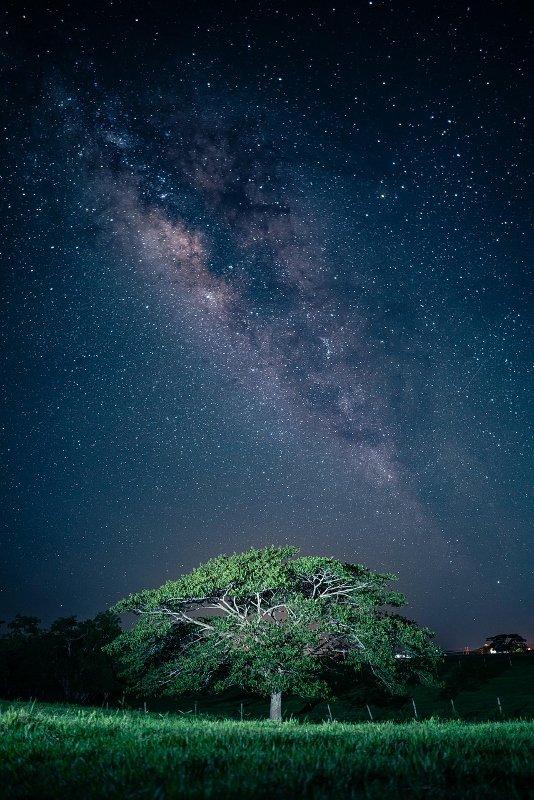
And then, sometimes, the Milky Way appears.
Not the faint suggestion people imagine they’ve glimpsed once or twice, but a pale, textured band stretching across the sky, uneven and luminous, like breath on glass. It has structure. Density. It feels improbably close, and impossibly far at the same time.
What becomes clear – quietly, without drama – is that this is not an enhancement of the night sky. It is the night sky, as it is meant to be seen. What we are used to is the diminished version.
Sussex offers a peculiar vantage point on this. It contains, within a relatively small area, both the problem and its partial absence. The coastal towns and inland centres cast their light far beyond their boundaries, creating a kind of atmospheric glow that reaches into fields and valleys that appear, at ground level, perfectly dark. You can stand in open countryside, miles from the nearest streetlamp, and still be under a sky that has already been altered.
This is the quiet reach of light pollution. It does not respect edges. It travels. Light spills upward, reflects off particles in the atmosphere, and returns as a diffuse brightness – visible tens of miles from its source. A town does not simply light itself; it lights the air above it, and the air beyond it.
And yet, in parts of the South Downs, there are still pockets where the darkness holds. Not perfectly – true darkness is now rare – but enough to reveal what has been lost elsewhere. Enough to show that the loss is not theoretical.
It is experiential.
The difference is not simply the number of visible stars, though that is measurable. In a typical town, you might see a few dozen stars on a clear night. Under a darker sky, that number rises into the thousands. The Milky Way, invisible to most, becomes unmistakable. But beyond the numbers, something else changes. A sense of scale, perhaps. Under a brighter sky, the universe appears contained, reduced to a handful of visible points. Under a darker one, it expands. The eye cannot easily settle. There is too much to take in.
You are no longer looking at stars. You are looking into space.
And with that comes a subtle recalibration. Of size. Of distance. Of time. The sky stops being decorative and becomes, instead, a kind of presence.
It is striking how quickly this awareness fades once you return to ordinary light. The eye readjusts. The mind follows. Within minutes, the diminished sky feels normal again. The absence of the Milky Way does not register as absence.
This may be the most curious aspect of light pollution: its invisibility as a problem. It removes something vast without leaving an obvious gap. There is no broken edge, no clear before and after in daily life. Only a gradual narrowing of what is considered ordinary.
You do not miss what you have never properly seen.
And so the loss goes largely unremarked. We discuss air quality, noise, congestion. We measure particulates and decibels. But the quality of the night – its depth, its clarity, its capacity to reveal the wider universe – rarely enters the conversation.
Perhaps because it seems, at first glance, aesthetic rather than essential.
But standing under a genuinely dark sky complicates that assumption. The experience is not merely beautiful. It is orienting.
For most of human history, the night sky was a constant presence. It provided navigation, certainly, but also continuity – a visible link between generations. The same patterns seen by ancestors, the same slow movements overhead. It offered, whether one sought it or not, a sense of place within something much larger.
There is, however, something quietly hopeful in this. Unlike many forms of environmental loss, light pollution is reversible. Darkness returns the moment light is removed. No decades of regrowth, no complex restoration. Simply less light, directed more carefully.
And already, in small ways, this is happening. Shielded streetlights. Reduced overnight illumination. Efforts, in places like the South Downs, to preserve what remains of the dark.
It does not require a complete return to unlit nights. Only a reconsideration of how much light is necessary, and where it is aimed.
The sky, after all, has not changed.
It is still there, in its full depth and complexity, waiting just beyond the reach of our lighting. The Milky Way still stretches overhead, unseen by most, night after night. The stars still number in their thousands.
We have not lost them.
We have only learned, for a time, not to see them.

CLICK HERE TO DONATE TO OUR CROWDFUNDER
HELP US BECOME STRONGER SO THAT WE CAN CONTINUE TO DELIVER POWERFUL CITIZEN JOURNALISM!






