


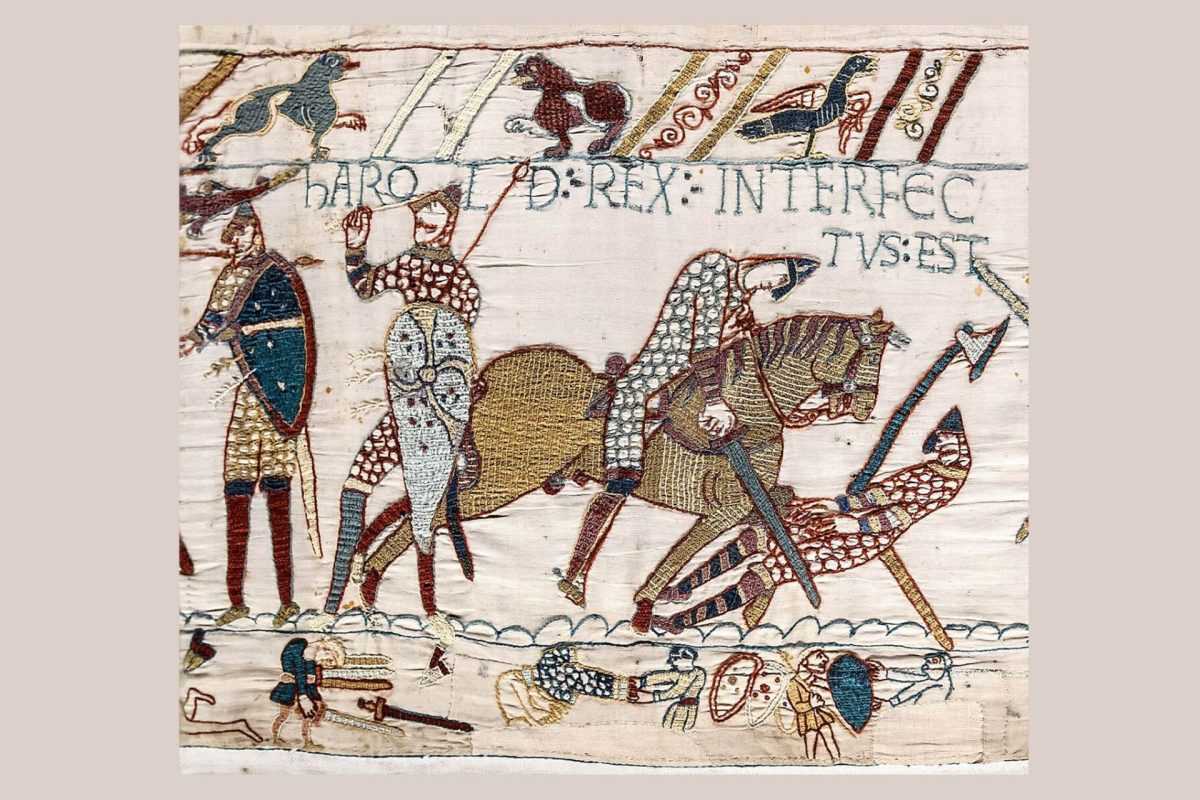
New research from the University of East Anglia reveals that King Harold’s legendary 200‑mile march to the Battle of Hastings in 1066 never happened. Instead, he sailed to Hastings.
The findings overturn one of the most iconic stories in English history, altering how the Norman Conquest is understood in classrooms, museums and public memory.
For more than two centuries, historians have repeated what they found in the Anglo‑Saxon Chronicle – one of the earliest and most complete written records of English history. The Chronicle seems to imply that Harold dismissed his fleet in early September 1066, leaving him no choice but to rush his troops south from Stamford Bridge in Yorkshire on foot.
It records that the ships “came home” –a phrase Victorian historians interpreted as meaning he disbanded the navy. And it was this narrative that shaped later accounts of the Norman Conquest.
But now Tom Licence, Professor of Medieval History and Literature at the University of East Anglia, has shown that the ships returned to London, their home base, and remained operational throughout the year.
The idea of a heroic march is a Victorian invention
Licence said, “I noticed multiple contemporary writers referring to Harold’s fleet, while modern historians were dismissing those references or trying to explain them away. I checked the evidence for him having sent the fleet home and found that it was just a misunderstanding. I went looking in the sources for evidence of a forced march and found there wasn’t any.”
Licence is keen to present King Harold’s actions in a new light in the face of William’s invasion. He said, ”Harold’s campaign was not a desperate dash across England; it was a sophisticated land–sea operation. The idea of a heroic march is a Victorian invention that has shaped our understanding, or misunderstanding, of 1066 for far too long.”
Contemporary sources describe Harold sending hundreds of ships to block Duke William after the Norman landing. These references previously caused confusion because historians assumed Harold had no fleet left.
Licence said, ”Harold’s ‘missing’ fleet was used to defend the south coast, then to support his campaign against Harald Hardrada, and finally to rush back south after the Battle of Stamford Bridge ready to face Duke William of Normandy.”
This startling news came earlier in the year, just as the Bayeux Tapestry was being prepared to travel from France to the UK for display at the British Museum. Professor Michael Lewis, Head of the Portable Antiquities Scheme at the British Museum and Curator of the Bayeux Tapestry Exhibition, said, “With the Bayeux Tapestry coming to the British Museum later this year, Professor Licence’s research shows there is much still to be learned about the events of 1066. It is clearly a fascinating discovery that, following the Battle of Stamford Bridge, Harold took an easier, more logical, trip south by ship to meet Duke William in battle, rather than a long trek overland, as has long been supposed.”
Why the new research matters
The findings challenge one of the best‑known narratives in English history, altering how the Norman Conquest is understood in classrooms, museums, and public memory. Prof Licence said: “Harold was not a reactive, exhausted commander, he was a strategist using England’s naval assets to wage a coordinated defence. “This reframes the events of 1066 and highlights a previously overlooked aspect of Anglo‑Saxon maritime capability.”
Licence re-examined the Anglo‑Saxon Chronicle, which survives today in nine manuscript versions, alongside other 11th‑century sources, correcting the error popularised by Edward Augustus Freeman in the 19th century.
By restoring the fleet to its central role, the research reconstructs Harold’s real strategic choices; from his northern campaign against Harald Hardrada to his planned naval interception of William before Hastings.
Roy Porter, the English Heritage Senior Curator of Properties who oversees Battle Abbey and the Hastings battlefield, said, “Professor Licence’s research shows the immense value of testing received wisdoms, and his conclusions are certain to sustain debate about the circumstances of England’s most famous battle. What we know about Harold’s previous military campaigns fits with the idea that he used naval forces to transport soldiers, and threaten William, and there are references in accounts of the Norman invasion which also lend weight to that possibility.”
Harold never disbanded his fleet
The research demonstrates that Harold’s ships were not dismissed in early September 1066, as has been long believed. The Anglo‑Saxon Chronicle states that Harold himself returned to London “off ship” –that is, from the south coast–when he heard of Harald Hardrada’s arrival.
No contemporary source describes a forced march. The term was introduced by Victorian historians and became received wisdom even as it was understood that a sea voyage from the Humber to London was faster, safer, and far more consistent with the Chronicle’s account.
Comparative evidence shows the march is unrealistic, with even well-equipped American Civil War forces only covering around 100 miles in five days under exceptional conditions.
Licence said, “Harold’s weary, unmounted men covering nearly 200 miles in ten days and then continuing straight to the Hastings peninsula is implausible given medieval roads and the aftermath of battle. Only a mad general would have sent all his men on foot in this way if ship transports were available.”
Past criticism of Harold marching south with “reckless and impulsive haste”, as one historian puts it, is therefore unfounded. His men had time to rest.
The Chronicle uses the Old English term lið, normally translated as “fleet” to describe the force Harold gathered at Tadcaster before marching on Stamford Bridge.
This indicates the English king deployed both naval and land forces against Harald Hardrada –a detail that has caused much confusion because historians wrongly believed the fleet was already scattered.
Harold attempted a naval pincer movement against Duke William
Early accounts describe Harold sending hundreds of ships south after William’s landing. Far from marching alone, Harold was coordinating a land–sea pincer designed to trap the Normans in the Hastings peninsula.
The fleet likely arrived too late, costing Harold his archers and cutting-edge troops.
Licence’s work also revives evidence for a forgotten naval clash. Both the Domesday Book and the Annales Altahenses hint at an English sea engagement during the campaign.
These references were previously hard to explain but now, reconsidered alongside this research, become plausible and historically significant. The English fleet arrived too late to save the day but may have clashed with William’s ships guarding his base at Hastings.
So, the myth popularised by the Victorians may be just that: a myth. Harold, far from taking a rash and eventually fatal decision to force march his weary troops south, showed himself to be an expert strategist. His tragedy might have been that his fleet arrived too late to save the day.
Watch Professor Licence explain the evidence underlying his challenge to the prevailing myth on YouTube:https://www.youtube.com/watch?v=L6VHyWTfFwY

CLICK HERE TO DONATE TO OUR CROWDFUNDER
HELP US BECOME STRONGER SO THAT WE CAN CONTINUE TO DELIVER POWERFUL CITIZEN JOURNALISM!






