“We must be certain to create our legends before we die” – Robert MacBryde, 1940
Their art shone brightly in the post-war years, but only briefly. The story of ‘The Two Roberts’, young, working-class gay men from the west of Scotland who forged an important role in modernist art, is told vividly in a new exhibition at Charleston in Lewes, curated by writer Damian Barr.
I was lucky enough, with others, to be shown round by Barr who, as a working-class gay Scot himself, has a personal affinity with the two Roberts. Barr took us on their journey from Ayrshire to Glasgow, Europe to London, important years in Lewes and untimely deaths. He brought to life their passionate and sometimes tempestuous relationship, and their dedication to painting through difficult odds.
Ayrshire to Glasgow School of Art
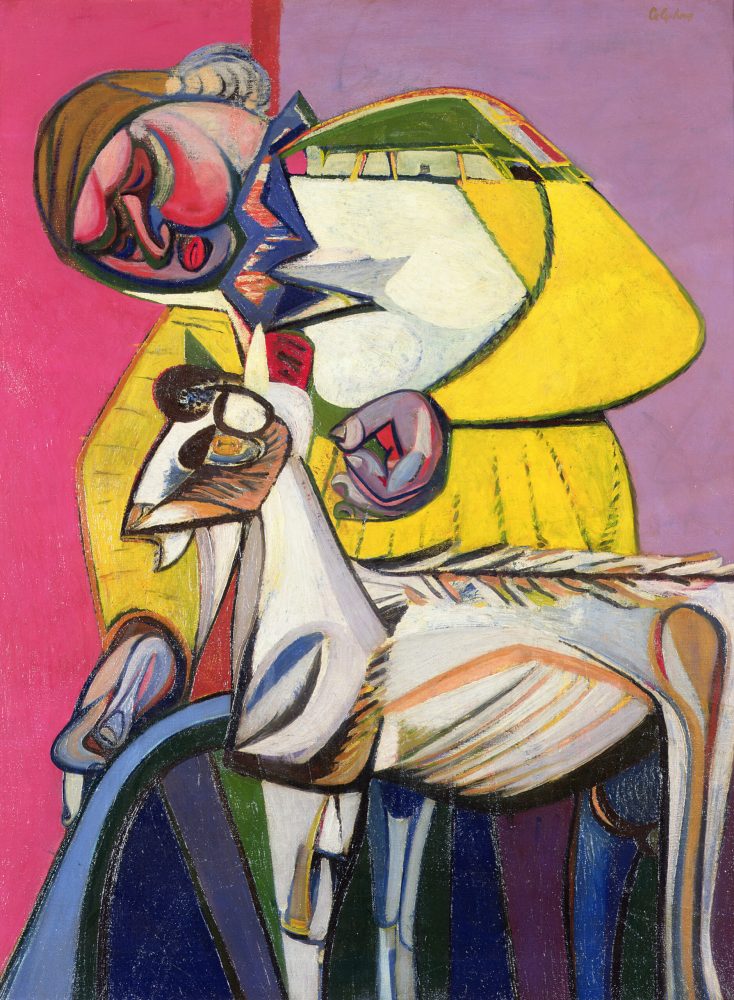
Robert Colquhoun (1914-62) and Robert MacBryde (1913-66) grew up within 20 miles of each other in Ayrshire. Although their early artistic talents were recognised by teachers, both had to leave school at 14 to work and help their families. Colquhoun later celebrated Ayrshire women in powerful paintings such as The Potato Diggers (1946).
Their lives were changed forever when they attended Glasgow School of Art (GSA) in 1933, meeting on the first day. They moved in together almost immediately, starting their lifelong romantic and professional relationship, and were soon seen as inseparable. Tutor Ian Fleming’s memorable painting of them (see main image) shows them sitting close together but not quite touching: homosexuality was illegal in England until 1967 and in Scotland until 1980.
Bohemian life in pre-war Europe
The two Roberts were star students – “a standard of work not inferior to professional artists”, wrote an assessor – and in 1938, Colquhoun narrowly beat MacBryde to win GSA’s travelling scholarship to Europe. However, GSA’s chair of governors unusually agreed to fund another scholarship for MacBryde so they could travel through France and Italy together.
They soon felt part of Bohemian life in Paris which for them was “opera, ballet and freedom”. MacBryde adopted the name ‘Sacha’; both men kept sketchbooks of the handsome young men they saw as well as the artwork. But darker events were underway with the rise of fascism, as shown in Colquhoun’s sinister Puppet Show Modena (1951) and other retrospective paintings of this period.
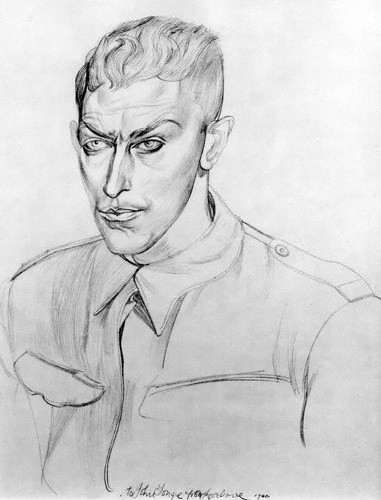
Returning to Britain at the onset of war in 1939, MacBryde was exempt from military service because of childhood tuberculosis, but Colquhoun was called up and spent two years driving ambulances by day and painting at night. His self-portrait pencil sketch, The Army Haircut (1940) shows a gaunt, rather haunted figure; a lifelong pacifist, it must have been a terrible experience.
Rising stars in post-war London
In London, MacBryde had a “life-changing” meeting with the millionaire founder of literary magazine Horizon, Peter Watson. In 1941, Watson helped him bring Colquhoun back to England, set them up in their own studio at 77 Bedford Gardens and introduced them to important galleries.
MacBryde capitalised on this, arranging a Six Scottish Painters show at the Lefèvre Gallery in 1942, which included their work. He became the one who fixed things, negotiated with art galleries and ran their domestic lives.

Colquhoun and MacBryde were hailed as “young artists of great promise” in Horizon, photographed in Vogue, and celebrated by London’s cultural community. Other exhibitions at the Lefèvre followed, where the two Roberts’ paintings were shown alongside other rising stars such as Frances Bacon and Lucien Freud, who became close friends.
The height of their rise to fame was accompanied by wild parties at Bedford Gardens and a three-year ‘throuple’ with artist John Minton. Minton’s beautiful portrait of Colquhoun, Painter and Model (1953) is in the Lewes exhibition.
Artists-in-residence in Lewes
Evicted from their studio at Bedford Gardens in 1946 because of “drunk orgies” (said their landlord), MacBryde and Colquhoun moved to Lewes. Here they were supported by sisters Caroline Byng Lucas and Frances Byng Stamper, known as the Ladies of Millers, who set up the Millers Gallery in Lewes and exhibited work by local artists. Through them the two Roberts met members of the Bloomsbury group, but apart from Duncan Grant they had little time for them, calling them the “Bloomsberries”.
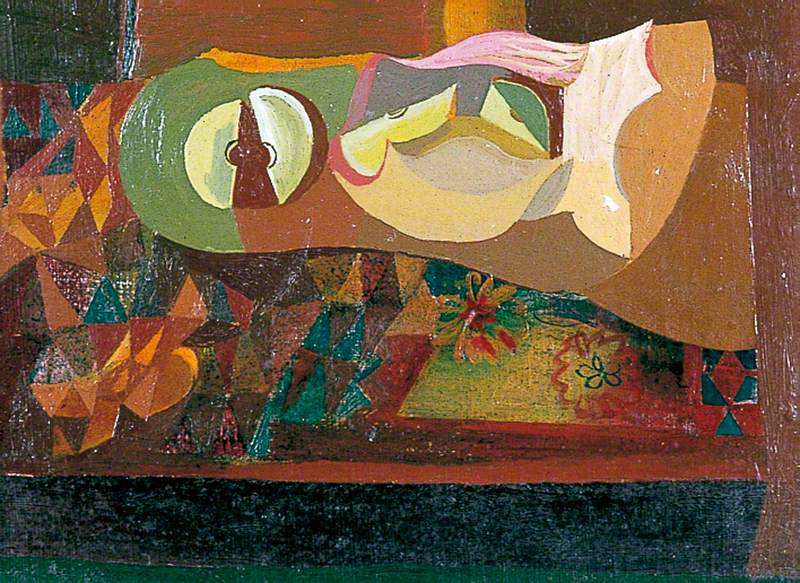
Supported by patrons again, this was a period of stability, where both men could focus on developing their art. MacBryde specialised in colourful still lifes, often based on the food he cooked for him and Colquhoun. The Lewes exhibition has a whole wall of them, which I loved for their rich, vibrant colours – deep maroon, orange and yellow – as well as giving an insight into their domestic life. Ken Russell’s 1959 film Scottish Painters, screened in the exhibition, shows MacBryde’s fascination for fruit in still lifes – “form, shape and colour”.
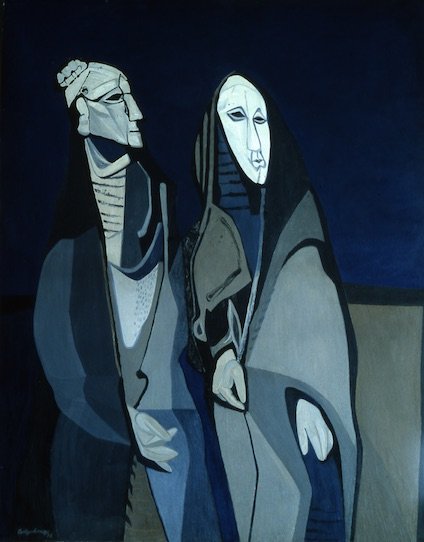
Colquhoun drew on his Celtic roots to focus on portraits, usually female, often sad but powerful figures such as Women in Ireland. In Russell’s film, he describes his interest in the human form, “almost as a thing in itself…always changing”. His prolific work is well represented in the exhibition; the range of detail and colour is beautiful and astonishing.
While living in Lewes, the two Roberts were commissioned to design the costumes for Léonide Massine’s ballet Donald of the Burthens, which opened at Covent Garden in 1951. Their colourful, jointly signed designs take up a whole wall of the Charleston exhibition.
Failing fortunes
After Lewes, and a few years in Essex, the two Roberts became nomadic, moving from place to place, such as the Suffolk studio “cheap enough at a pound a week to let them paint full-time” shown in Russell’s film. They were penniless and Colquhoun developed a drink problem: Lucien Freud said he seemed “doomed”. In the Russell film both men look older than their years.
MacBryde secured a show for Colquhoun in 1962, but he died in the arms of his lifelong partner, working on a drawing for the event. Very poignantly, Still Figure is the final piece in the exhibition.
With this landmark exhibition, Charleston in Lewes is continuing its aim to present untold, radical stories. I’m delighted to have been able to learn more about these relatively unknown but important artists. The legacy of ‘The Two Roberts’ is secure.
Robert MacBryde and Robert Colquhoun: Lovers, Artists, Outsiders, is at Charleston in Lewes until 12 April 2026.
Damian Barr’s novel The Two Roberts is published by Canongate Books.

CLICK HERE TO DONATE TO OUR CROWDFUNDER
HELP US BECOME STRONGER SO THAT WE CAN CONTINUE TO DELIVER POWERFUL CITIZEN JOURNALISM!