Roger Fry (1866-1934) is best known as an influential art critic, curator and member of the Bloomsbury Group, but he always thought of himself as an “artist first”. In the first major exhibition of his paintings in the UK for 25 years, Charleston in Firle brings his vibrant landscapes and portraits to a wider public, showing his prolific work across two galleries.
Born to a wealthy Quaker family, Fry first trained in Natural Science, but later focused on art (against parental disapproval) after studying painting in France and Italy. He became a specialist in Italian Renaissance art before becoming interested in more modern painters of the time, particularly Cézanne, whose work he studied closely for many years.
Vibrant landscapes
This influence is clear when you go into the first exhibition gallery, full of large landscapes with vibrant colours which literally shine out from the walls. At first glance, they could be Post-Impressionist paintings because of their intense colour, and a focus on form and shapes which verges on abstraction.
It is no coincidence, because Fry actually coined the term Post-Impressionism and organised the first exhibitions of work in England by artists such as Cézanne, Gauguin, Picasso, Matisse and Van Gogh at the Grafton Galleries in 1910 and 1912. The initial response was negative – people were shocked and Fry was called mad – but over time their importance was recognised and helped to establish Fry’s reputation as an innovative art critic.
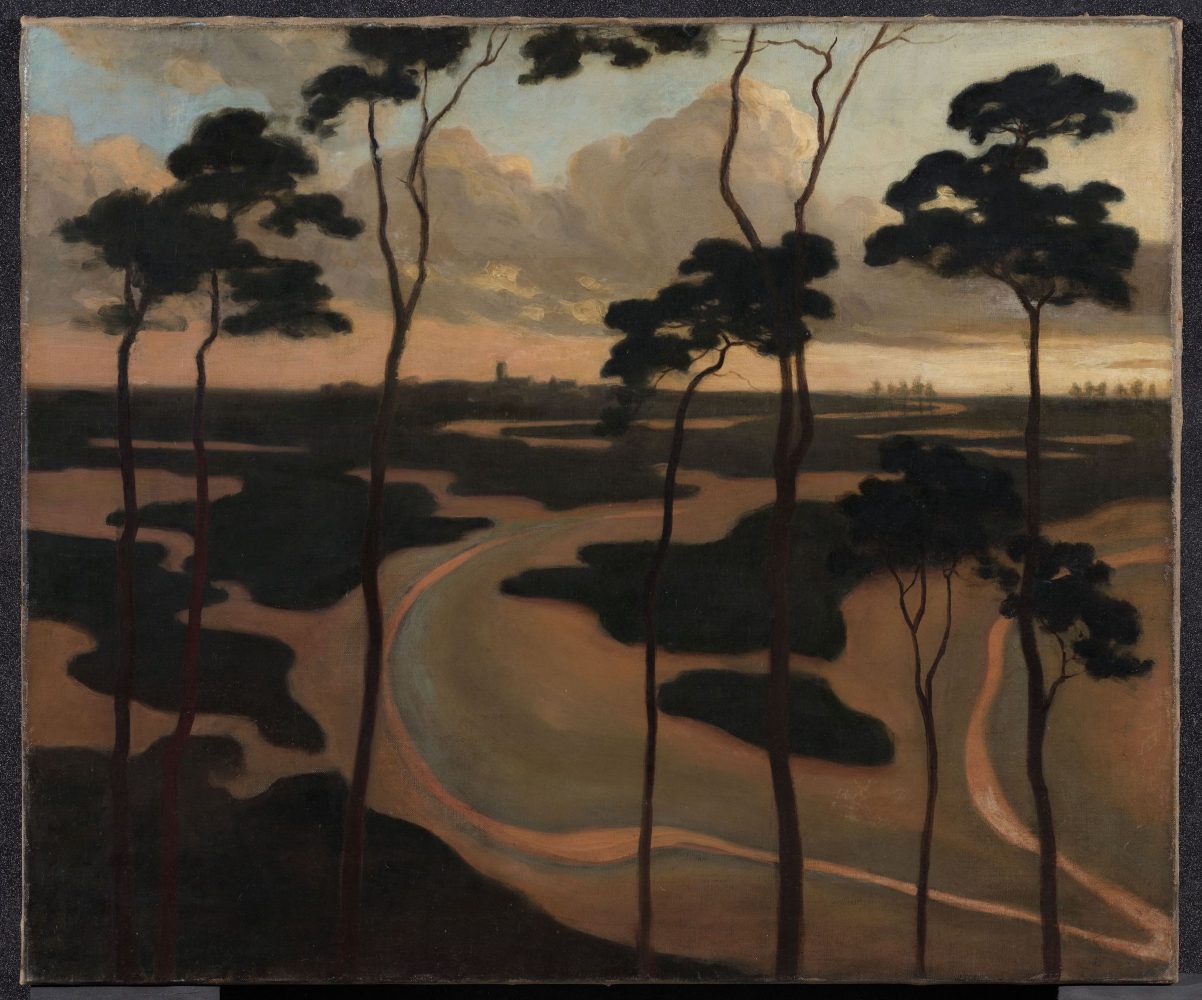
Inspired by these artists, Fry developed a theory of art called formalism, which emphasised the visual aspects of art such as line and composition rather than the subject matter. He also experimented with these ideas in his own artwork. Paintings such as the atmospheric Blythburgh, The Estuary (c.1893, see below), brightly-coloured The Black Sea Coast (1911, main image) and Studland Bay (1911) all show features of his focus on form, line and colour.
My particular favourites in this part of the exhibition are Town in the Mountains with Poplars, where the lines of the tall, dark green poplar trees contrast with the softer reddish hills and mountains, and the Cézanne-like River with Poplars (c.1912), full of solid, colourful shapes. Fry held his first solo exhibition of some of these landscapes in 1912, many of them based on his travels in France.
An array of smaller landscapes is also shown in the second gallery. Although some are individually beautiful, the overall impact is less than the larger work because of more muted colours; (to me) hanging them in a group reduces their distinctive effect.
Abstract still lifes
Soon after this, Fry started to experiment with still lifes and a number of these are shown in the first gallery. I preferred the more abstract paintings such as Poinsettias in a Vase, c.1915 (see below), with its strong lines and colour. Fry held a successful exhibition of these in 1917, which was praised by the artist Walter Sickert as “serious and thoughtful work, full of feeling”.

Design work and creative spaces
Fry’s membership of the Bloomsbury Group is well known. He had a close, lifelong relationship with Vanessa Bell, a former lover, and cooperated with her and Duncan Grant in founding the Omega Workshops in 1913. These were based in a radical approach to interior design and provided work for up and coming artists and designers. Fry wrote: “It is time that the spirit of fun is introduced into furniture and ceramics.”
Lesser known is that Fry designed his own house in Surrey, and later designed the Studio at Charleston for Bell and Grant, a significant space which is now being restored. He also helped to design the courtyard garden at Charleston and even recommended which flowers should be planted, such as red hot pokers and artichokes, which are striking to look at and paint. Fry’s paintings of Charleston and Vanessa Bell, shown here, demonstrate the importance of this close relationship.
Psychological portraits
The highlight of the second gallery is the collection of Fry’s portraits of major figures in early 20th century modernism, such as writers EM Forster and Aldous Huxley, the latter painted in 1931, the year he wrote Brave New World.
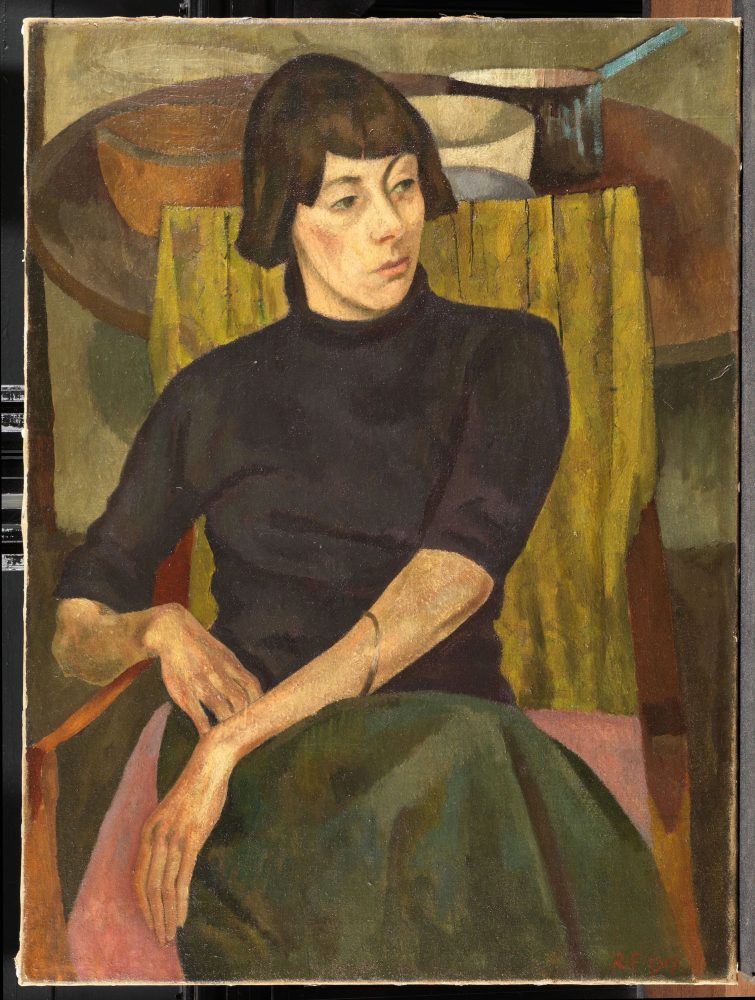
My favourite is the portrait of Welsh artist and writer Nina Hamnett, another former lover (see below), known as the Queen of Bohemia. Painted in 1917, it is strikingly modern; Hamnett’s dark hair, eyes and clothes give a dramatic effect, in contrast to the domestic pots and pans on the table behind her.
Fry also painted a series of self-portraits, four of which are shown in the exhibition. In these he comes across as serious and subdued, with a rather gaunt face. This contrasts with Virginia Woolf’s description of him, with pockets “stuffed with a book, a paint box or something intriguing – he had canvases under his arms; his hair flew, his eyes glowed”.
Fry was certainly a “creative powerhouse” and a hugely influential figure in 20th century British art. This exhibition shows that he was also a highly talented artist.
The Roger Fry exhibition at Charleston in Firle runs until 15 March 2026.
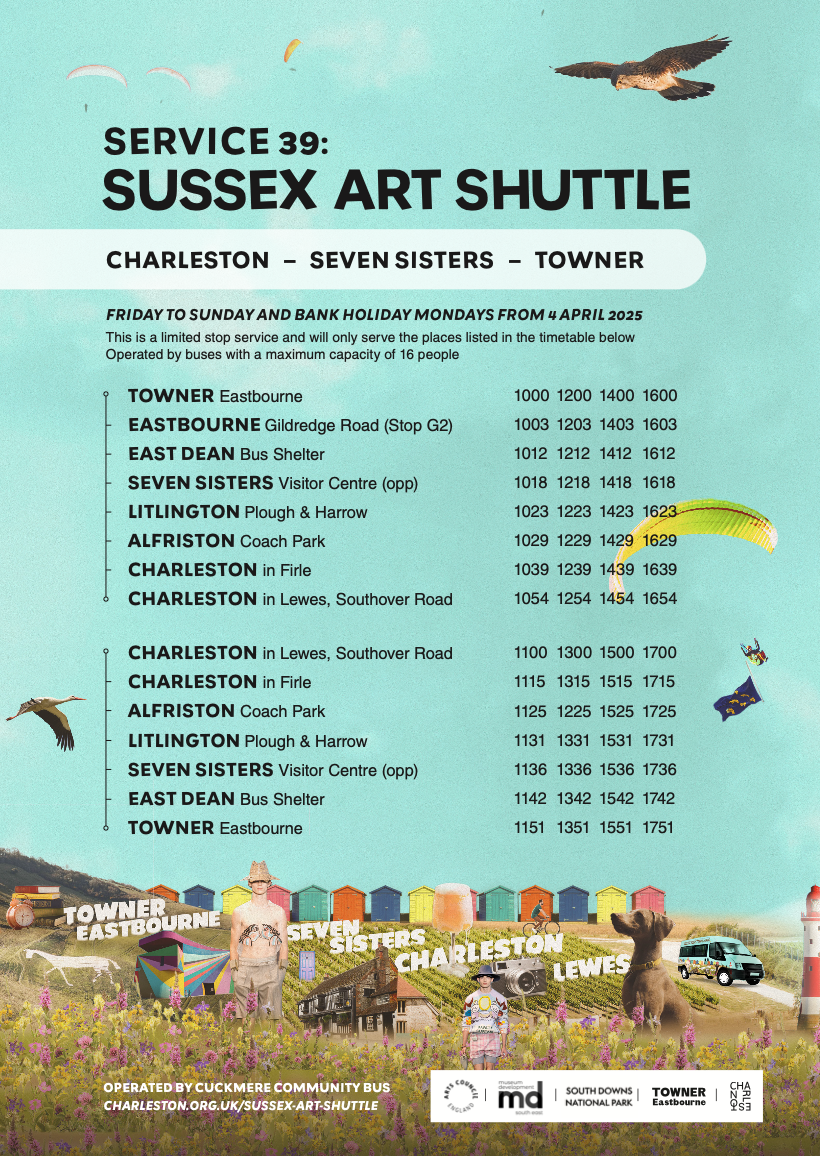
Viv travelled there from Charleston in Lewes on the Sussex Art Shuttle bus, which also runs from Eastbourne Towner gallery on Fridays-Sundays and Bank Holidays. See timetable.

CLICK HERE TO DONATE TO OUR CROWDFUNDER
HELP US BECOME STRONGER SO THAT WE CAN CONTINUE TO DELIVER POWERFUL CITIZEN JOURNALISM!