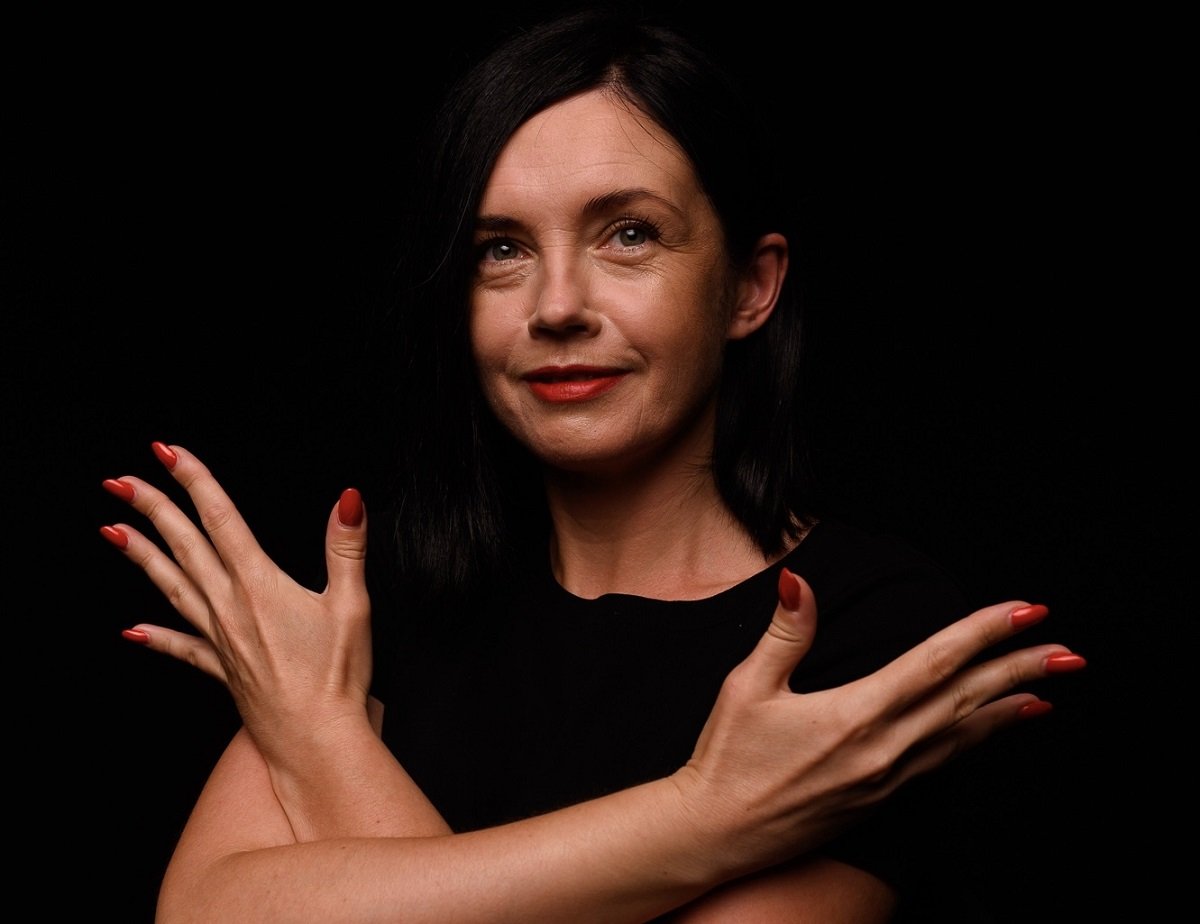
Yaroslava has been writing her war-coffee blogs on Twitter/X and Sunday letters from Kyiv since the beginning of the 2022 Russian invasion of Ukraine. They are a wonderful mix of personal experience, ranging from what it feels like to be under bombardment from Russian missiles to an introduction to the countryside and culture of Ukraine. Yaroslava’s photos of her cat Victory, always referred to with the qualifier ‘still a cat’, street scenes in Kyiv, and art from the galleries that she visits, are a delight.

We publish two extracts from her Sunday letters here: the first and more recent a wintry reflection on the threats that Ukrainians confront every day of their lives, and the solace that art brings; and the second an account of a spring visit to the village where her mother and aunt were born.
Extract from a Sunday Letter – Kyiv, 11 February 2024

I slept badly. My mind was carving images of the family killed by the fire in Kharkiv. So I woke up earlier than planned, made a large cup of war-coffee (very strong and blackishly black), and started browsing cultural news and looking at the paintings. Distraction. I needed it.
Beauty always helps me, cradling me in its arms and keeping me sane.
I usually read a lot. My curious mind makes me discover new names and things. This week, I learned about an artist from Kherson, Oksana Osnach. During Kherson’s occupation, she started painting large canvases. She wanted to paint Ukrainians. So I use her paintings of that period in my letter. At the end of it (the letter) I will show you something unusual she also creates.
Oksana Osnach was born in 1965 in Kherson and obtained two degrees, one in art. When the full-scale war began, and Russians occupied Kherson from the beginning, Oksana found it difficult to know how to live and act in these conditions. Many people avoided going out unnecessarily. However, she began painting large canvases and drawing Ukrainians after a while. In total, she created ten paintings during the occupation.
Now let’s talk about the latest news in Ukraine.
Early in the morning on February 7, Russians launched a large-scale attack against Ukrainian cities. Kyiv, Lviv, Mykolaiv, Dnipropetrovsk, and Kharkiv oblasts were targeted. Russia attacked Ukraine using 64 missiles of various types and drones. Ukrainian air defence destroyed 44 targets.
In Kyiv, a fire broke out in an 18-storey building; four people were killed and 39 injured.
In Mykolaiv, around 40 residential buildings were damaged. One man died, and six people were injured as a result of the attack.
We need a painting.

‘Red Viburnum’ by Oksana Osnach – an image inspired by the wonderful Ukrainian folk song – Oi U Luzi Chervona Kalyna – sung here by a young refugee in Lithuania : https://www.youtube.com/watch?v=LIUoFuSuvTM
After this part, I made a short pause. I needed a glass of water and a deep breath. And now, I want to continue the story about Oksana Osnach, a Kherson painter. She is an artist of the project ‘Chumak Icon on Flounder’ and the author of more than 40 images on fish.

The depiction of icons on fish is an ancient tradition. The сhumaks used them as amulets in their travels. Usually, the images were applied to flounder. There is information that the сhumaks gave the icons to churches after their journeys as a gratitude for the survival of all the oxen.
A few words about chumaks: Chumak was a historical and traditional wagon-based trading occupation in the territory of modern Ukraine in the late Medieval and early modern periods of history. It involved the delivery of goods (salt, fish, grain, and others) for long-distance sales using carts harnessed to oxen. They prospered until the end of the 19th century when competition from railroads made longer trade routes unprofitable.
Extract from a summer letter from the village: ‘Village of my heart’, 8 July 2023

Hi! I’m writing this letter to you from the village.
I’m sitting on the stairs near the house, enjoying the warm and beautiful weather. My eyes are bathing in this beauty.
I spent my childhood summers in this village. Maybe for this reason, I’m in love with nature. As everything breathes it here. And this blessed silence. They don’t have sirens in the village. They have so bad internet and mobile connection that news is lost their way sometimes. They plant vegetables in the early spring, milk cows, collect eggs, breed pigs, and pick up the harvest in autumn. They work hard with their iron hands.
It wasn’t always like this.
There was a front line here during the First World War in 1914. The village was evacuated, and its residents sought refuge in the Czech Republic. People left their homes, taking horses, cows, and whatever belongings they could. Only one house remained untouched, as the others were destroyed during the war.
Even my grandmother’s parents had to leave. My great-grandmother’s first husband was killed in this war. The story of my life begins with her second husband, my great-grandfather. My grandfather’s parents were sent to Siberia because their three sons were part of the Ukrainian Insurgent Army (UIA). My grandfather was one of these three sons. He was imprisoned while his parents were sent to Siberia…. He was eventually released after the death of Stalin, as political prisoners were freed following the dictator’s demise.
My family’s story holds many untold secrets, as every family does. However, some live on in our memory, and we pass them down to our children.
Another story I want to tell you is about a traditional Ukrainian garment called a zapaska. Women used to wear it on top of their skirts.
My grandmother hid her zapaska because, during the Soviet Union era, the blue and yellow colors (representing the Ukrainian flag) were prohibited. People could be imprisoned or even killed if someone discovered them. My grandmother wore this zapaska at her wedding in 1943.

History repeats itself. Nowadays, the Ukrainian flag is banned in occupied territories. People hide their allegiance by wearing blue and yellow colours only in their hearts.
Life continues, and we remain brave enough to protect our land, towns, and villages.
Ukraine is a beautiful land that has endured suffering for a long time. I hope every part of it will be free and prosperous one day, filled with children’s laughter and with blue and yellow flags waving freely from every house.
You can follow Yaroslava on Twitter/X and subscribe to her #warcoffee letters here: https://twitter.com/strategywoman/status/1756781850373104034
Local events in Sussex to mark the second anniversary of the Russian invasion of Ukraine can be found on: https://www.communityworks.org.uk/events/anniversary-of-the-ukraine-invasion/