


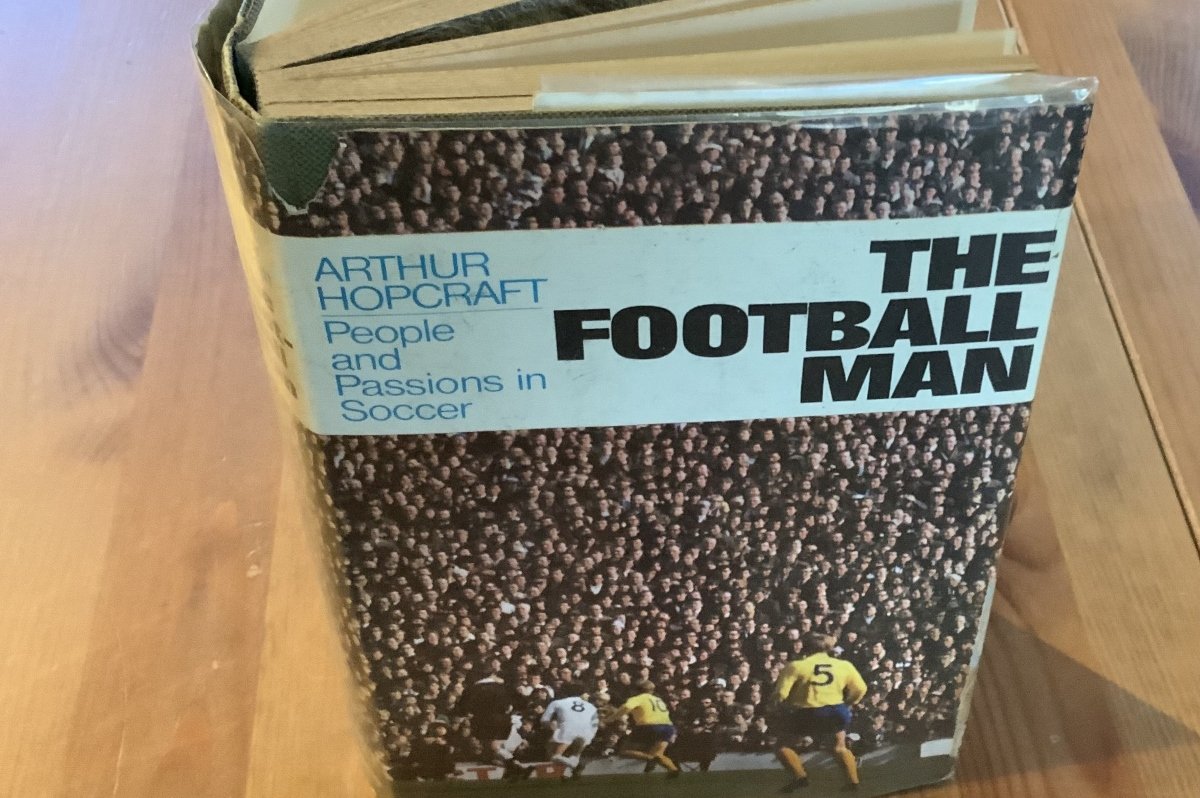
Among admirers of football books, The Football Man by Arthur Hopcraft is spoken of with a kind of quiet reverence. For years I resisted it, suspicious of its reputation and wary of approaching a classic too late.
My reasoning was simple enough. How could a football book written in 1968 still have anything urgent to say to the modern game?
I was spectacularly wrong. The book not only survives its age, it seems, in places, to have outlived and out-thought much of what followed it. Yet its power is not easy to pin down.
Its chapters move between interviews with players of the 1950s and 1960s, Hopcraft’s own boyhood memories of the match-going life, and sharp-eyed reflections on the future of football in Britain and Europe.
On paper, there is nothing especially remarkable about this arrangement. In practice, it has the loose, wandering intelligence of conversation. Hopcraft does not always join the pieces neatly; some passages fade away, only to return after a long anecdotal detour. But the digressions are part of the charm.
The one event that supplies a central thread is England’s World Cup triumph in 1966. Hopcraft’s memories of the tournament are wonderfully alive: the carnival atmosphere in unlikely places such as Middlesbrough; the town’s affectionate adoption of the North Korean players after their astonishing run; the bear pit of Goodison Park rising to acclaim Pelé and the Hungarian marksman Flórián Albert. The final itself yields one of the book’s most telling social observations, as Hopcraft finds himself surrounded by well-spoken spectators in “rugby club blazers”, ignorant of England’s players and only faintly acquainted with the team yet comfortably installed in the expensive seats.
An entire social world
Elsewhere, the book turns its gaze on legendary managers such as Sir Matt Busby and Stan Cullis; on players such as Derek Dooley, whose career was cruelly cut short; and on George Best, already beginning to vanish into the glare of his own fame. Hopcraft also finds room for referees, Sunday footballers and club directors, giving the sense not of a sport viewed from the grandstand alone, but of an entire social world being patiently, unsentimentally mapped.
There is, inevitably, nostalgia here: for terraces, heavy leather balls, working-class players taking the tram to the ground, and the fug of Woodbines drifting out over the pitch. Hopcraft does miss certain textures of the 1930s and 1940s. Yet what makes the book remarkable is that it is never merely backward-looking. Beneath the reminiscence is a writer with a startlingly modern eye.
He is scathing about the insularity of the home nations towards the early World Cups and European club competitions: “British arrogance has been reflected vividly and calamitously in football.” He anticipates a future in which powerful clubs might form a super league, even a European league. He notes the growing interest in football in North America and cautiously imagines a flourishing US competition. Again and again, the past seems to be speaking to the future with unnerving clarity.
Serious without being solemn
Hopcraft is equally severe on the condition of British stadia and the unsafe facilities endured by supporters. Two decades before Heysel and Hillsborough, he was already condemning unregulated terraces: awash with urine, vulnerable to surges, and capable of driving bodies against crush barriers and perimeter walls. He also saw clearly the spread of hooliganism beyond the ground, into trains and streets: the ritual geography of the match day.
Other forecasts are quieter but no less striking. He expects referees to become professional, violent play to be driven gradually from the game, and lower-league clubs to move towards semi-professionalism — the last of which still feels sensible, even if it has never quite arrived.
In the end, The Football Man is a rambling, discursive and fascinating book: part social history, part memoir, part prophecy. Its greatness lies in the seriousness with which it treats football without ever making it solemn. Hopcraft writes as though the game matters because it belongs to ordinary life — to class, memory, language, place, money, weather, violence and joy. He helped make possible a kind of football writing that was incisive, irreverent and intelligent, trusting supporters to be readers as well as fans.
It is, in every sense, heartily recommended.

CLICK HERE TO DONATE TO OUR CROWDFUNDER
HELP US BECOME STRONGER SO THAT WE CAN CONTINUE TO DELIVER POWERFUL CITIZEN JOURNALISM!




