


Jamie Woodward, University of Manchester
UK environment secretary Thérèse Coffey has demanded that water companies share plans for how they will reduce sewage discharges into rivers. They could start by coming clean on how much sewage is being dumped. If we don’t know how much sewage is actually being released – for at least the worst offending locations – we won’t be able to measure environmental and industry improvement with any confidence.
Water companies in England have failed to invest sufficiently in wastewater treatment and sewerage infrastructure to keep pace with increasing populations and more intense rainfall. To take pressure off their sewer networks, companies allow huge volumes of untreated wastewater and sewage to be dumped into our rivers and coastal waters.
In the absence of effective regulation since the Environment Agency’s monitoring budget was slashed just over a decade ago, dumping sewage in rivers has contributed to a spectacularly profitable business model. Sewage pollution incidents – many of which were legal – increased 29-fold over five years and countless urban rivers are now effectively extensions of the sewerage network. Our rivers are running out of time.
Only 14% of rivers in England have “good” ecological status and this figure could fall to just 6% by 2027. In February 2023, campaigns to save Britain’s rivers were launched by the Times, the Independent and New Scientist.
Water companies are under unprecedented scrutiny from the media, politicians, activists, university researchers like me and the wider public. Politicians know the sewage dumping scandal could cost seats at the next general election.
This is why Coffey is now demanding “every company comes back with a clear plan for what they are doing on every storm overflow, prioritising those near sites where people swim and our most precious habitats”.
Mapping sewage
Thames Water recently launched an interactive map of 468 sewer overflow locations. The map updates every ten minutes, and shows in near real time where the company is discharging untreated wastewater and sewage to rivers.
In the middle of January 2023, after rainfall, about one third of the Thames Water sewer outfalls were discharging and another third had done so within the previous 48 hours. The map has also confirmed that many sewage discharges take place during dry weather.
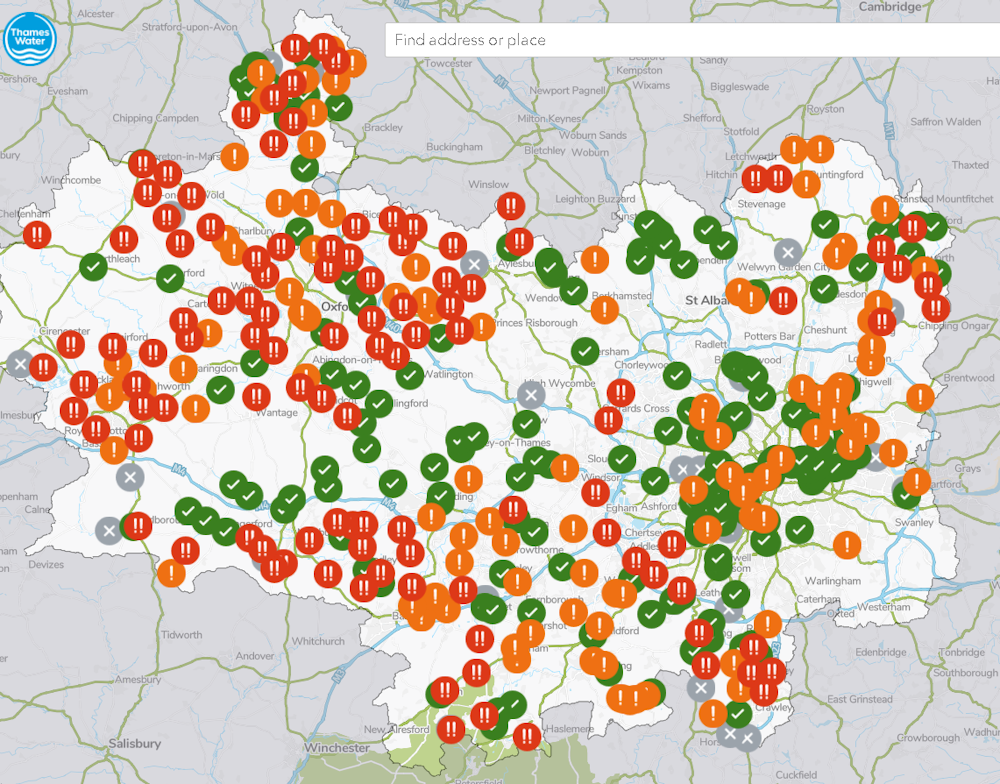
Thames Water
Thames Water is the first water company to make such data across its entire region available to the public. The map highlights the staggering scale of the pollution problem and adds to a growing body of evidence showing that water companies are routinely using overflows to dump sewage and other pollutants such as microplastics as an alternative to treatment.
We know when sewage was dumped – but not how much
But as a geographer and geomorphologist who specialises in rivers and has taken a keen interest in this sewage crisis, I know there is something missing in the data. Sewage discharges to rivers are recorded by sensors known as event duration monitors. These measure the start and end time of any flow, but are rarely set up to measure the volume of that flow.
This leaves the data open to manipulation. Was an “event” 100 litres or 1 billion litres? 1 billion might sound far-fetched, but Mogden sewage works next to Twickenham Stadium discharged over 1 billion litres of sewage directly into the River Thames on each of two days in October 2021.
So a water company could in theory reduce the duration and frequency of discharge events – turning the above map from red to green – but still increase the total amount of sewage dumped into rivers.
The absence of reliable baseline data on sewage dumping is a major problem and research has shown that water companies have not reported the full scale of their discharges.
The Environment Agency has a poor record of sewage pollution data scrutiny and several water companies are now routinely declining environmental information requests. How can we address the biodiversity crisis and make rivers safe for recreation if we don’t have reliable data on the volumes of pollutants pumped into them?
People need accurate information on what is happening to their local rivers so they can identify the worst offending discharge sites and hold water companies to account. The Thames map is therefore a welcome step towards increasing transparency in the water industry and rebuilding trust, but it does not go far enough.
We need sewage volume data
In July 2022, United Utilities, which serves north-west England, announced a £230 million investment to upgrade wastewater treatment infrastructure on several rivers by 2025. The company states this will reduce the discharge of untreated wastewater and sewage into the region’s rivers by “more than 10 million tonnes a year – the equivalent of 4,000 Olympic-sized swimming pools”.
This is a remarkable admission of sustained sewage dumping on a colossal scale. It appears water companies can provide volumes when it suits them.
Water companies in England have been unwilling to calibrate their event duration monitoring sites to estimate sewage volumes. Yet they routinely collect very accurate data on the volumes of drinking water supplied to millions of homes, in order to calculate water bills.
The 2021 Environment Act requires them to make near real-time data about the frequency and duration of sewage discharges publicly available no later than 2025. But if the government’s plans to reduce sewage dumping are to be realised, we still need to know wastewater discharge volumes.
The Environmental Audit Committee made such a recommendation in its landmark 2022 report on river pollution, but the government argued it was too expensive. If Thérèse Coffey is serious about tackling this scandal, she must reverse that decision.
Jamie Woodward, Professor of Physical Geography, University of Manchester
This article is republished from The Conversation under a Creative Commons license. Read the original article.

CLICK HERE TO DONATE TO OUR CROWDFUNDER
HELP US BECOME STRONGER SO THAT WE CAN CONTINUE TO DELIVER POWERFUL CITIZEN JOURNALISM!







