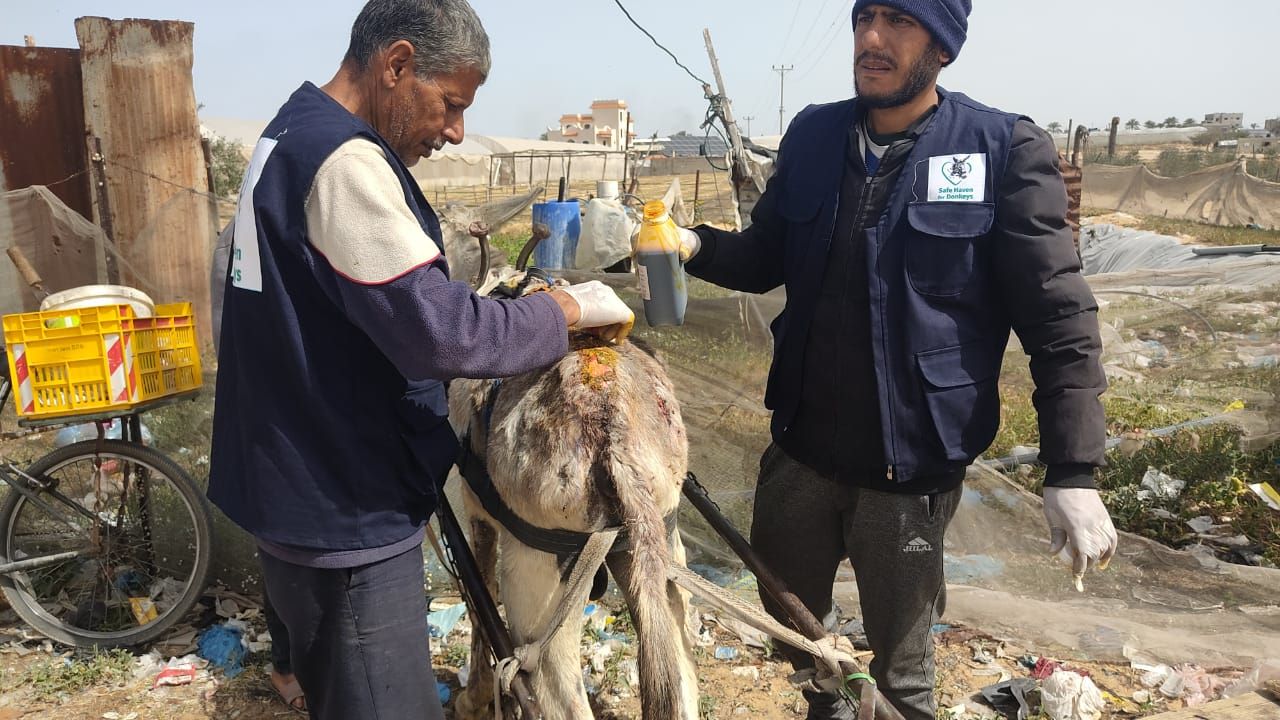
A British charity, Safe Haven for Donkeys, is providing emergency care to working donkeys and horses in Gaza. The animals are proving critical to the civilians in Gaza, who are living through an ongoing catastrophe that has brought death and destruction on an unimaginable scale. Thousands have died, many more have been injured, and huge swathes of people are fleeing for their lives. Now more than ever they are relying on their working animals to help them survive.
Safe Haven for Donkeys was set up in 2000 and cares for working and abandoned donkeys in Israel, the Palestinian Territories and Egypt. It is currently funding a mobile first-aid team to treat animals needing veterinary intervention, focussing largely on the donkeys and horses that are becoming crucial to those living in Gaza.
An important role for the animals
With fuel scarce, and many trucks, vans and cars destroyed, donkeys and horses have become the main mode of transport – moving people, often those who are injured, to hospital, alongside carrying food, water, and essential medicines through a war-ravaged landscape, and also for evacuation between areas.
Dr Saif, the lead of the Palestinian veterinary team, explained that now that fuel is so rare in Gaza, cars and motorcycles are useless. “I had never used a donkey before the war. Now, all of us use donkeys.” His mother, he said, “used to have two cars…very nice, expensive cars. She never thought of using donkeys. Now, my mother proudly uses a donkey to go from one area to another.”
Understandably, given the situation on the ground, with the desperate needs of the people and the lack of alternative transport, these animals are working in appalling conditions – suffering malnourishment, dehydration and excruciating wounds from the heavy loads they carry and pull.
Led by Dr Saif, Safe Haven for Donkeys’ team in Gaza is working tirelessly every day to provide relief to donkeys and horses that have horrific harness wounds, as well as injuries from missiles and bombs. Having treated approximately 1000 donkeys and horses since the team started their work in April, this number is only growing.
Today the people of Gaza ask more of their donkeys than ever before
Andy Foxcroft, CEO of Safe Haven for Donkeys explains: “Trucks, vans and cars, even ambulances are rare, fuel is rarer still. So, the iconic image of a car with its engine removed being towed by an underweight donkey, is now a reality. They are now the main mode of transport; not just for humans themselves, but for everything they need.”
In a heartfelt recollection, Dr Saif details how the “vast majority of my people now depend on donkeys. A friend of mine had a wife who was due to give birth. There was no way for an ambulance or car to take her from home to the hospital, due to the danger involved in the area so we had to use a donkey. She had twins in the hospital, and it was a donkey that saved her and her babies’ lives.”
Despite the evident reliance on donkeys in all aspects of life, it is still the case that donkeys continue to work under horrific conditions in Gaza. Due to food shortages, fatigue and beating, as well as a considerable number suffering from injuries sustained from explosions of missiles and bombs, the team’s work has never been more needed. Dr Saif shared how “Shrapnel has killed some and hurt many. This is why they are so vulnerable.”
The mobile clinic team continues to battle to reach every working donkey in need before it is too late and for some, the medical intervention came just in time. Dr Saif adds, “There’s certainly very good improvement to the majority of cases we’ve treated. It’s important to mention that we have done all this even though we don’t have enough equipment and medicine.”
Time is of the essence
The situation for the team on the ground is fraught. Due to the last aid shipment from Safe Haven currently being held at the border, the team are forced to function on minimal supplies and work as best they can in a difficult situation. “To access medications we often have to travel far, even up to 20 kilometres, to get them,” explains Dr Saif.
Andy Foxcroft, CEO of Safe Haven for Donkeys, says, “Our shipment of food and medicines are desperately needed in Gaza. The donkeys will only be able to support their owners and the community if they are fed and cared for.”
Asked whether aid provisions should all be going to the humans in Gaza rather than the donkeys, Dr Saif urges people to put themselves in the shoes of the Gazan people to understand how important the donkeys are to survival; to move between areas, to transfer injured to hospital, to bring water. “If these people didn’t have donkeys they would die”.
For more information on Safe Haven for Donkeys and to support the donkeys in Gaza visit https://www.safehaven4donkeys.org/gaza-2024/
This article is based on a press release provided by the charity Safe Haven for Donkeys.

CLICK HERE TO DONATE TO OUR CROWDFUNDER
HELP US BECOME STRONGER SO THAT WE CAN CONTINUE TO DELIVER POWERFUL CITIZEN JOURNALISM!