


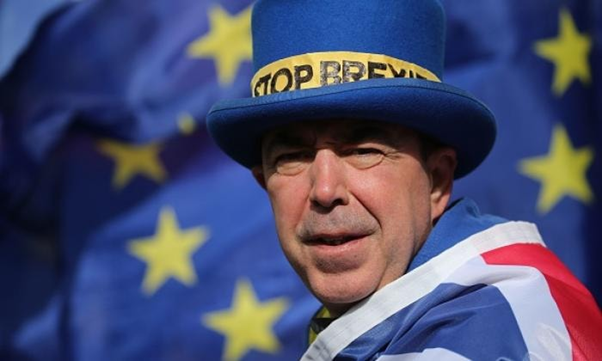
At a time when our parliamentary democracy is under threat as never before, those few courageous voices in the media and in public life who are prepared to come forward and expose corruption, wrong-doing and lying sometimes appear to be the only upholders of our democratic system. This is the seventh in a series of articles that profiles some of the key figures in the fight for right over might.
On the eve of the fifth anniversary of the EU referendum vote, Sussex Bylines went in search of one of the most iconic figures of the past five years – the man who acted as a role model for the millions who campaigned against Brexit, who became known as “The Shouty Man”, distinctive in his blue top hat and cloaked in the EU flag. He has appeared in the background of numerous news broadcasts outside Westminster, waving a giant EU flag (to the fury of presenters and politicians), and his roar of “Stooooop Brexit!” became legendary. He even has his own Wikipedia entry – Steven Bray.
For three years Bray became a familiar figure outside the Houses of Parliament. He was there every day that parliament sat, arriving in a car packed to the gills with flags, bunting and banners, sometimes surrounded by large groups of supporters, sometimes a lonely figure braving biting winds and the bitter cold. He has been attacked by right-wing thugs and vilified by the ultra-Brexiter press and politicians.

It takes an exceptional individual with extraordinary courage to persist in the teeth of all this. What kept him going?
Bray talked to Sussex Bylines about the influences and events that have shaped his passion for truth, justice and democracy, and what led him to pursue his campaign outside parliament.
He was born into a Service family, and in his lilting Welsh voice Bray describes a peripatetic childhood, moving between RAF bases in the UK and Germany, with the inevitable interrupted schooling and lost friendships. “Like many Service kids I found things difficult,” he says, “but it did make me used to making new friends, moving on, meeting new people. And I have learned that no matter where I live, I can call it home.”
At the age of 15 Bray quit school and home in Bridgend and travelled to London with just £30 in his pocket. He ended up living in a squat in Brixton and working in the black economy. Subsequent jobs included long spells working in factories, time in the army and finally, 20 years ago, setting up his own business as a numismatist, a dealer in old and rare coins. “I didn’t want to be tied down to the 9−5 life. I wanted to be my own boss.” And in a most unlikely twist of fate, it was his rare coin dealing that led him to become a political activist.
“Most of my work was online,” Bray explains, “so while I was working, I would have the news on in the background. And as I was listening to these people,” [referring to Leave-supporting politicians with withering contempt] “I don’t know what it was, but I knew damn well that they were lying. I’d never been political before, this was my first ever protest but, living in Port Talbot, I knew how much money the EU had put into it over the years through the Social Fund. So my mission started with trying to persuade friends and family of the case for Remain. You had these people saying that we can still have freedom of movement, we can still be in the Customs Union and Single Market – and I knew damn well that if we left the European Union, there was no way we could still have all that. I listened to what the Remain campaign was saying and I was equally disappointed. Everything was negative, they didn’t sell it on the positives. And that was probably the beginning of the end.”

After the referendum result he kept up his battle online (losing lifelong friends in the process) and started to become active around Port Talbot, conducting a guerrilla campaign to raise the EU flag above the council offices. He raised money to bring the infamous Theresa May float to London on the back of a van to join the pro-EU vigil being held outside Downing Street.
It was at the vigil that the idea for SODEM (Stand of Defiance European Movement) and his campaign outside parliament first emerged. “I didn’t want to stay in this online bubble. I wanted to be out on the street. I worked out early on that the best thing that I could do was to get as much publicity for the Remain side as possible.” And he was immensely successful in doing so. It’s ironic that many professional politicians were much less effective in getting the key issues across.
So five years on from the referendum vote, what now?
Bray still travels to London for every Prime Minister’s Questions, and he now focuses his campaign on exposing self-serving politicians and corruption at the heart of government.
He is deeply concerned about social injustice in modern Britain and what he terms “forgotten communities”. “Port Talbot is one of the most deprived communities in the UK, and people there feel invisible, disenfranchised. It’s a decades-old problem that’s never been resolved.”
He ends our discussion with a call to action: “If politicians start serving themselves and not the people, we can change that. Every one of us has a part to play. Only we can make a difference, only we can change things.”


