Reprinted with permission from the ‘Kyiv Independent’
When Russia launched its full-scale invasion of Ukraine in February 2022, it dramatically changed the continent. The largest conventional war in Europe since World War II demanded Western leaders move away from their peacetime thinking and step in decisively to help stop the aggression.
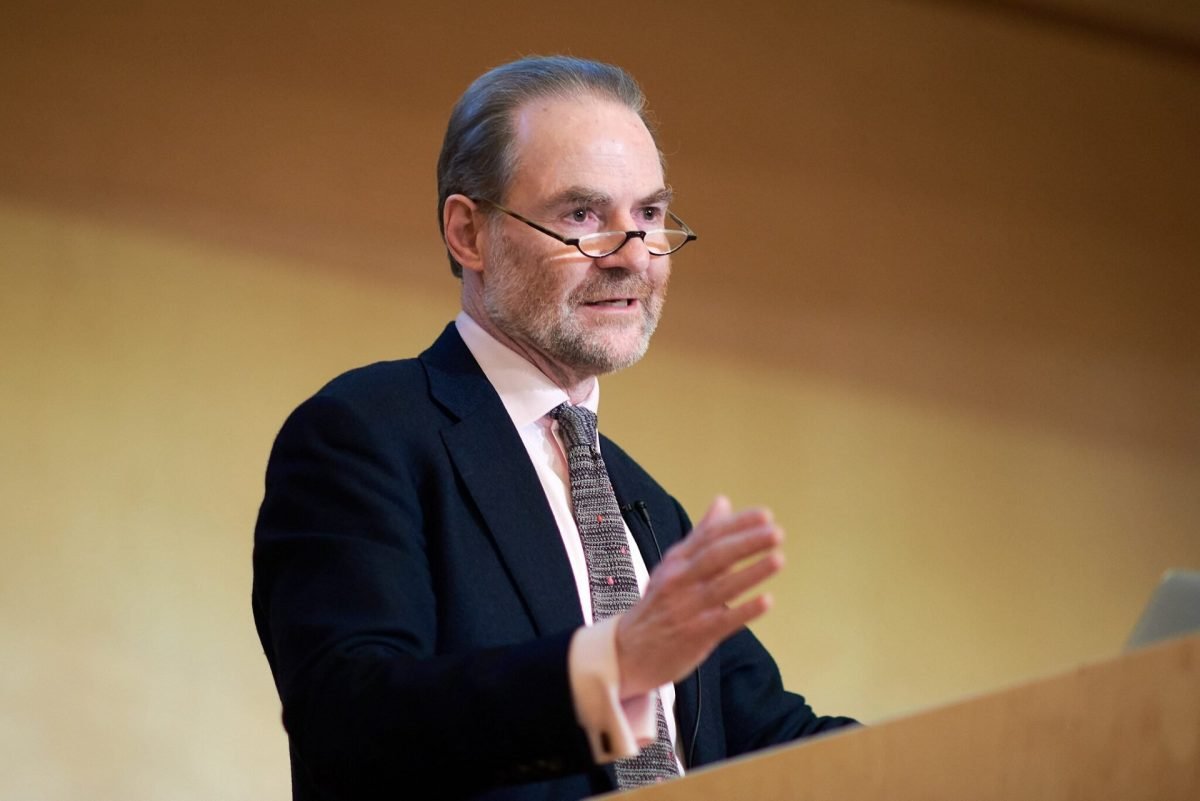
Despite clear warnings leading up to that moment, “many were too slow to heed this call”, says Timothy Garton Ash, an Oxford professor, historian and commentator, in this interview with the Kyiv Independent.
In his prize-winning 2023 book Homelands: A Personal History of Europe, Garton Ash provides an account of European history from the post-World War II period, pointing out mistakes that led to the full-scale invasion of Ukraine. Garton Ash is also a prolific columnist, penning articles that call for more decisive action by the West in support of Ukraine.
A shortened version of the interview transcript on 17 May 2024 follows.
Timothy Garton Ash: Europe is harbouring an illusion
Clarity [is lacking] in the rest of Europe, and in the rest of the world, that we need Ukraine to win. Around half of Europe is still harbouring the illusion that there’s a halfway house, which is captured in the formula: “Russia not to win and Ukraine not to lose.”
We have these policies of self-deterrence from the Biden administration, and to some extent from the Scholz government in Germany and other governments. The effect is to enable Ukraine to go on fighting but not to win.
In a global opinion polling that my Oxford research project did last October, we saw that China, India, Saudi Arabia, Brazil – all these major non-European powers – think that Russia is at war with the West, not with Ukraine.
In that view, they’ve accepted the Russian narrative about Russia against the West, and therefore our own credibility is at stake. We may think it was Ukraine that lost. The rest of the world will think it’s the West that lost and Europe that lost.
Why are Western leaders hesitant in their support?
Not all Western leaders [are hesitant]. We have some very good ones. Kaja Kallas in Estonia. Petr Pavel in the Czech Republic has been magnificent on this subject. The British – all of our prime ministers, not just Boris Johnson (laughs).
I think it’s a mixture of things. The fear of escalation – clearly, Biden’s instruction was: don’t get me into World War III. Ergo, in the fighting in Kharkiv, the Ukrainians are being told, “You can’t use any Western weapons to hit Russian territory.”
Probably the most important reason is that you have leaders who’ve got so used to peacetime ways of functioning that it’s very difficult to adjust to the different requirements of war. In war, you have to be bolder, act and speak more decisively and faster.
Scholz is carefully weighing every decision. That’s a very good thing if you’re making an investment decision for a peacetime business, but not if you’re trying to help a country that is fighting for its survival.
And then I think the third element is: “We have to have a relationship with Russia going forward. Russia is a great power. It’s a nuclear power.” So that’s trying to keep some sort of balance between Ukraine and Russia.
Different responses to the war across Europe
If you want to understand why different European countries reacted differently to the war in Ukraine, you have to look at their history.
The Czech Republic has its own history with Russia. In Britain, all you have to say is Putin is the new Hitler, and immediately people get it. Britain has to be on the side of those fighting for freedom against the new Hitler.
Objectively, you need to say: “If he wins here, he won’t stop there. He probably won’t attack Estonia directly, but Moldova would be highly threatened. So it’s an issue for European security.”
And for the USA, where the top issue is China, you have to say, “You see Putin in Beijing with Mr Xi. You see how close they are. If you want to encourage Xi Jinping to have a go at Taiwan, then let Putin win in Ukraine.”
What must change to lead to a lasting peace between Ukraine and Russia?
The question is so that Ukraine can be secure and doesn’t face the prospect of renewed Russian aggression in six months, six years, ten years. Ultimately, the answer has to be NATO.
I remember hearing then Finnish prime minister Sanna Marin at the Munich Security Conference explaining why Finland has now decided to join NATO: “That’s the line the Russians won’t cross.”
There has to be some package of support that is together so strong that, even if Russia has regenerated its forces, it won’t risk it.
Of course, the best way forward would be a change within Russia itself. We can’t count on it, but nor should we exclude it. The characteristic of regimes like Putin’s is that they don’t bend, but occasionally they break.
Such a change is going to be catalysed by a Russian defeat, not by a Russian victory. The Soviet Union lost in Afghanistan, and that was one of the causes that gave us [Mikhail] Gorbachev, and then they lost the Cold War. So Russia can certainly lose. And often, when it lost, it has catalysed political change inside Russia.
Europe became complacent
In what I call the post-Wall era – the period after the fall of the Berlin Wall, particularly in the early to mid-2000s – we convinced ourselves that history was simply going our way, inevitably, in the direction of democracy, the direction of freedom.
We became complacent. We became over-self-confident, also in our economic model. Remember, two things happened in 2008. One was Putin’s seizure of two great chunks of Georgia (South Ossetia and Abkhazia). The other was the beginning of the global financial crisis, which plummeted Western democratic capitalism into a long-term crisis.
From that time forward, we have this cascade of crises.
In terms of Putin’s Russia, specifically, I argue that 2014 was the turning point at which the West failed to turn. If we had had a much stronger response at that point, much stronger sanctions on Russia, reducing our energy dependency on Russia instead of increasing it, going after the dirty Russian money swilling around cities like London, rearming, helping Ukraine to build up militarily, sending a much clearer message to Putin … You can never know what would have happened, but it’s plausible to think we might not be in the mess we’re in now.
Is the West learning its lesson?
Too late. Now everybody is suddenly talking about Russian imperialism. We have finally understood that this is at the heart of this story, this one sentence: “The empire strikes back.”
The lesson that we need to be tougher is understood if you go to a think tank, a university or an editorial meeting. [But] whether the wider society is ready and prepared for the consequences of that, I very much doubt it.
Viktor Orbán is going in a different direction. What Orbán is showing is that you can have a hybrid regime that is no longer a proper democracy but an electoral authoritarian regime with a policy of hedging between the West, China, Russia and other great powers, even while being a full member state of the EU. And that’s extremely worrying.
Aleksandar Vučić does it in Serbia, Turkey does it, India does it, and we just have to accept that and find a way of dealing with that. What we shouldn’t accept is that it’s possible inside a full member state of the EU.
The world’s focus is already shifting away from Ukraine
Undoubtedly. First of all, the very fact that [the war] has lasted so long has meant it’s disappeared from the front page. The same thing happened with Bosnia.
Gaza has completely knocked Ukraine off the front page. And just as we were beginning to convince the rest of the world that they should be on Ukraine’s side, they turned around and said there are double standards in the West, which is denouncing violations of international humanitarian law in Ukraine but being very reluctant to do so in Gaza.
[Since 24 February 2022], we’re at the beginning of a new era, which means that what we do now is particularly important. And what’s characteristic of such periods is that there’s a wide range of alternatives. In more normal, settled times, the options are much smaller.
But here, the alternatives are large, which is why it’s so important that we in the West and in the rest of Europe achieve clarity that we must, in our own interest, want Ukraine to win. Then, think about how we can actually help Ukraine win.
Martin Fornusek is news editor at the Kyiv Independent.
The Kyiv Independent is committed to serving the principles of honest journalism even during an ongoing war, and has won multiple awards for its work. See @KyivIndependent on Twitter and https://www.facebook.com/kyivindependent on Facebook. Please consider subscribing and donating to support their outstanding reporting. Become a member Support us just once

CLICK HERE TO DONATE TO OUR CROWDFUNDER
HELP US BECOME STRONGER SO THAT WE CAN CONTINUE TO DELIVER POWERFUL CITIZEN JOURNALISM!

.