Screenings are taking place at only a limited number of cinemas so I felt part of an exclusive club of nature nerds as I waited for the film to start. I also felt slightly nervous as there have been several films over recent years in a similar vein, albeit not about rewilding but ‘regenerative’ or nature-friendly farming. These cater to the middle-class yuppy market with beautiful cinematography and celebrity cameos propping up exaggerated narratives and greenwash. I hoped that Wilding would be different.
Based on Isabella Tree’s best-selling book of the same name, Wilding tells the story of how she and her husband Sir Charles Burrell transformed Knepp Estate in West Sussex from a failing, debt-laden farm into one of Britain’s best biodiversity hotspots.
A different relationship to the ecosystem at the Knepp Estate
After making the painful decision to stop farming in 2000, they were left wondering what to do with the Estate that had been in Burrell’s family for generations. Thankfully, they’d already begun thinking differently about their relationship to the ecosystem after receiving advice about their oak trees from one of the UK’s preeminent experts on ancient oaks, Ted Green, who had made them aware of the damage they were doing to the network of mycorrhizal fungi associated with the trees when they ploughed the surrounding soil.
Green subsequently introduced them to a Dutch ecologist, Frans Vera, whose controversial theory of grazing ecology was being put to the test in the Oostvaardersplassen reserve a few miles from Amsterdam, where large herds of free-roaming cattle and Konik horses had been released.
Vera’s contention was that, far from being covered in closed canopy forest as the conventional wisdom assumed, prehistoric Europe would have been a much more open mosaic of habitats, a consequence of herds of large herbivores grazing the land and preventing vegetation reverting to woodland.
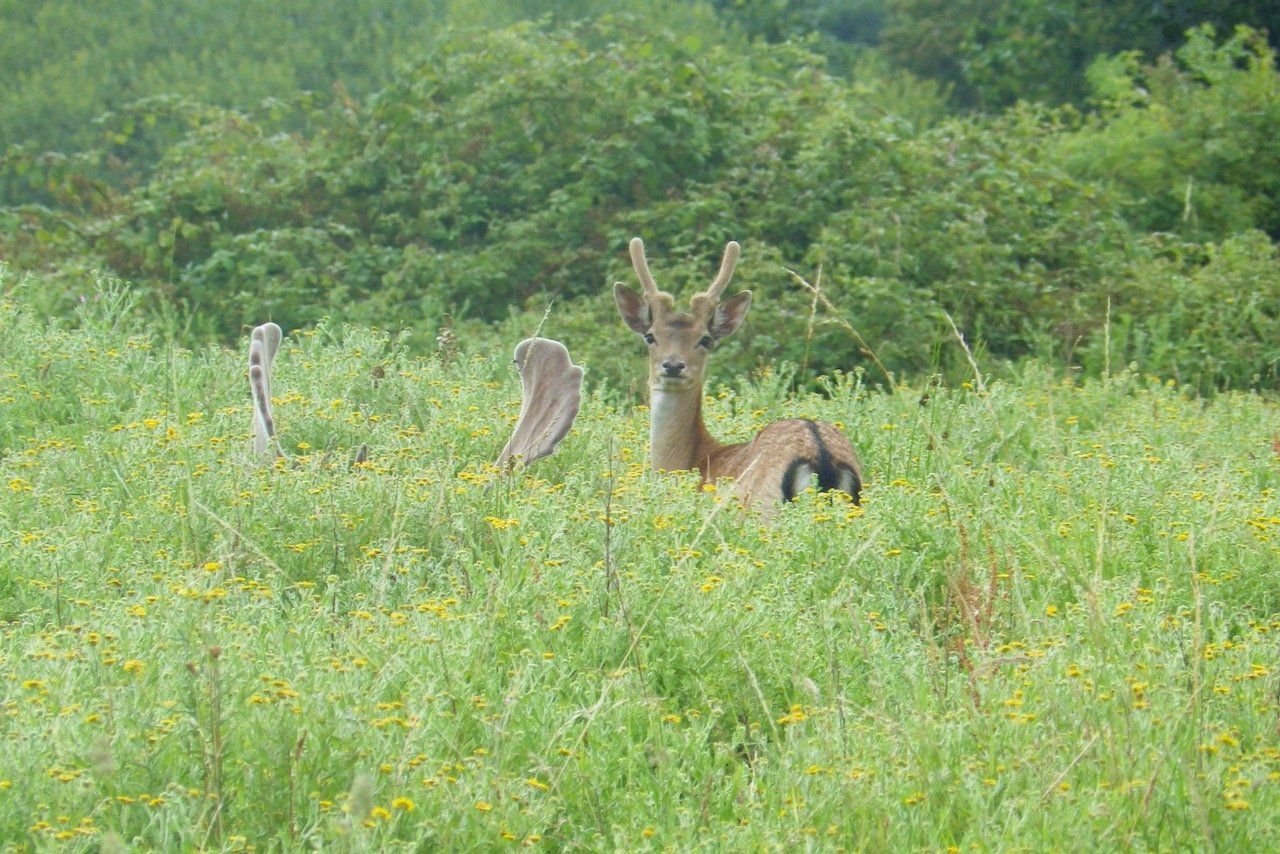
Using this idea as inspiration, the Burrells released English longhorn cattle, Exmoor ponies, red and fallow deer, and Tamworth pigs into Knepp, to act as proxies for extinct or absent wild species like the aurochs, wild horse and wild boar.
They then courageously let nature take the steering wheel – rewilding is fundamentally about restoring ecosystems to a point where they require minimal human management. In so doing, they withstood furious opposition from neighbouring landowners. The extraordinary results can now be seen on the big screen.

Majestic red deer stags and an active turtle dove nest
The film certainly looks very chic, with plenty of lustrous shots of trees silhouetted against sunrises and red deer stags looking majestic in glades, accompanied by the reflective twinkling of insects in flight. The narrative is driven mainly by interviews with Tree and Burrell, and uses actors (both human and animal) to recreate scenes from the early years of the rewilding project, such as a young Burrell on a bicycle chasing pigs off of the lawn directly outside Knepp Castle.
It contains some real gems, like the shot of an active turtle dove nest – gold dust in terms of British wildlife – as a voiceover from Tree describes how the species is likely to be extinct in Britain within the decade, with Knepp being its last real stronghold. It also features white storks and beavers, the only two wild species to have been actively reintroduced to the site.
That said, some important details were omitted from the film, suggesting there is a carefully crafted narrative at work here and that, at bottom, we’re watching a piece of clever marketing for a high-end ecotourism business owned by a couple of landed aristocrats.
There was no footage, for instance, of the Crawley and Horsham Hunt, whose opening meet is still held at Knepp every year, but which doesn’t quite fit with the image of harmonious environmentalism that the Burrell’s aim to present.
Secondly, Knepp arguably places too much stock in Frans Vera’s theory. When discussing Oostvaardersplassen, there’s only the briefest mention of the mass die-offs of herbivores that became fairly regular until public outcry forced the Dutch government to impose greater welfare regulations on the project; not surprisingly the film didn’t include these grim scenes in its Oostvaardersplassen footage.
While such die-offs can be a natural phenomenon, at Oostvaardersplassen the issue was compounded by the fact that the animals were enclosed in a relatively small, fenced reserve, unable to migrate in search of food. Vera’s theory takes little account of such migrations over vast areas, or of the modifying effects of apex predators on the numbers and behaviour of grazing herbivores.
Large herbivores released in a phased manner
The film also fails to mention that Knepp’s large herbivores were released into different parts of the Estate in a phased manner, which provided a comparative experiment on their impacts. While the ‘Northern’ and ‘Middle’ blocks of Knepp had free-roaming livestock from the beginning of the project, they couldn’t initially attract funding to ring-fence their ‘Southern’ block, which meant that for several years they were unable to release livestock there. It is there, in the southern block, where biodiversity recovered the fastest, suggesting that initially, the free-roaming herbivores may have hindered the project as much as they helped it.
Rather than waiting for mass starvation events, Knepp controls its herbivore populations by culling a limited number of each species to keep densities low, selling the premium quality organic meat as a supplementary income stream. However, it’s unclear whether the number of animals they cull is underpinned by good ecological data – in other words, mimicking natural population controls – or merely a reactive process to create the prescribed outcome of a Vera-inspired wood pasture; in the latter case, would it really be accurate to call it rewilding?
Overall, I thoroughly enjoyed the film, and would highly recommend it to anyone who can find a screening near them. Nevertheless, parts of it should be taken with a pinch of salt, and those new to rewilding should be aware that it can apply to a wide range of environmental restoration processes, and that some ways of doing it are better than others.
Wilding shows at the Brighton’s Duke’s at Komedia starting Thursday 27 June.
CLICK HERE TO DONATE TO OUR CROWDFUNDER
HELP US BECOME STRONGER SO THAT WE CAN CONTINUE TO DELIVER POWERFUL CITIZEN JOURNALISM!