


Monday 4 March saw a flurry of media activity, as the Royal National Lifeboat Institution (RNLI) celebrated the bi-centenary of its foundation in a London City tavern under the chairmanship of the then Archbishop of Canterbury.
A testament to the effectiveness of today’s RNLI press department is that we have been educated pretty comprehensively on the activities of what is arguably the country’s best-loved charity, so what can be said by your humble correspondents to enhance your knowledge of the RNLI?
Warm welcome from exhausted crew
Newhaven Lifeboat Station welcomed us warmly on the Monday morning with a mug of tea, the all-pervasive aroma of bacon butties, along with the discarded plates, adding to the domestic aura of the spacious premises.
Around a large central table sat about eight of the crew, looking fairly shattered it must be said, as they had had a shout during the night. Body clocks required recalibration with caffeine and carbs before facing a succession of press visitors, of whom we were the first.
The crew-room vibe would have been interchangeable with any similar organisation from the NHS, military or staff common room. Some comms equipment was being taken apart by Simon for repairs, and the VHF was chatting away in the background as we conversed with the crew.
Volunteers from all walks of life
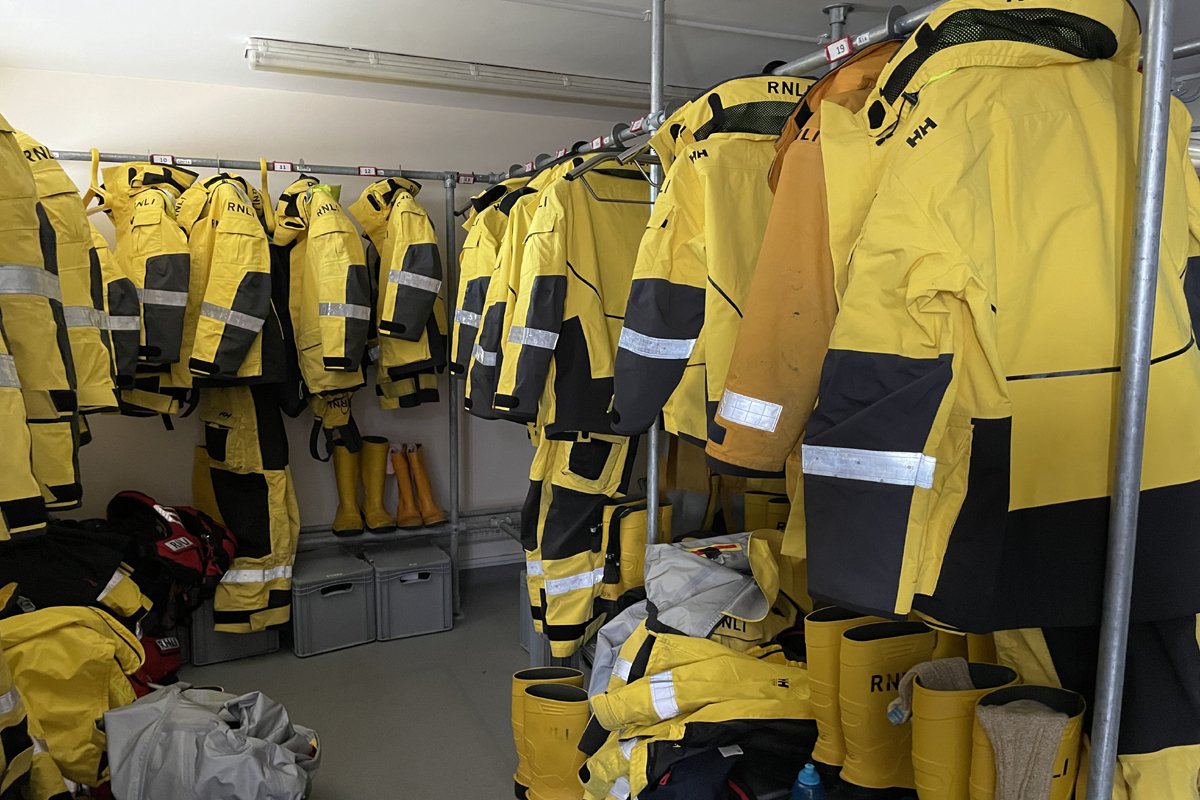
The difference here is that the personnel are volunteers from all walks of life, with a quiet passion and manifest, low-key pride in their role. Proud to identify as a team, they sported RNLI logos on their kit. Having to respond at a moment’s notice, most of the sea-going crew live in the immediate vicinity.
This station fields some 100 volunteers, many of whom do not go to sea. Their involvement ranges from campaigning and fund-raising, manning the extremely successful little shop, administration and maintenance, communicating with the public and education: duties less geographically critical to the running of Newhaven Lifeboat Station.

Partnership of equals
Immediately apparent was the absolute lack of hierarchy: the RNLI is a partnership of equals, whose individual contributions ensure the success of the whole. Selling Christmas cards in Lewes, to pay for Wellington boots, commands pretty much equal respect to being woken up at 2am attending a shout in mid-winter. With the exception of the coxswain/chief engineer Lewis Arnold, no one else is on the payroll.
The decline of fishermen and similar professional mariners, who traditionally manned the boats, has led to modern lifeboats currently engaging an equal mix of men and women of all ages and not all natural mariners. Included at Newhaven are an architect, a taxi-driver, trainee doctor, NHS ambulance paramedics, all with varying experience and length of lifeboat service.
Training and teamwork
Crew dynamics were obviously first-class: the RNLI have in place exemplary systems of pastoral care for those facing up to traumatic events and experiences. The shadow of Penlee still looms large over the entire institution; in the event of a fatality, the order is: no flowers, just donations! There is no judgment or criticism of the people who are rescued, just relief and pride that a mission has been successful.
As one of the busier stations in the UK, Newhaven’s Severn class lifeboat,‘David and Elizabeth Acland’, built by the RNLI, is the station’s workhorse, and is supported by a D-Class RIB for inshore rescues. This prototype is on trial and the crew are reluctant to hand it back!
Sunday and Tuesday training sessions build up teamwork skills and everyone is required to attend world-class tuition at the Poole headquarters. Complementary crew skills contribute towards an effective operation.
Ordinary people doing extraordinary things
Like many lifeboat stations, Newhaven boasted a volunteer service long before the foundation of the RNLI. The foundation has brought an economy of scale and greater resources than any individual costal community could command. As a very large charity, the RNLI is not above criticism and has made mistakes; but negative coverage has tended to have had unforeseen results, as Farage’s taxi rant demonstrated – a warning to opportunistic politicians who seek to make capital.
In a narcissistic age, when industry leaders demand outrageous pay for running failing enterprises, actors feel snubbed at the Oscars and nations are at war, how truly refreshing to meet the lifeboat crew in Newhaven. Ordinary people from the midst of our society in Sussex doing extraordinary things. Not for money, not for glory or medals, but out of the unselfish motive to be useful members of our society.
The most informative and best experience of our visit was to be able to say a face to face thank you to these extraordinary, wonderful people.

Donate to the RNLI to save lives

CLICK HERE TO DONATE TO OUR CROWDFUNDER
HELP US BECOME STRONGER SO THAT WE CAN CONTINUE TO DELIVER POWERFUL CITIZEN JOURNALISM!







