Sophie Watt, University of Sheffield
I have spent the past two years examining the living conditions in informal refugee camps along the northern coast of France as part of an ongoing research project on borders. These sites are where people gather before attempting to cross the Channel to the UK.
The UK government recently announced a returns agreement to discourage people from making the crossing and economic sanctions against people smugglers, following an increase in funding for border control and a decision to use counter-terrorism tactics in an effort to “smash the gangs”.
But from what I have observed, such policies appear to do little to stop people from making the journey. Quite the opposite – the more police crack down, the more the smuggling networks take risks to get around difficulties.
My fieldwork has been primarily conducted through volunteer work with Salam, a grassroots organisation that provides hot meals and clothing to the main informal camps in Calais and Dunkirk. I have also collaborated with other groups such as Alors on Aide and Opal Exil.
In the past few years, smuggling networks have adjusted their tactics to evade police. While smugglers used to inflate boats on the beaches between Calais and Dunkirk, they are now mostly using “taxi boats”. These leave further north or south on the coast, as far as Le Touquet. They then pick up groups of refugees waiting in the water along the coast, avoiding police intervention.
Sophie Watt
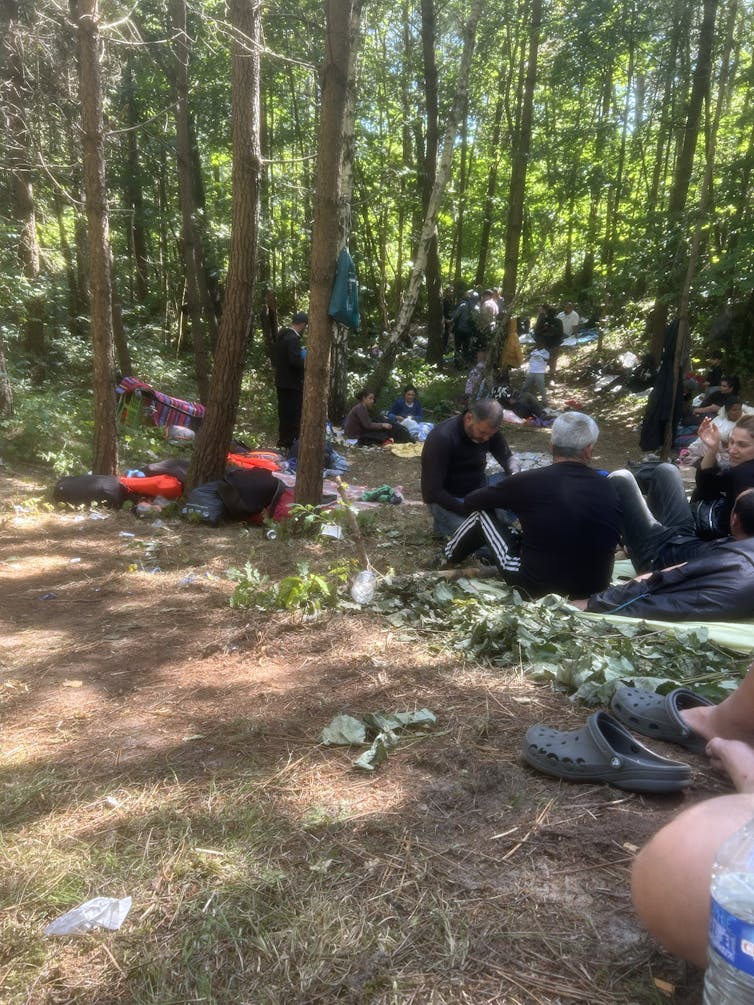
In response, and in order to intensify the crossings, “microcamps” have emerged – smaller temporary settlements closer to the beach, along the coast between Hardelot and Calais. These microcamps act as connecting points between the larger camps and the coastal departure locations where taxi boats pick them up. They allow for people to make several attempts at crossing without having to return to the large camps, where living conditions are more difficult.
The larger camps (such as Loon Plage and Calais) are the epicentre of the smuggling operations. The camps are evicted at least once a week (every 24 hours in Calais) due to France’s official “zero fixation point” policy. This policy, which bars people from forming long-term settlements, was implemented after the dismantling of the Calais “Jungle” refugee camp in October 2016.
Camp conditions
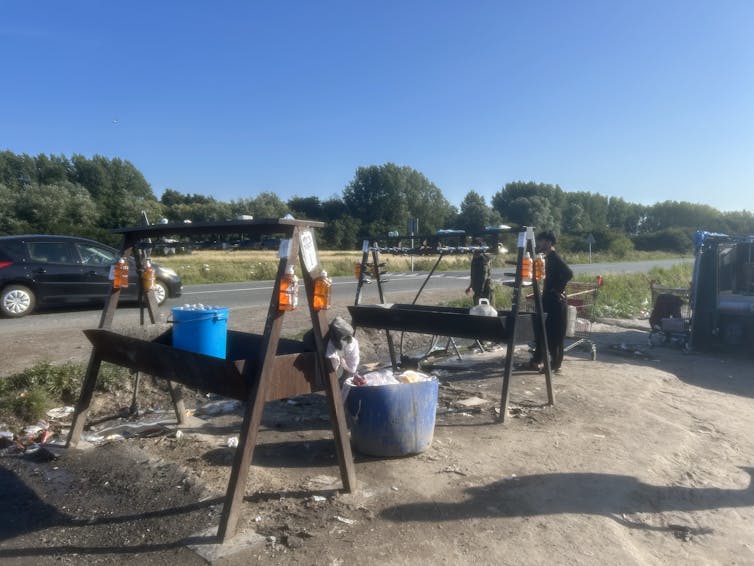
Police efforts to uphold the zero fixation point policy entail frequent evacuations, restrictions of humanitarian aid and physical site disruption. At Loon Plage, I saw that the sole access to water is a livestock trough.
Official guidance from the UN’s refugee agency states that, irrespective of the informality of these camps, their residents should have access to water, sanitation and shelter.
Sophie Watt
The non-profit watchdog group Human Rights Observers has documented instances of police violence and seizures of people’s belongings and tents at the camps.
In addition to regular evictions of the larger camps, the microcamps have recently seen more brutal police action. There have been reports of police using teargas, puncturing life jackets and tents, contributing to untenable living conditions. Violence and shootings between smuggling groups have also been reported in Loon Plage camp.
While working with Alors On Aide and photographer Laurent Prum we met around 50 people, including seven children (ages one-17), in a microcamp on the edge of the Ecault forest near Boulogne-sur-Mer. We immediately noted a tension between the group and the gendarmes who were standing watch.
Most of this group had spent a few years in Germany before being refused asylum. They told me they felt they had been forced to come back to France, because of the deportation measures currently being implemented by the German government.
A few confided that this was their fifth and final try at crossing the Channel. This is a new tactic the smuggling organisations use to make more money more rapidly: while refugees used to be able to try as many times as they needed, they now have to pay again after five failed attempts.
The previous day, this group told us they had been chased out of another part of the forest. There, we had found several empty canisters of tear gas – consistent with reports that French police have deployed tear gas in operations against informal camps.
This group had wanted to stay there because they could use a dilapidated shed to shelter themselves and their children from the rain. Eventually, the gendarmes evicted them, forcing them to spend the night in the rain – the field in question was privately owned. Following the eviction, we witnessed that the landowner had covered the area with manure to stop them returning.
A young Sudanese man showed us videos of the altercation. The exchange, during which five people were arrested, was violent. The children were terrified and the video showed the gendarmes using teargas against the group. A Palestinian mother was arrested and taken into custody, forced to leave her two young daughters. Her husband asked me: “Why did they arrest her when they could see she had two children with her?”
Alors on Aide mobilised several of its members to bring clothes, blankets and food for the group, and got the Palestinian woman released from custody, as she had not been charged with any offence.
Slashing boats
While living conditions in camps and the capacity of the French asylum system make staying in France difficult, police are also taking firmer action against boats attempting the crossing.
As part of a coastal patrol (helping refugees after a failed crossing attempt), we arrived on the beach in Équihen at around 7am on July 4 to find that French police had just punctured a boat in the water.
The UK government praised French police for this action, performed in front of international media. The UK and France have also discussed allowing coastguards to intercept taxi boats up to 300 metres off the coast.
This would be a marked change from current regulations, which prohibit French police from intervening offshore except when responding to passengers in distress. Even the border police have doubts about the legal basis for this measure and its practical implications at sea, particularly given the heightened risk of accident.
Trapped between hounding by police on the beaches and constant evacuations from the informal settlements, the refugees have no choice but to try to cross the Channel at any cost. A record number of 89 refugees died at the Franco-British border in 2024. Thirteen deaths at sea have already been recorded in 2025.
In my view, the recently announced French-British measures to intensify policing and border enforcement are unlikely to deter people from attempting dangerous crossings. Instead, they will create an incentive for more dangerous tactics by smugglers, putting more lives at risk and violating human rights. Any agreement to return asylum seekers, restrict their access to asylum or force people back across borders will exacerbate the dangers already experienced by those seeking refuge.
Sophie Watt, Lecturer, School of Languages and Cultures, University of Sheffield
This article is republished from The Conversation under a Creative Commons license. Read the original article.

CLICK HERE TO DONATE TO OUR CROWDFUNDER
HELP US BECOME STRONGER SO THAT WE CAN CONTINUE TO DELIVER POWERFUL CITIZEN JOURNALISM!