


On 17 December 2023, the Labour Party announced that Tom Gray, from the band Gomez, is to be their candidate for Brighton Pavilion in the upcoming general election. Gray looks like a real contender, with a strong record as a progressive campaigner and keen support from the likes of Alastair Campbell and Feargal Sharkey.
His selection represents a serious challenge to the Green Party’s only Westminster seat, its sole toe-hold on the political rockface, and the battle to come will tell us a lot about the prospects for achieving genuine progressive change in this country.
Already, voters in the constituency will be wondering whether they have to expect more wearying in-fighting among the left of centre factions or whether there is a chance that a genuinely progressive agenda can be adopted, here and more widely.
Caroline Lucas’s achievements leave big shoes to fill
Clearly, if the Greens were to lose this seat, held since 2010, it would be a disaster for pluralistic politics generally, for the Green Party itself and for the hundreds of thousands of Green Party voters for whom the Pavilion MP, Caroline Lucas, is their only voice.
At the last election, the Green Party received an incredible 835,000 votes nationally, but thanks to the twisted logic of our first past the post system (FPTP), Lucas was the only candidate to get elected. And, as nearly all commentators agree, she has been a fine MP.

As well as being an excellent constituency representative, she has single-handedly been able to push several key progressive causes higher up the national agenda. Not least: the impending climate emergency; the growing threat to democracy across the world, manifest in the UK by the unfair FPTP voting system with its side-lining of millions of voters; the limits of political tribalism that fails to engage with the electorate, especially excluded groups and the young.
Cooperation between progressives has never been more important
Undoubtedly, her departure will leave a vacuum at both national and local levels. Voters in Brighton Pavilion are having to think about how they should respond, knowing, as they seem to do, that if we are to tackle rising inequality, combat the climate crisis and rebuild our crumbling public services, we need greater cooperation between progressive parties, not less.
The Green candidate, former co-leader Siân Berry, acknowledged the “enormous responsibility” of following in Lucas’s footsteps. She said: “Brighton Pavilion needs a Green MP in parliament…and I can promise every voter in Brighton Pavilion that I will work every moment between now and the general election to win their trust and support.”

However, the omens are hardly auspicious. Labour’s new leader in Brighton and Hove City Council, Bella Sankey, posted on Twitter that the Greens were “a disaster for our city. An unmitigated disaster”, even though Labour knows the public services crisis derives from the £120m removed from the Council budget by the central Tory government over the last 12 years. You might think they’d want to attack the Tory government rather than the Greens, but that’s not how things work in tribal politics.
The call for proportional representation
The pressure group Compass, which describes itself as “‘an umbrella grouping of the progressive left whose sum is greater than its parts”, is keen to show things needn’t be this way. It emphasises that, with a different voting system, seats could match votes and people could vote for whichever party they want, without fear of depriving another progressive of the representation they deserve.
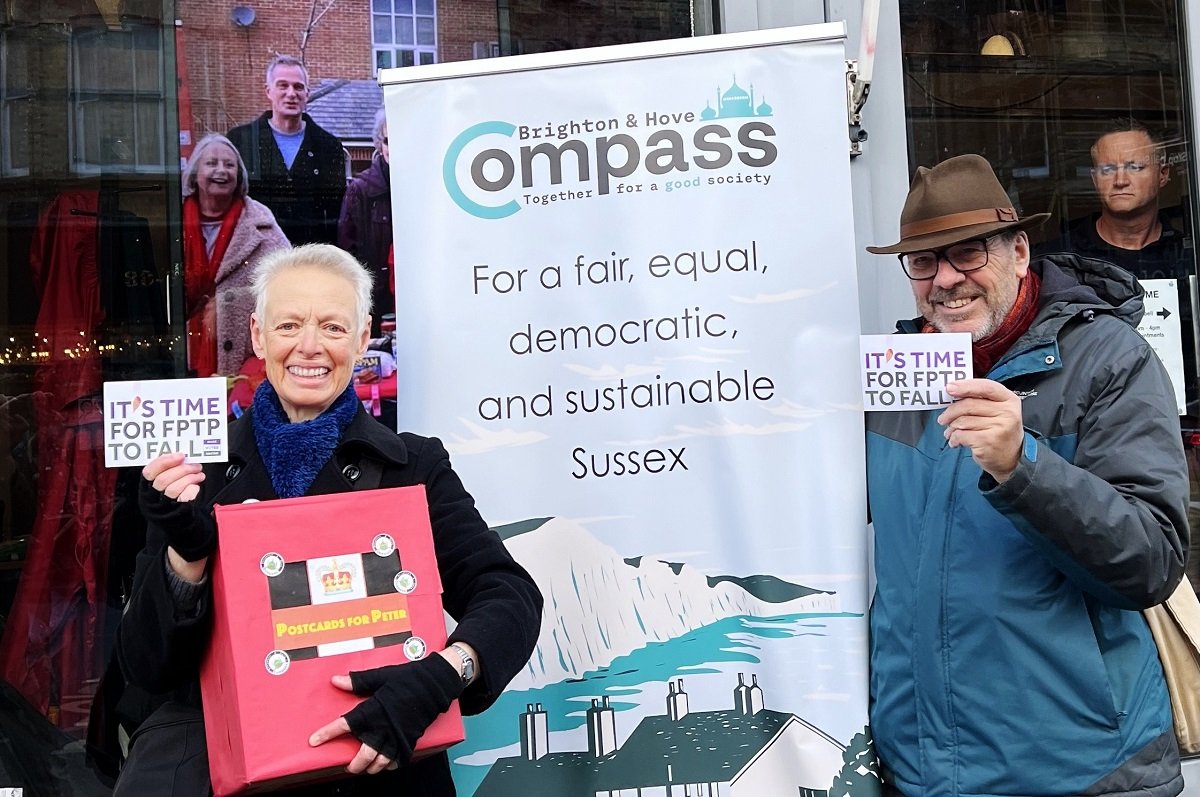
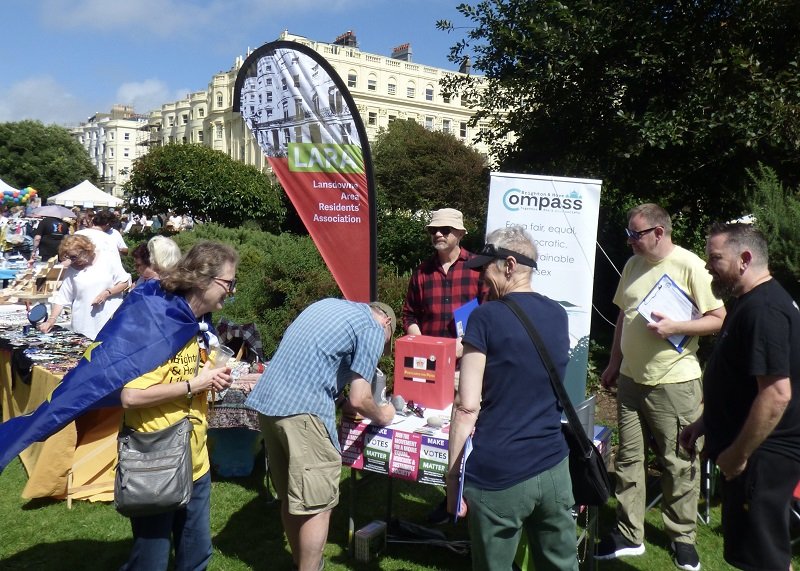
As the parties muster their troops in Brighton Pavilion, the local chapter of Compass is specifically asking all candidates to back proportional representation (PR), so that whoever wins will fight for democratic justice: “We follow a long-running formulation of prioritising the best placed candidate who supports proportional representation. We will want to interrogate all candidates as to their position on PR.”
The Greens are strongly in favour of PR and can be expected to showcase it as a key plank of their manifesto. Pavilion voters may reflect that experienced Green candidate Berry can show the way to more pluralistic politics and therefore a more adventurous progressive agenda, not least genuine action on the climate emergency.
Berry is concerned about Labour’s shift to the right: “Keir Starmer is abandoning so many pledges so quickly, it’s sending a real message to people on the left – like controlling rents…It will only be Green MPs arguing for these things in the next parliament.”
In contrast, Compass and Berry anticipate that, as the Labour leadership is opposed to PR (despite 61% of its supporters and 83% of its members being in favour), Tom Gray, as a new candidate, will want to toe the party line or, at the very least, keep his head down on the subject.
When asked about this recently, Tom Gray was very grumpy. “It’s such a weak attack line – bless them,” he said. “Having a Green MP was pretty cool during the Tory government. Caroline Lucas was wonderful, but the idea of forgoing a Labour representative in a Labour government who can work … from the inside … pull the other one.”
Who will the voters trust?
Strong stuff from the new kid on the block, even if patronising and belittling the much-respected Lucas might be thought ill-advised. Then again, under the FPTP system, Tom is fighting for his political life; and he’s only just getting started. He tweeted earlier that, although Brighton Pavilion has a Green MP at present, “Rishi is still digging oil wells…only Labour stops him.”
Hearing that, Greens may wonder exactly who it is that needs to pull the other one. Gray, of course, omits to mention that Labour have already said they will not revoke the latest gas and oil licences and that the party seem to be preparing to abandon the much-touted £28 billion commitment to a Green New Deal.
There is a lot of smoke and mirrors here. Gray looks like a good candidate, but Greens argue that they need to hold a Starmer government’s feet to the fire. They contend they need a Green MP to do this – and aim to elect more than one – and with the example of Caroline Lucas’s exemplary 13 years, who can reasonably argue?







