


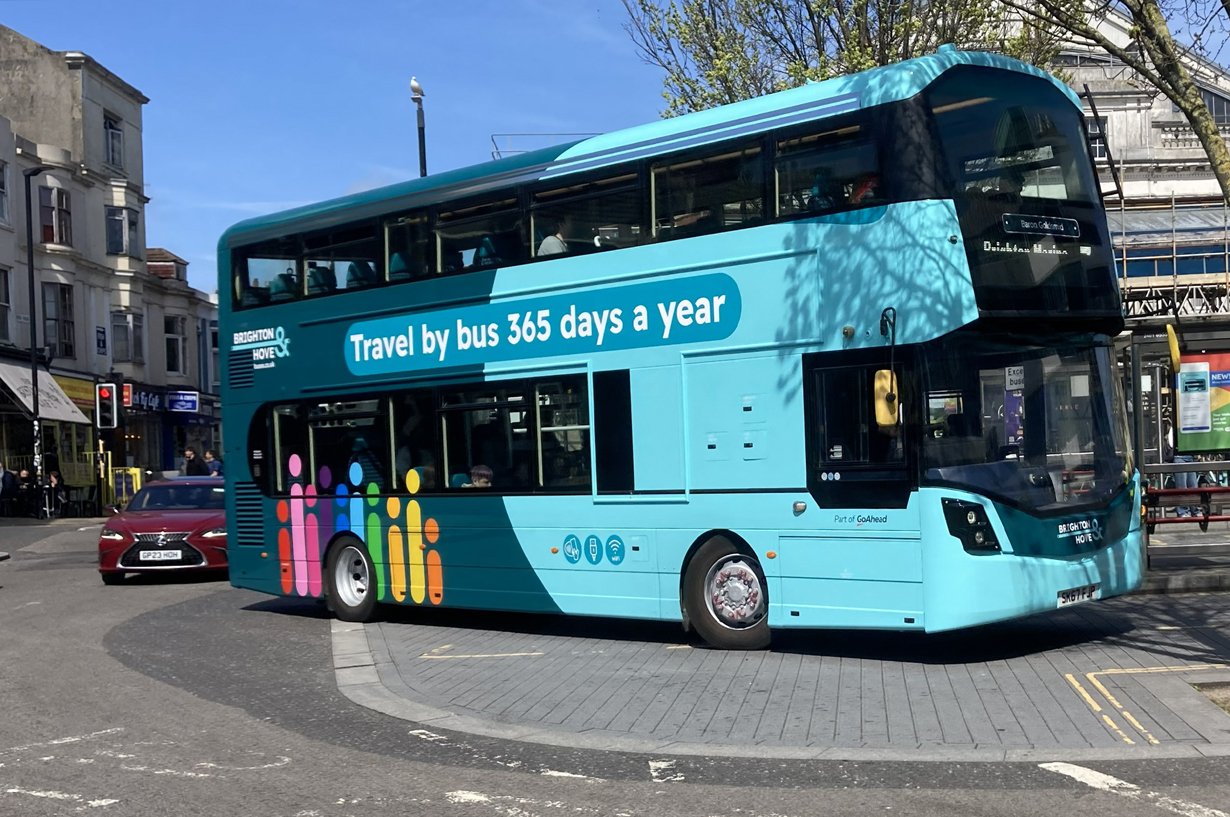
At the end of March, Brighton & Hove City Council announced that it would apply to the Department of Transport for funding to conduct a feasibility study into franchising the city’s bus network. This follows the passage last October of Labour’s Bus Services Act, which makes it easier for local authorities to implement franchising models, no longer requiring approval from the Transport Secretary. This will allow the council to exercise control over routes, fares and service standards currently determined by the private operator, Brighton & Hove Bus and Coach Company (hereafter Brighton Buses).
A dysfunctional system run for profit
For context, let’s briefly outline the dysfunctional state of Britain’s bus system. With the Transport Act of 1985, Margeret Thatcher’s government privatised and deregulated (except for London) Britain’s bus networks. Services mostly under municipal control were subsequently sold off. Brighton & Hove’s service, hitherto merged with Southdown Motor Services as a subsidiary of the National Bus Company, was parcelled off and sold in 1987.
Ever since, buses have been run by private companies for profit, with local authorities heavily subsidising them to run unprofitable routes and provide concession fares for people on low incomes and other special circumstances. This is public money being used directly to plug the shortfall in service under a market system, much of which disappears to shareholders. These subsidies have become increasingly burdensome as austerity has cut local budgets.
Even despite subsidies, service quality has often declined, many routes have been cut – particularly those servicing rural areas – and fares are unaffordable for many. The Conservative government’s 2021 bus strategy for England found that average fares have risen by over 400 per cent since privatisation, far outpacing the cost of driving. Moreover, in deregulated networks, where multiple private operators run different routes, the system often sees poor synchrony of timetables and incompatibility of tickets between different operators, resulting in a chaotic and expensive experience for passengers. In 2021, a report led by Philip Alston, a former UN special rapporteur on poverty and human rights, found that Britain’s privatised bus system breached basic rights.
Buses in Brighton & Hove
Admittedly, the situation in Brighton & Hove isn’t so dire as in many parts of the country. The city has reintroduced some regulation in recent years, and its buses are well used. The bus network here works on an ‘enhanced partnership’ model, in which the council funds certain capital schemes such as bus lanes, junctions, improvements to stops, parking restrictions and other infrastructure that makes network operation easier – in addition to abovementioned subsidies – in return for which the operator guarantees standards of service and vehicles. The bus company has argued that this delivers the benefits of regulation without the additional public cost of franchising or municipal ownership.
However, such partnerships give local authorities little say over setting routes or fares. Thus, public money is used at the front end to fund capital investment, and then at the back end to pick up the shortfall of a service designed to make profit, not serve the public.
Brighton Buses is a subsidiary of the Go-Ahead Group, a transport company operating across several nations which itself is co-owned by two parent companies, which are in turn owned by Canadian and European pension funds. In the year ending December 2024, Brighton Buses made almost £9.5m profit after tax, and paid over £900,000 to its five directors. In 2022 it paid out £10m in dividends. That’s passengers’ money being sucked out of the city to line shareholders’ pockets instead of being reinvested in the service.
Franchising would give more public control
Franchising would not only give the council control over setting routes and fares – these would be fixed in the contracts that it puts out to tender – but it would also allow control over the profiteering of the operators, with revenues from profitable routes being specified for use in cross-subsidising unprofitable routes.
Franchising would involve upfront costs and risks for the council in taking on liabilities from the private operator, as noted by a previous feasibility study. But in a small city like Brighton & Hove, run under an enhanced partnership and with most of the network operated by Brighton Buses, the process of franchising would surely be far easier than it was in a large, totally deregulated, free-for-all network like Greater Manchester. And in the longer-term, national estimates suggest that franchising could save around £340m a year (excluding London) for bus networks from retained profit.
Of course, franchising isn’t public ownership, and private contractors under a franchised model are still making profit, albeit more controlled. The 2025 Bus Services Act lifted the decades long ban on local authorities starting new municipal bus companies themselves. This model means that the single municipal bus company would usually have exclusive operation across the entire network, simplifying integration and ticketing and reinvesting profit in the service. Savings under municipal ownership could be higher than franchising, up to £506m a year nationally. It’s also the right thing in principle for public services to be publicly owned.
While municipal ownership should arguably be the ultimate goal, the council’s interest in franchising Brighton’s buses is a definite step in the right direction. For both social and environmental reasons, public transport is more important than ever. Too important to be left at the mercy of the market.

CLICK HERE TO DONATE TO OUR CROWDFUNDER
HELP US BECOME STRONGER SO THAT WE CAN CONTINUE TO DELIVER POWERFUL CITIZEN JOURNALISM!







