


Labour leadership dramas abound! But where did it all start? Well, long before 8 May. But let’s recap on the events of that day first …”Feeling squeezed, Rick?” The jibe came during a long day at the Hastings count as the votes cast the previous day were totted up, and it was a far from a comfortable one for a first-time Labour wannabe councillor in an election that was set to see the party lose in large swathes across England.
As the in-tray baskets of voting slips began to fill up, it was momentarily exciting to see crosses against my name. But it soon became clear who were ahead — as the votes for Green candidates and Reform piled up on tables throughout the room.
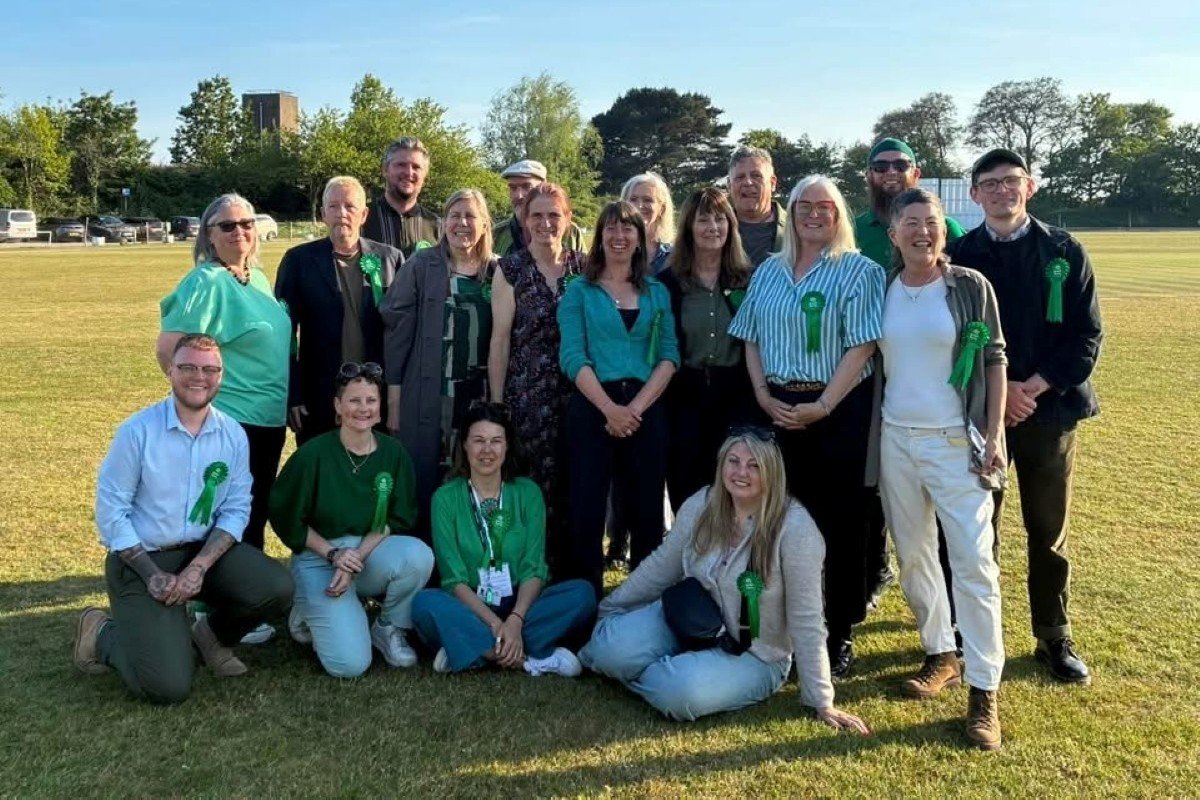
The result: the Greens cemented their hold on Hastings Borough Council with the election of 10 councillors and were for the first time joined by six from Reform. No Labour or Conservatives candidates were successful and the Liberal Democrats came in at a distant fifth. The mocking shout came from a group of councillors who had quit Labour in late 2024. But they had little to shout about: only one of them was re-elected.
For the record, I got 128 votes. The Greens won the seat with 492 votes, although in several more contestable wards, Labour’s support held up more strongly. The Greens now have 19 councillors, Reform six, Labour three, Conservatives three and Independents two.
Results across Sussex
In a separate vote, the Greens also made a good showing at the county level, winning six divisions, to Reform’s two. Elsewhere, the results were not so favourable for progressives. The former Tory bastion of East Sussex Council (ESCC) is now likely to be Reform-led. Its 50:50 split exemplifies what is often called Divided Britain:
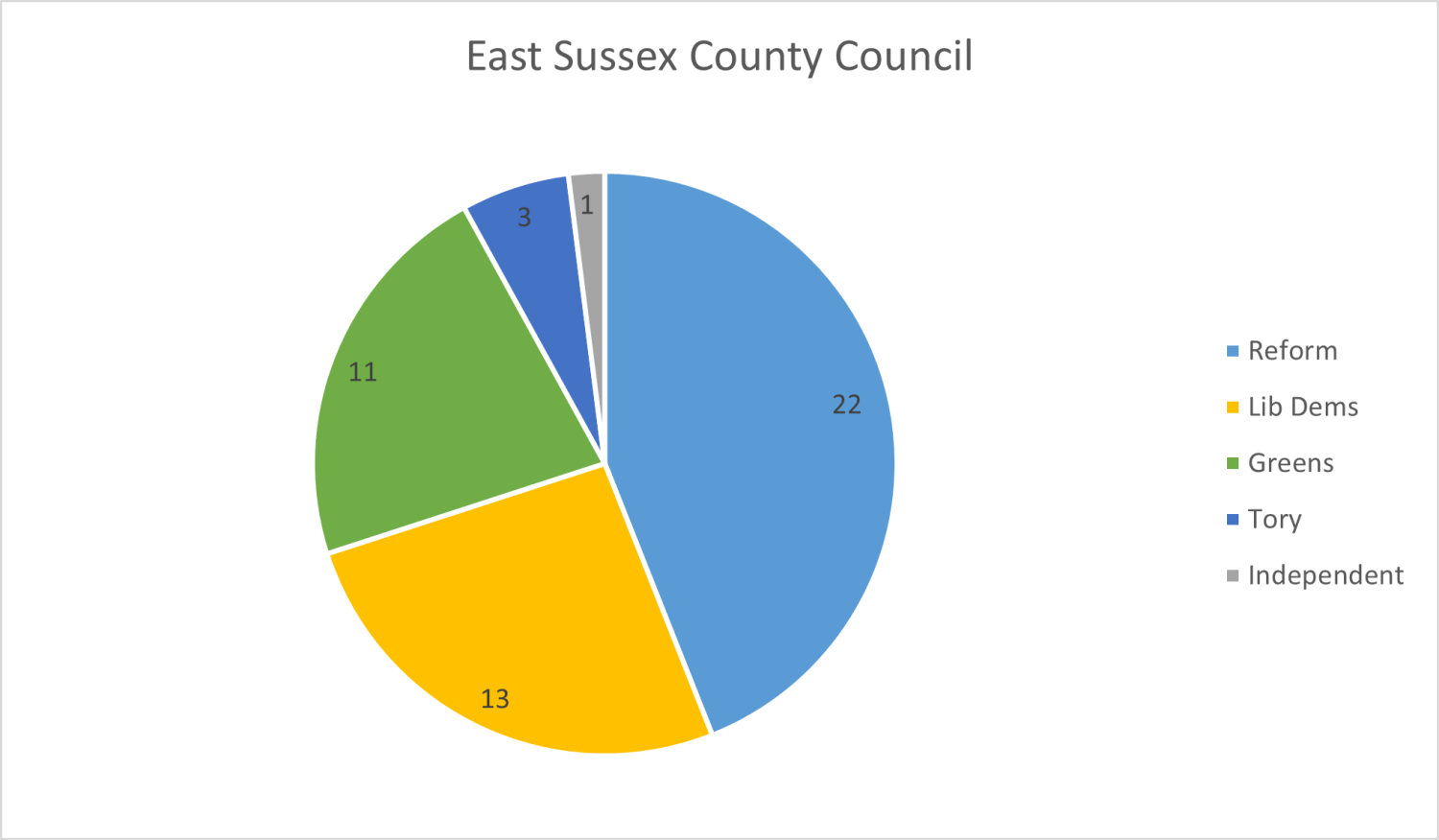
With no party having overall control, a sole ‘kingmaker’ appears to be Independent councillor Stephen Shing. In the past, he and his family have simply voted on issues, rebuffing party alliances. So, it gives Reform-plus-Tories the edge.
These results reflect, in varying degrees, those in the rest of Sussex.
In Worthing, the council slipped from Labour to no overall control, with the Greens and Reform taking all but two of the 13 seats up for election. Labour had ousted the Tories in 2022, and is still the majority party with 15 of the council’s 37 seats. A confidence and supply agreement seems more likely than a formal coalition agreement with the eight Greens. Councillors meet this week to elect a new Leader and Mayor.
In Adur, Reform won six seats, but the Greens just one. It means Labour, who won five seats, retains control with 17 of the district’s 29 councillors. The Conservative wipe-out continued. Having lost to Labour in 2024, they now have not a single councillor.
In Crawley, Labour also retains control, despite Reform winning ten of the 13 seats up for election.
West Sussex, like East Sussex, is split 50:50 — but in this case between the Liberal Democrats and Reform, with 23 seats apiece. No other parties are strong enough to create a convincing grouping to assume control. With 11 Tories, seven Greens, five Labour and an Independent, the maths just doesn’t add up.
More than just tactical voting
Tactical voting in all of the 7 May contests cannot be ruled out. But that is not the only story. On their doorstep, disaffection within Labour was evident and it centred on Keir Starmer, more often than not. This is in spite of Labour having a widely respected local MP, Helena Dollimore. Local issues, in what were after all local elections, were secondary.
In modern politics, it is not enough to point to the creditable achievements in Labour’s first two years, such as pumping more money into deprived local areas; reducing NHS waiting lists by more than half a million; and freezing rail fares and prescription charges.
Nowadays, it’s about vibes; whether or not a leader makes people feel good and on that score Starmer doesn’t cut it. I feared this outcome after Starmer’s popularity slumped in Labour’s first year, writing: “Once the public has fallen out of love with a politician, it’s very difficult to win that love back.”
So, many progressives transferred their hopes onto the Greens: a young left-leaning leader in Zack Polanski, saying things they liked. Bolstered by an already impressive grass-roots organisation in Hastings, where they already ran a minority administration.
Hastings was a ‘Leave’ town in the 2016 Brexit referendum — and it is likely that Brexit supporters once more rallied to Nigel Farage in his current incarnation as leader of Reform.
Mega political fallout
Now the dust has settled on the elections the political fallout is mega. A Labour leadership contest is gearing up. Events are moving fast.
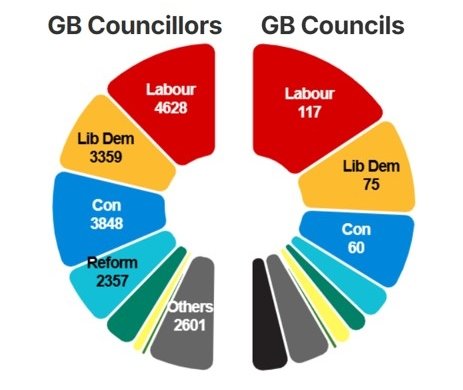
It is by no means over for Labour in local government, as the figures show. In England, only around 5,000 seats were contested on 7 May out of 17,000 across the country. These pie charts from Open Council Data show the combined picture in England, Wales and Scotland.
However, the people have spoken. Between now and the next General Election, aside from by-elections, Sussex voters have at least two more opportunities to speak again. The newly elected councillors only have a short tenure: boroughs, districts and counties will be swept away in local government reorganisation. Fresh elections will determine the largest party two years before the next General Election. The two Sussexes, along with Brighton, will also elect a regional Mayor.
These elections will be closely watched. Whichever party triumphs, or comes a close second, may signal who will end up with the keys to No.10. To every progressive’s horror, that is on course to be Farage – thanks to our first-past-the-post vote system.
It gave Labour a huge majority in the House of Commons on just 33.7% of the vote. Reform would need only around 26% to pip other parties to the post, according to a study by the Electoral Reform Society.
One way to prevent this outcome would be for the Government to adopt Proportional Representation (PR). It became official party policy in 2022, although subsequently shelved as ‘not a priority’.
Significantly, Andy Burnham, the favourite to succeed Starmer among many MPs and party activists, backs PR. He reiterated his support recently, listing it as among a number of pledges in a potential leadership bid.
Introducing PR must be part of a larger radical agenda to win over the public. But if it happens, it won’t just be Reform that loses out. Labour will, too. It would almost certainly mean the end of a one-party government.
* With apologies to the late great Spike Milligan, whose wartime memoir was titled ‘Adolf Hitler: my part in his downfall’

CLICK HERE TO DONATE TO OUR CROWDFUNDER
HELP US BECOME STRONGER SO THAT WE CAN CONTINUE TO DELIVER POWERFUL CITIZEN JOURNALISM!







